DURBAN — Southern Africa must stop exporting its raw resources and start building the industries needed to process, manufacture and create wealth from them, President Cyril Ramaphosa said as he called on SADC member states to take greater control of the region’s economic future.
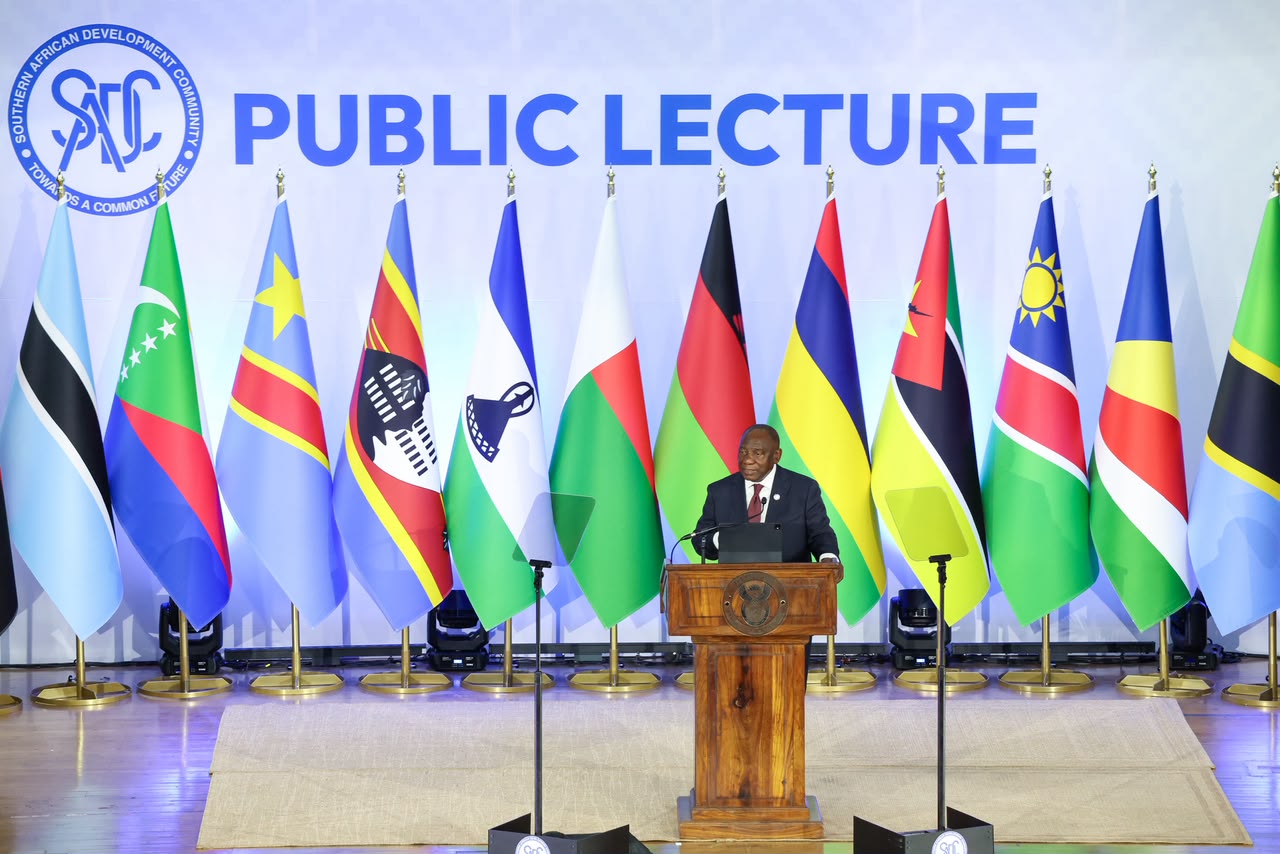
Ramaphosa, speaking in his capacity as Chairperson of the Southern African Development Community (SADC), delivered the keynote address at the SADC Public Lecture at the University of KwaZulu-Natal on 14 August, ahead of the 46th SADC Summit of Heads of State and Government.
The lecture, held under the theme “Translating SADC Vision 2050 into Action: Pathways Towards Solidarity, Equality and Shared Prosperity,” brought together political leaders, SADC officials, academics, business representatives, civil society, traditional and community leaders, women and youth representatives, and students.
At the centre of the discussions was a question that has confronted the region for decades: how to turn ambitious regional commitments into tangible improvements in the lives of ordinary people.
From resource-rich to industrialised
Ramaphosa argued that SADC’s vast mineral wealth, agricultural resources, energy reserves and human capital would have limited value if the region continued to export raw materials and import finished products.
He called for greater regional cooperation to develop value chains that allow countries to combine their resources, skills and industrial capabilities rather than competing against one another in fragmented markets.
For that to happen, he said, SADC must tackle the trade barriers, regulatory inconsistencies and delays at border posts that continue to make it difficult and expensive for goods, services and people to move across the region.
Greater harmonisation, he argued, would create opportunities for businesses, entrepreneurs and workers while expanding regional markets.
Infrastructure would be equally important. Ramaphosa highlighted the need for integrated transport corridors, energy networks, ports, logistics systems and digital infrastructure capable of connecting markets and supporting industrial production on a regional scale.
Africa must mobilise its own capital
One of the strongest messages from the address was the need for SADC to rely more heavily on African and regional sources of finance to fund its development priorities.
Ramaphosa called for greater mobilisation of capital from regional financial institutions, pension funds, public investment institutions, commercial banks and private investors to finance strategic infrastructure and cross-border projects.
The argument comes against a longstanding concern that African development projects remain heavily dependent on external financing, potentially leaving the continent vulnerable to priorities and conditions determined outside the region.
Ramaphosa also identified pharmaceuticals, digital technology and agriculture as strategic sectors requiring greater investment if SADC is to strengthen its economic and health sovereignty.
READ MORE: NATJOINTS Puts SADC Summit Security On High Alert, Warns Disruption Will Not Be Tolerated
In agriculture, he pointed to irrigation, agricultural technology, seed development, veterinary science and agro-processing as areas capable of improving food security, productivity and employment.
He stressed that industrialisation must also be inclusive, with women and young people playing a central role in the region’s economic transformation.
Peace and security, good governance and climate resilience, he said, must remain integral to the development agenda.
SADC faces a changing global environment
International Relations and Cooperation Minister Ronald Lamola placed the discussions within an increasingly difficult global environment marked by geopolitical rivalry, trade tensions, climate and health threats and growing competition for Africa’s natural resources.
He argued that regional solidarity, self-reliance and collective action were becoming increasingly important as African countries navigate these pressures.
SADC Executive Secretary Elias Magosi reinforced the need to move from commitments to implementation.
Vision 2050, he said, must ultimately be measured through tangible outcomes, including infrastructure delivered, industries established, regional value chains strengthened, jobs created, energy security improved, food systems strengthened and livelihoods enhanced.
READ MORE: Eswatini Takes Centre Stage as Shakantu Prepares to Lead SADC Security Organ
Magosi also called for greater ownership of the regional agenda by member states and non-state actors, including the private sector, academia, civil society, women and youth.
Effective financing, coordination, monitoring and accountability would be critical to ensuring that the vision translates into results.
Other speakers included Minister in the Presidency Khumbudzo Ntshavheni, UKZN Vice-Chancellor and Principal Professor Nana Poku, KwaZulu-Natal provincial government representative Thami Ntuli, Trade, Industry and Competition Minister Parks Tau and eThekwini Mayor Cyril Xaba.
Together, the speakers emphasised regional unity, public diplomacy and stronger ties between the people of SADC countries.
Integration must reach ordinary citizens
A recurring theme was that regional integration cannot remain confined to governments, diplomatic agreements and summit declarations.
Speakers argued that ordinary citizens must be able to experience the benefits of integration through easier movement, greater trade, educational exchanges, cultural cooperation and stronger regional economic links.
Greater cooperation among regional media organisations was also identified as one way of helping citizens better understand neighbouring countries and the common interests that connect the region.
From Vision 2050 to action
A high-level panel discussion following Ramaphosa’s address focused on the practical challenges of implementing the SADC Vision 2050 agenda.
The discussions covered industrialisation, regional value chains, infrastructure development, trade, human capital, peace and security, and inclusive development.
An audience engagement session then allowed participants to question officials and speakers on how the region could translate its commitments into measurable results.
The message ahead of the 46th SADC Summit was clear: the region’s success will ultimately be judged by what it builds, produces and delivers, rather than by the strength of its declarations.
For SADC, the challenge is now to turn Vision 2050 into functioning regional value chains, stronger infrastructure, greater economic integration, improved livelihoods and a more self-reliant Southern African economy.