Across much of Southern Africa, elections are often treated as moments of renewal. They carry the promise that change is imminent, that a single vote can reset the direction of a country. In Zimbabwe, that belief has hardened into something close to doctrine: that the mere act of holding elections is enough to produce transformation.
It is a comforting idea. It is also a misleading one. Elections, on their own, do not change societies. Systems do.
Zimbabwe’s political trajectory over the past two decades tells a consistent story. The country has held multiple elections under a constitutional framework that emphasises direct presidential contests. Yet the outcomes, both political and economic, have shown striking continuity. The same actors dominate the landscape. The same party structures shape results. And, for many citizens, the same frustrations endure.
This is not because voters have failed. It is because the system within which they vote has remained largely unchanged.
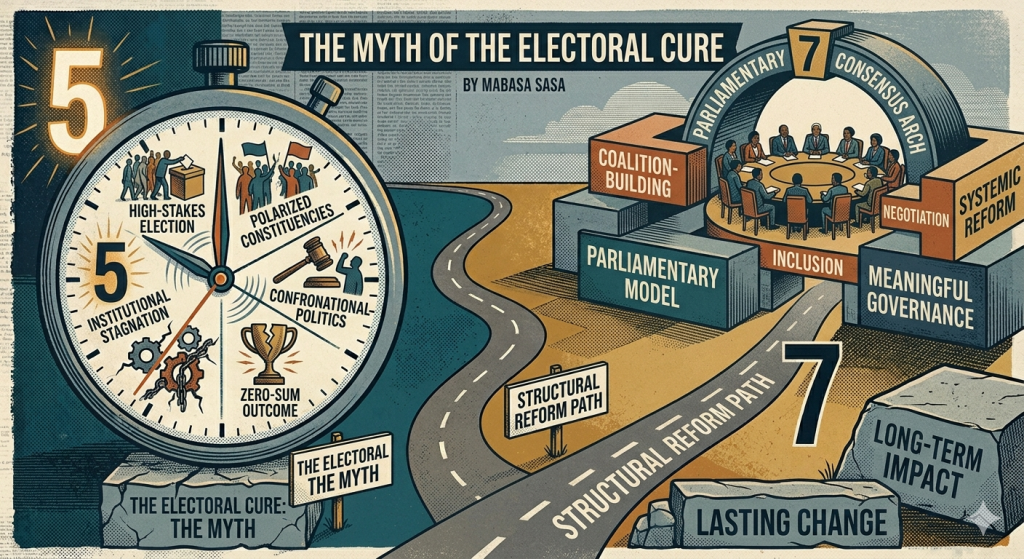
The current model incentivises confrontation rather than collaboration. It rewards candidates who can mobilise strong, often polarised constituencies, rather than those who can build a broad-based consensus. The result is a zero-sum political culture, where winning is absolute and losing is exclusionary. Governance, in turn, reflects that logic. It becomes centralised, contested, and frequently disconnected from the diversity of voices within society.
ALSO READ: Zimbabweans Continue to Make Their Voices Heard at Constitutional Hearings
Zimbabwe has, however, experienced a different model, albeit briefly.
The Government of National Unity, formed in the aftermath of the 2008 Zimbabwean general election, did not emerge from a clear electoral victory. It was the product of negotiation, pressure, and compromise. It was imperfect and, at times, uneasy. But it introduced a degree of stability that had been absent. Inflation was brought under control, public services stabilised, and there was a measurable, if temporary, restoration of institutional functionality.
What that period revealed was a simple but often overlooked principle: inclusion can matter more than outright victory.
A parliamentary system seeks to embed that principle into the structure of governance. By requiring executive leadership to emerge from Parliament, it shifts the emphasis from individual dominance to collective legitimacy. Leadership becomes dependent on negotiation, coalition-building, and sustained agreement. Power is not simply won once; it must be maintained through consensus.
This is not an abstract theory. It is reflected in the political systems of countries such as South Africa and Botswana, where parliamentary frameworks have contributed to relative political stability and greater continuity in policy direction. These systems are not without flaws, but they have demonstrated an ability to absorb political differences without tipping into systemic crisis.
There is also a practical dimension that cannot be ignored. Elections in Zimbabwe have increasingly become high-stakes national events. They are costly, both financially and socially. They disrupt economic activity, heighten political tensions, and often leave lingering disputes over legitimacy. In such a context, reducing the intensity and frequency of electoral cycles is not inherently anti-democratic. It can, in fact, be a stabilising intervention.
This is where the proposal to extend the presidential term to seven years enters the conversation. Framed narrowly, it can appear as an attempt to delay accountability. But viewed structurally, it raises a different question: whether the current electoral cycle allows enough time for meaningful governance to take place.
ALSO READ: Zimbabwe’s Amendment Bill No. 3 Sparks Nationwide Debate as Public Hearings Draw Thousands
Accountability is not only expressed through the ballot box. It is also reflected in the performance of institutions, the delivery of services, and the consistency of policy implementation between elections. A system that prioritises frequent electoral contests but struggles to produce sustained outcomes risks confusing activity with progress.
For the Southern African region, Zimbabwe’s debate carries broader significance. Many countries in the region operate within similar constitutional frameworks and face comparable tensions between electoral legitimacy and governance effectiveness. The question is not whether elections matter. They do. The question is whether elections, in their current form, are sufficient.
Zimbabwe’s experience suggests they are not. The deeper issue is structural. It is about whether the design of the political system enables or constrains change. Whether it encourages inclusion or entrenches division. Whether it allows governments the time and stability needed to implement policy, or keeps them in a perpetual cycle of contestation.
The belief that elections alone can deliver transformation has endured because it is simple and reassuring. But simplicity should not be mistaken for accuracy.
The real question is not whether Zimbabwe needs elections. It is whether it needs a system that can turn electoral moments into lasting change.
So far, the evidence suggests that without structural reform, the promise of elections will continue to exceed their outcomes.
Mabasa Sasa is a veteran journalist with over 20 years of experience covering politics, governance, and regional affairs in Southern Africa. He has served as Editor of The Southern Times in Namibia and The Sunday Mail in Zimbabwe, and contributor for New African, bringing deep regional insight and a strong track record in shaping cross-border public discourse.