By Dr. Zamani Saul, Northern Cape ANC Chairperson
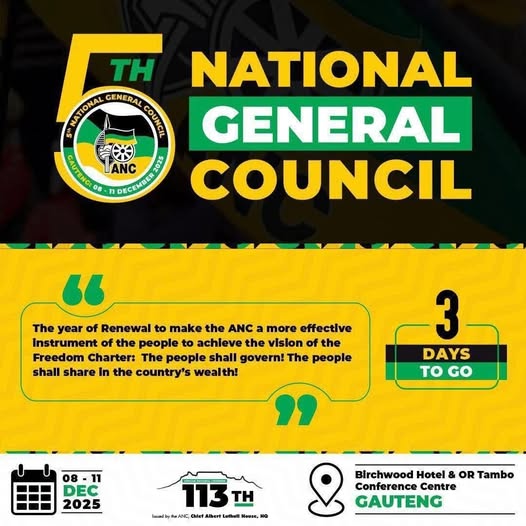
Next week, Monday will mark the first day of the 5th National General Council (NGC) of the African National Congress (ANC). The 5th NGC will take place against the backdrop of a country gripped by the enquiry proceedings at the Madlanga Commission, Parliament Ad hoc Committee, and the Nkabinde Enquiry, all investigating allegations of malfeasance that have compromised the work of the security cluster.
On the 10th of June 2025, President Ramaphosa announced the National Dialogue, an initiative that was reportedly “gathering great support and enthusiasm”. The President also announced the Eminent Persons Group to guide and champion the work of the National Dialogue.
However, less than a month later, on the 6th of July, Lt General Mkhwanazi convened a press conference where he slammed the disbandment of the Political Killings Task Team (PKTT) and alleged that there is a capture of SAPS by politicians working with criminal syndicates. These allegations from a senior police official effectively torpedoed the hype surrounding the National Dialogue, and the dialogue has since been eclipsed by the proceedings of the Madlanga Commission and the Parliament Ad hoc Committee.
As if this was not enough, the Nkabinde enquiry, which commenced hearings on the 17th of November, has further added to the media frenzy. The Nkabinde Enquiry is examining the fitness of the suspended Gauteng Director of Public Prosecutions.
These enquiries have literally eclipsed and overshadowed everything else. This is not by accident or political gaslighting, it’s a deadly matter, as every South African is directly or indirectly a victim of crime, including our President. According to ANC internal research, crime ranks as one of the top five concerns of all South Africans.
ALSO READ: South Africa’s Police Service in Crisis: The Battle for Integrity Amid Political Interference
The positive trends in the economic, political, and social trajectory of the country are being overshadowed and eclipsed by these enquiries. For example:
– South Africa’s successful exiting of the Financial Action Task Force (FATC) grey listing due to significant progress in combating money laundering is being eclipsed.
– The country’s upgrade by the Standard & Poor rating agency for the first time in 20 years is being eclipsed.
– Eskom’s reporting a profit for the first time in 8 years is being eclipsed.
– The opening of the first African data centre in Johannesburg is being eclipsed.
– The rand’s 10% gain against major currencies is being eclipsed.
– Minister Godongwana’s very progressive Budget Policy Statement under a precarious fiscal environment is being eclipsed.
– The successful hosting of the G20 for the first time in Africa is being eclipsed.
– The marginal increase in employment for Q3 of 2025 is being eclipsed.
– The reported positive growth trajectory of the economy is being eclipsed.
– Bafana Bafana’s qualification for the 2026 World Cup, for the first time in 15 years, is being eclipsed.
– The extraordinary performances of the rugby and cricket national teams are all being eclipsed.
Everything is being eclipsed by the enquiries; will this be the fate of the 5th National General Council?
The NGCs are the ANC’s second most important national gatherings since 1994 and set the tone for the National Conferences. NGCs have evolved into critical platforms for policy debate, strategic review, and leadership accountability.
The last four NGCs literally gripped the country’s attention. This was due to the fact that South Africans fully understood the implications of NGCs for the development trajectory and direction of the country.
ALSO READ: South Africa’s police serve the ANC insiders, not the people: here’s how it happened
The first NGC took place in July 2000 in Port Elizabeth, under the theme “ANC – People’s Revolutionary Movement and Agent for Change”. The NGC took place after the leadership transition from the Mandela generation, the adoption of GEAR, and the confusion over the government’s response to HIV/AIDS treatment. The NGC engagements on these contentious matters united the broader Alliance. South Africans were inspired by the immediate tasks identified by the people’s revolutionary movement and agents for change.
Subsequent NGCs were convened in 2005, 2010, and 2015. Though the opening of the 2005 NGC was disrupted by robust discussions on the non-attendance of then former Deputy President Jacob Zuma. After the matter was resolved, delegates focused on the task at hand. The NGC reaffirmed the People’s Contract, a program aimed at aligning government policies with the aspirations of the masses and underscored the commitment of the ANC to the Revolutionary Tripartite Alliance.
The 2010 NGC focused on economic resilience, job creation, and infrastructure investment. This led to the R1 trillion infrastructure rollout programme as a catalyst for economic growth. The NGC also highlighted the need for greater coordination between the government and the private sector. The 2015 NGC tackled state capture, radical economic transformation, and land reform resolutions.
From the past events, it is quite evident that ANC NGCs are significant and momentous occasions for the party and the country. This is because NGCs foster strategic continuity, which is about the ANC remaining aligned with its core principles while adapting to new challenges. By reviewing mid‑term progress at the NGCs, the party can recalibrate policies without waiting for the five‑year conference cycle.
NGCs are also important for internal democracy as they provide a platform for rank‑and‑file members to influence decision‑making, fostering a sense of ownership and reducing disillusionment. The NGCs are key to policy innovation as debates at NGCs often lead to policy experiments, allowing the ANC to test ideas before full implementation. The NGCs are also a demonstration of transparency in the party; as deliberations, especially on contentious issues like corruption and land reform, bolster the ANC’s image as a responsive and accountable governing party.
So, it will be self-defeating for both ANC members, supporters, and as well as the broader society to allow the 5th ANC NGC to be eclipsed by the many enquiries taking place in the country. This NGC must be focused on dealing with the many challenges the party and the country are confronted with, particularly on the economic front. In a recent NEC meeting, the President stated that “our economy is in a state of emergency”.
The performance of the South African economy has not been good for the 2010 -2025 period and failed to keep up with the average world GDP growth. This has adverse implications on the government’s potential fiscus and ability to respond to the vast socio-economic challenges of South Africans.
This worsened over the past six years with subdued growth of less than 1%, which is outpaced by the annual population growth of about 1.5%. This trajectory spells disaster for a country like South Africa with an economic landscape characterised by high levels of unemployment.
The state of the economy is what delegates to the 5th NGC should be seized with, as the economy is desperate for real growth. Consequently, we cannot allow the importance of the 5th NGC, accompanied by four days of heavy-lifting, to be dragged into oblivion by enquiries that have engulfed the political and social discourse in the country.
As our criminal justice system is being restored, we need to stimulate economic growth, drastically reduce unemployment, and realise our full industrial potential.