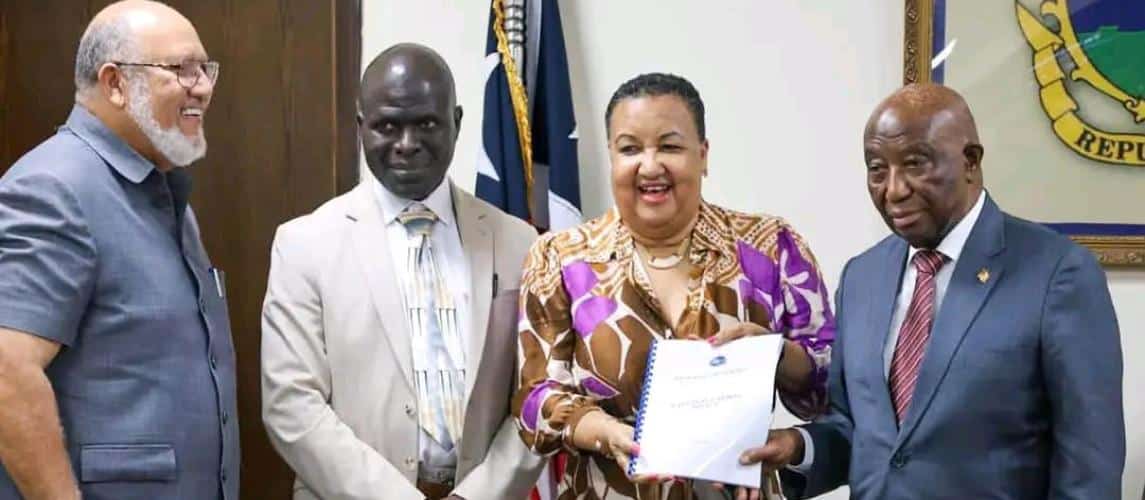
MONROVIA, Liberia – Liberia has taken a major step towards participating in the global carbon economy after President Joseph Boakai received the country’s National Carbon Policy, a framework intended to regulate carbon-market activities and strengthen access to climate finance.
The policy follows an extensive consultation process involving forest-dependent communities, civil society organisations, government institutions, the Environmental Protection Agency (EPA) and members of the Legislature.
It is designed to establish clear roles for government institutions involved in carbon markets and climate finance while ensuring that Liberia’s participation in the emerging carbon economy is guided by national interests, transparency and broad stakeholder participation.
Receiving the policy, Boakai said Liberia needed to ensure that its natural resources generate tangible economic benefits for its citizens, particularly communities that live alongside and help protect the country’s forests.
The President said the framework could provide a structured pathway for Liberia to attract climate finance, participate in carbon-market transactions and support conservation and climate-related development.
“There are amendments we will make, but we have to have something done for now, and that’s what we have to do,” Boakai said, signalling that the government intends to begin implementing the framework while allowing room for future improvements.
Turning forests into climate finance
The policy comes as Liberia seeks to turn the environmental value of its forests, wetlands, mangroves and other ecosystems into a source of sustainable development finance.
According to Liberia’s Environmental Protection Agency, the country contains about 69% of the remaining Upper Guinean Forest ecosystem while contributing only a small share of global greenhouse-gas emissions. The country’s ecosystems absorb and store significant amounts of carbon while supporting livelihoods and providing food, water and other resources to communities.
The World Bank has previously identified Liberia as one of the countries with significant potential for carbon markets and forest-based climate finance. Its 2024 Country Climate and Development Report said Liberia hosts one of West Africa’s largest rainforests and has opportunities to use carbon markets and benefit-sharing mechanisms to finance climate action and more resilient development.
ALSO READ: Boakai tells Cabinet: ‘Procure with accountability’ as Liberia’s contracting system faces scrutiny
The policy is not limited to forestry. Government documents indicate that carbon projects could also be developed in agriculture, renewable energy, waste management, transportation, industry, coastal and marine ecosystems, urban development and ecotourism.
Potential projects include reforestation and mangrove restoration, renewable-energy development, clean cooking, climate-smart agriculture, recycling and composting, landfill-gas capture and lower-emission public transport.
New carbon-market institutions
The policy builds on a step taken by the Boakai administration in October 2025, when the President established the Carbon Markets Authority (CMA) through Executive Order No. 155.
The authority was created as the lead national institution for carbon-market development and climate finance, with responsibility for policy formulation, market participation and compliance with relevant international frameworks, including the Paris Agreement.
Under the new policy, the CMA is expected to serve as Liberia’s principal carbon-market regulator, including having authority over the approval of carbon-credit transfers and trading.
A National Carbon Registry will also track carbon credits using unique identification numbers. The system is intended to improve transparency and help prevent the double counting or sale of the same carbon credits, an issue that has become central to efforts to establish credible international carbon markets.
The EPA will lead Liberia’s Measurement, Reporting and Verification system, which will be responsible for measuring emissions reductions, verifying project outcomes and generating information for national and international climate reporting.
Independent verification will also be required before carbon credits can be issued or traded.
Community benefits at the centre
For Liberia, one of the most important questions will be how revenue from carbon credits is distributed.
The policy places significant emphasis on community participation and land rights. It recognises the rights of communities, customary landowners and private landowners, with carbon ownership generally linked to legal ownership of the land, forest or other resource from which the credit is generated. Projects affecting community land or resources are required to obtain the Free, Prior and Informed Consent of affected communities and undergo the necessary environmental and social assessments.
The framework also establishes benefit-sharing arrangements.
ALSO READ: Regional Power Pools Seen as Key to Strengthening Africa’s Energy Security
For carbon credits generated from government-owned resources, the policy provides that, after applicable taxes and verified project costs, 40% of proceeds would support national social, education and health programmes. A further 20% would support the CMA, EPA and relevant sector agency, 30% would go to project developers and 10% would directly support affected communities.
Where the carbon-generating resource is owned by a community or private party, 50% of net proceeds would go to the community or private owner, 30% to the project developer and 20% to responsible government institutions.
Government carbon revenues are also expected to be managed through the Liberia Carbon Investment Fund rather than the government’s general revenue account, with the intention of directing funds towards climate action, development and sustainable management of natural resources.
Liberia enters a growing global market
The move comes as carbon markets continue to expand internationally, although questions over the quality, verification and credibility of carbon credits remain important.
The World Bank’s State and Trends of Carbon Pricing 2026 report says carbon pricing now covers nearly 30% of global greenhouse-gas emissions and mobilised more than $107 billion for public budgets in 2025. It also reported that carbon-credit issuance increased by 8% between 2024 and 2025.
For forest-rich African countries, the potential is particularly significant. The World Bank has highlighted the growing role of forest-carbon programmes in generating payments for countries that reduce emissions from deforestation and forest degradation, commonly known as REDD+.
But the experience of other countries also demonstrates why strong safeguards are necessary. Carbon projects require credible measurement and verification, clear land and carbon rights, transparent transactions and mechanisms to ensure that local communities benefit from the revenue generated by their natural resources.
Liberia has been working on these issues for several years. A World Bank assessment has previously identified land-rights arrangements and uncertainty around carbon rights as important considerations for the viability of carbon projects in parts of the country, while emphasising the need for communities to receive benefits from carbon revenues.
Boakai, meanwhile, urged Liberia to have confidence in its own technical expertise and not allow prolonged debate to prevent action.
He commended the EPA and the technical team involved in developing the policy, saying their work demonstrated Liberia’s growing ability to address complex national and international issues.
The policy now provides the government with a framework to move from discussions about Liberia’s carbon potential towards establishing a functioning market.
For a country whose forests are both a major environmental asset and an important source of livelihoods, the success of that transition will depend not only on how much carbon finance Liberia can attract, but also on whether the resulting revenues are transparently managed and reach the communities that protect the resources generating the credits.