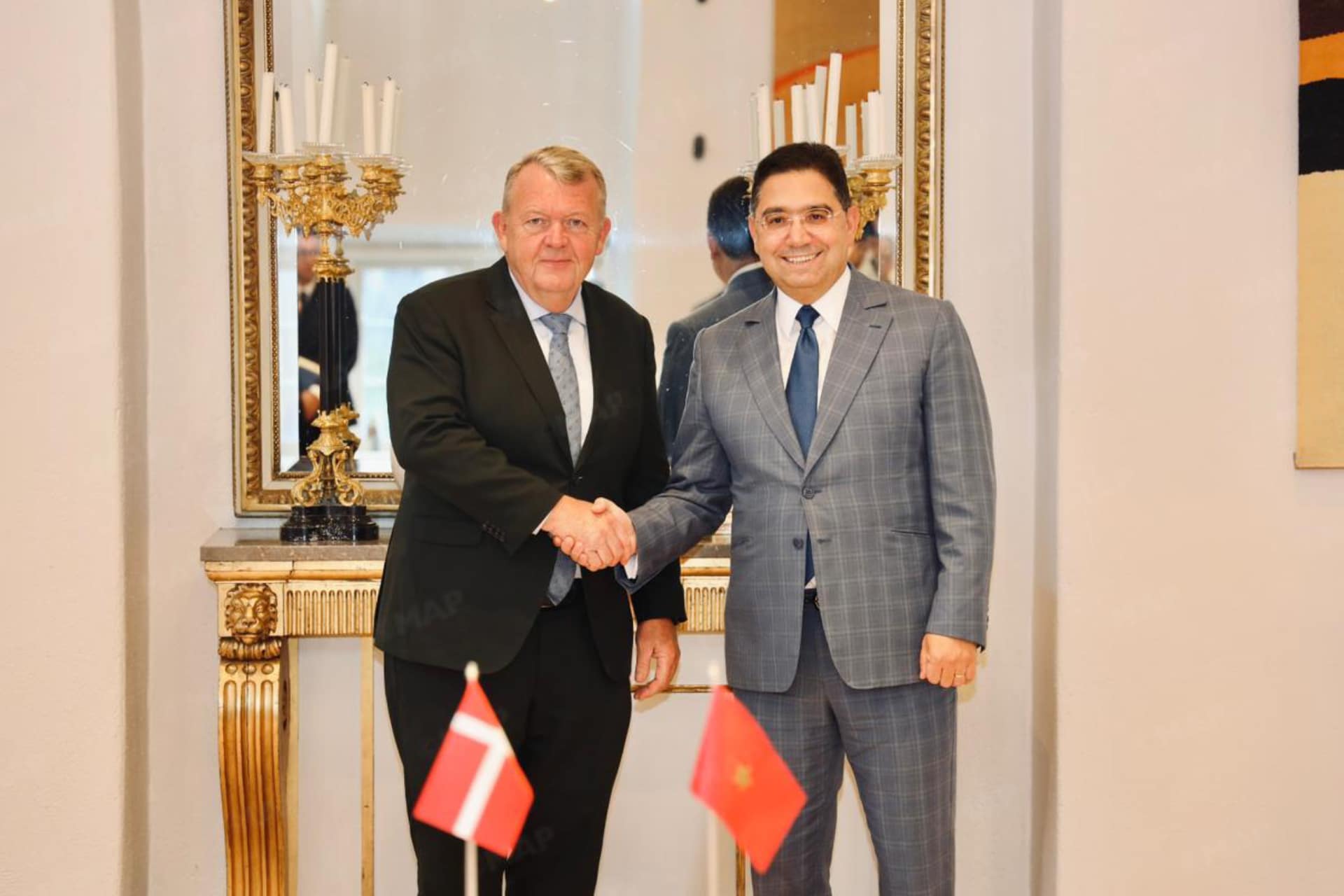
RABAT – Denmark has thrown its diplomatic weight behind Morocco’s autonomy proposal for Western Sahara, describing the plan as a credible basis for negotiations and aligning its position with the latest direction of the United Nations and European Union.
Danish Foreign Minister Lars Løkke Rasmussen made the remarks on Friday during a working visit to Copenhagen by Morocco’s Foreign Minister Nasser Bourita.
Rasmussen said Denmark welcomed the adoption of United Nations Security Council Resolution 2797 and supported Morocco’s autonomy proposal in the ongoing UN-led process.
“Denmark lauds, in line with the European Union’s position, the adoption of UNSC Resolution 2797,” Rasmussen said.
He went further in describing Morocco’s proposal as “credible”, saying it makes “a serious and essential contribution to the ongoing UN process” and constitutes “a good basis for a mutually agreed solution by all parties.”
The statement reaffirms Denmark’s position on the disputed territory and comes at a significant moment in the decades-old Western Sahara dispute.
UN process increasingly centred on autonomy proposal
Resolution 2797, adopted by the UN Security Council on October 31, 2025, renewed the mandate of the United Nations Mission for the Referendum in Western Sahara, or MINURSO, until October 31, 2026.
More significantly, the resolution directed the UN Secretary-General and his Personal Envoy, Staffan de Mistura, to facilitate negotiations “taking as basis Morocco’s Autonomy Proposal” to reach a just, lasting and mutually acceptable settlement consistent with the UN Charter. It also states that genuine autonomy could represent “a most feasible outcome”.
The resolution nevertheless retains the requirement that any final settlement must provide for the self-determination of the people of Western Sahara. It calls on the parties to negotiate without preconditions and encourages them to submit constructive ideas that could contribute to a mutually acceptable settlement.
ALSO READ: At least 19 Killed in Collapse of Two Buildings in Morocco’s Old City of Fez
The resolution was adopted with 11 votes in favour, three abstentions by China, Pakistan and Russia, while Algeria did not participate in the vote.
UN Personal Envoy Staffan de Mistura subsequently described the resolution as significant, saying it demonstrated renewed international energy to resolve a conflict that has lasted for decades. He said the UN process would take the 2007 Moroccan autonomy plan as a basis for negotiations while also considering other proposals and ideas.
The European Union has also adjusted its position in line with Resolution 2797. In February 2026, the European Commission said the EU had, with the unanimity of its member states, updated its position on Western Sahara to align with the Security Council resolution.
What is Morocco proposing?
Morocco submitted its autonomy initiative to the United Nations in 2007 as an attempt to break the diplomatic deadlock over Western Sahara.
Under the proposal, the territory would enjoy extensive powers to manage its own internal political, economic, social and cultural affairs through regional legislative, executive and judicial institutions.
Morocco would retain responsibility for areas including defence, foreign relations and certain constitutional and religious prerogatives. The proposal also envisages the agreement being submitted to the population concerned through a referendum.
The United Nations formally took note of the Moroccan proposal in 2007 while also taking note of a separate proposal submitted by the Frente POLISARIO. Security Council Resolution 1754 subsequently called on the parties to enter negotiations without preconditions in pursuit of a just, lasting and mutually acceptable political solution providing for the self-determination of Western Sahara.
That history is important because the dispute has never been simply a disagreement between Morocco and the Polisario Front over administrative arrangements. At its core is a dispute over the political status and future of the territory and the meaning of self-determination.
A conflict dating back to the end of Spanish rule
Western Sahara was administered by Spain until its withdrawal in the mid-1970s. Morocco and Mauritania subsequently laid claims to the territory, while the Polisario Front fought for independence.
The International Court of Justice rejected the territorial claims advanced by Morocco and Mauritania in 1975, while affirming that the findings before it did not establish sovereignty over Western Sahara and that the principle of self-determination remained relevant. Fighting subsequently broke out between Morocco and the Polisario Front, with Algeria becoming an important regional actor in the conflict. Mauritania renounced its claim in 1979.
A UN-backed ceasefire took effect in 1991, accompanied by the establishment of MINURSO. The mission was initially created to prepare for and support a referendum on the future status of Western Sahara. The ceasefire largely held for decades, although hostilities resumed in 2020. MINURSO remains in the territory and continues to monitor and report on the situation.
The absence of a final political settlement has made Western Sahara one of Africa’s longest-running unresolved territorial disputes.
Denmark’s position adds to diplomatic momentum
For Morocco, Copenhagen’s latest statement carries significance beyond the bilateral relationship.
Denmark is currently a member of the UN Security Council, meaning its position comes from a country directly involved in the body responsible for international peace and security and for the UN political process on Western Sahara.
The Danish government had already described Morocco’s 2007 autonomy plan in 2024 as a “serious and credible contribution” to the UN process and as a good basis for an agreement between the parties. Danish parliamentary records document that position.
The latest statement therefore represents a reaffirmation rather than an entirely new diplomatic position.
ALSO READ: UN Resolution 2797 Causes ANC To Rethink Strategy For Western Sahara
It also comes amid a wider European shift towards treating Morocco’s autonomy proposal as an important framework for negotiations. The EU’s updated position in 2026 explicitly aligned its approach with Resolution 2797.
Morocco has sought to build international backing for the proposal for years, while the Polisario Front continues to insist on the right of the Sahrawi people to self-determination and has historically advocated independence as an option.
The competing interpretations remain important. A UN document outlining the Polisario position argues that Resolution 2797 does not make Morocco’s proposal the only basis for negotiations and stresses that the final objective remains a mutually acceptable political solution providing for self-determination.
The diplomatic challenge ahead
Denmark’s endorsement does not, by itself, resolve the Western Sahara dispute. The central challenge remains getting Morocco, the Polisario Front, Algeria and Mauritania into a negotiating process capable of producing a settlement accepted by the parties.
Resolution 2797 explicitly recognises the roles of those parties and calls for negotiations without preconditions.
For Morocco, however, the diplomatic environment has changed considerably since the autonomy proposal was submitted in 2007.
The Security Council’s decision to make the Moroccan proposal the basis for negotiations, while retaining the requirement for a mutually acceptable settlement and self-determination, has given Rabat a stronger diplomatic platform.
Denmark’s latest intervention adds another layer to that evolving international position.
For Copenhagen, the message is that Morocco’s proposal is not merely another document on the negotiating table. In Rasmussen’s words, it is a “credible” initiative that makes a “serious and essential contribution” to the UN process and offers “a good basis for a mutually agreed solution by all parties.”
The question now is whether that growing diplomatic convergence can translate into substantive negotiations and, ultimately, an agreement capable of ending one of Africa’s most enduring territorial disputes.