What does it take for Africa to help unlock the mysteries of black holes and reshape our understanding of the universe? World-renowned astrophysicist Professor Sera Markoff brought that question to Unisa, where scientists and academics explored the continent’s growing role in global astronomy, from the Event Horizon Telescope to the ambitious Africa Millimetre Telescope.
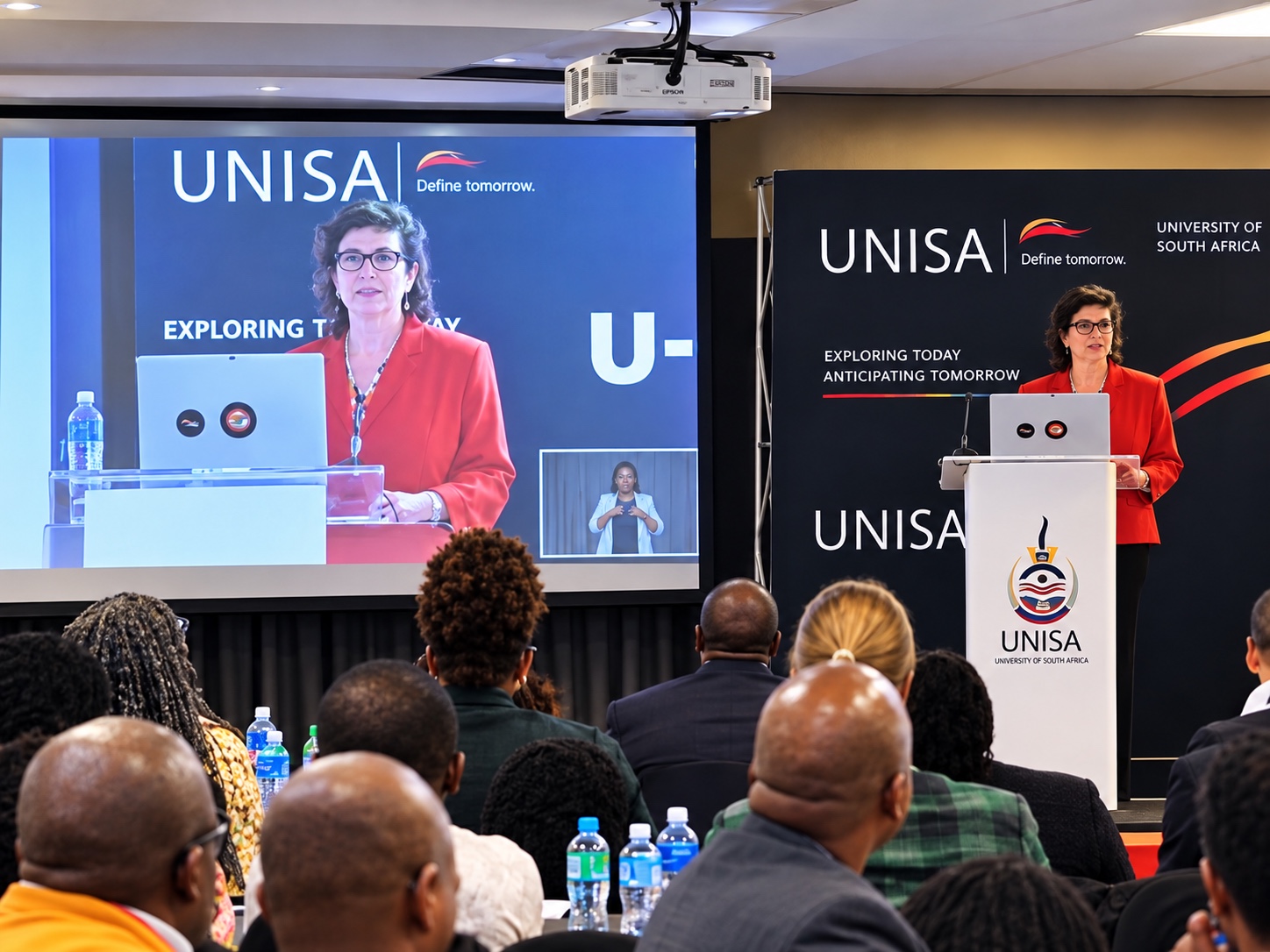
PRETORIA – Africa’s place in humanity’s exploration of the universe took centre stage at the University of South Africa (Unisa) this week, as leading astrophysicists and academics examined how the continent can strengthen its role in some of the world’s most ambitious scientific projects.
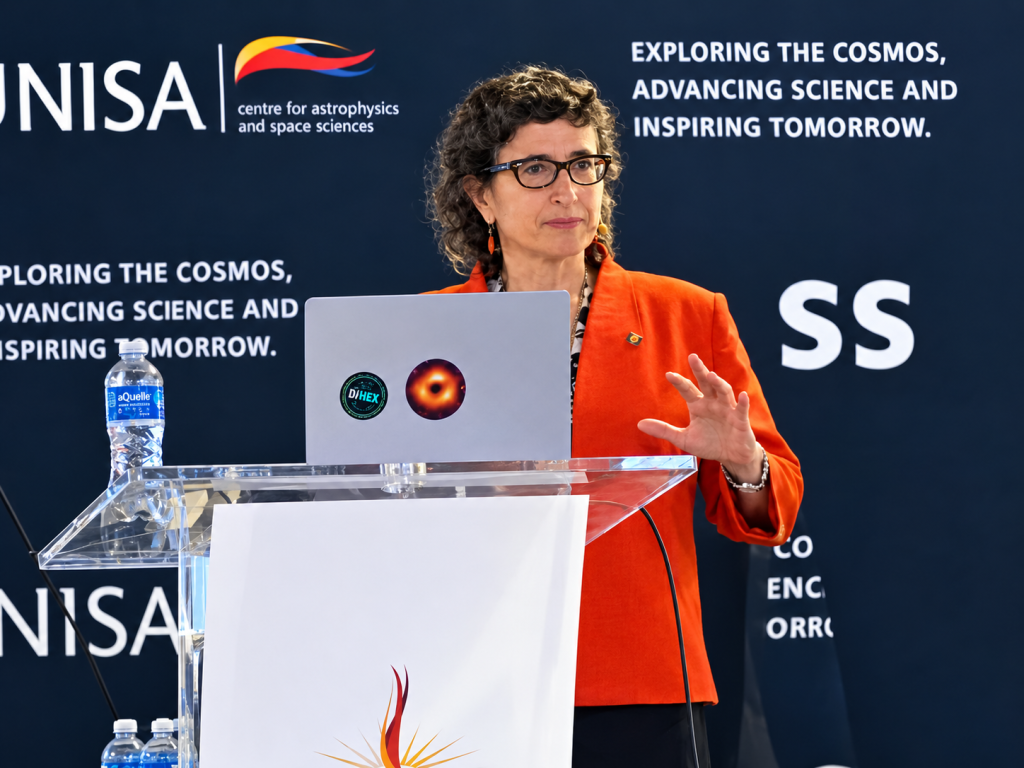
World-renowned astrophysicist Professor Sera Markoff delivered a public lecture at Unisa’s Muckleneuk Campus in Pretoria on Monday, 21 September, titled “From Black Hole Images to Movies with the Event Horizon Telescope”.
Markoff is a founding member of the Event Horizon Telescope (EHT) Collaboration and served on its Science Council from 2016 to 2022. Her work with the collaboration contributed to a series of major scientific achievements that earned the team the Breakthrough Prize in Fundamental Physics, the American Astronomical Society’s Bruno Rossi Prize and the Einstein Medal, all in 2020.
She is currently the Plumian Professor of Astronomy and Experimental Philosophy at the University of Cambridge, a chair dating back to 1704 and previously held by renowned astronomers including Sir Arthur Eddington, Sir Fred Hoyle and Lord Martin Rees. She is also Professor of Theoretical High-Energy Astrophysics at the University of Amsterdam.
Her connection to Africa’s astronomical ambitions is direct. Markoff is co-principal investigator of the Africa Millimetre Telescope (AMT) project through her BlackHolistic research programme, placing her among the scientists helping shape the continent’s growing observational capabilities.
From black holes to a new era of astronomy
Markoff’s lecture explored some of the most compelling questions in modern astronomy, including the nature of black holes, regions of space where gravity is so powerful that not even light can escape.
Studying these extreme objects lets scientists test fundamental theories of physics while investigating the processes that shape galaxies and generate some of the universe’s most powerful phenomena.
The EHT has played a central role in that work.
Rather than being a single telescope, the EHT is a global network of radio telescopes that work together as a virtual, Earth-sized telescope. In 2019, the collaboration produced the first image of a black hole’s shadow, revealing the environment around the supermassive black hole at the centre of the M87 galaxy.
The achievement gave scientists a new way of studying black holes and provided a powerful test of Albert Einstein’s general theory of relativity under some of the most extreme conditions in the universe.
But astronomy is moving beyond still images.
ALSO READ: Breaking Stereotypes: Bokamoso’s TVET Journey Into The Skilled Trades
As technology and observing techniques improve, scientists are increasingly seeking ways to capture changes in these extreme environments over time. This is the idea behind the “movies” in the title of Markoff’s lecture.
For Africa, the development of new observing infrastructure could place the continent closer to the centre of that scientific effort.
Astronomy lecture speaks directly to Unisa’s space science agenda
The lecture also sits within one of Unisa’s ten Catalytic Niche Areas (CNAs), the university’s strategic focus areas intended to strengthen research, innovation and engaged scholarship while addressing challenges facing South Africa and the wider continent.
Astronomy and space science fall under CNA 5: Space Studies and the Square Kilometre Array (SKA). Unisa identifies the area as a strategic opportunity to build capacity in astronomy and astrophysics, strengthen research and postgraduate training, and deepen the university’s contribution to major international scientific initiatives.
The university has been involved in the SKA project since 2012 and offers astronomy and astrophysics studies from undergraduate through to doctoral level. Its astronomy infrastructure also includes the Unisa Observatory, which is used for student training and research.
The CNA, however, is broader than the study of stars and distant galaxies. Unisa describes its catalytic niche areas as scholarly spheres of strategic importance that are intended to shape the institution’s identity and inform teaching and learning, research, postgraduate supervision, innovation and engaged scholarship.
This makes the lecture’s focus on Africa’s role in advancing astronomy particularly relevant to Unisa’s institutional agenda. The discussion places astronomy not only within the realm of fundamental science, but also within questions of research capacity, scientific collaboration, skills development and Africa’s participation in major global scientific projects.
That emphasis is consistent with the university’s wider interpretation of the space studies niche. Unisa’s recent CNA activities have highlighted astronomy and space science as areas through which the institution can connect academic research with STEM education, innovation, international collaboration and the development of research capacity needed to address future challenges on the continent.
Building Africa’s astronomical capacity
In her welcome and opening address, Unisa Principal and Vice-Chancellor Professor Puleng LenkaBula emphasised the importance of international partnerships in creating opportunities for research, knowledge exchange and global academic engagement.
She pointed to Unisa’s relationships with institutions such as the University of Oxford, the University of Amsterdam and the University of Turku in Finland as examples of how collaboration can expand opportunities for researchers and students.
“These collaborations provide platforms for knowledge sharing, joint research and participation in global scientific networks, while strengthening the capacity of African institutions to contribute to and benefit from advances in science and technology,” LenkaBula said.
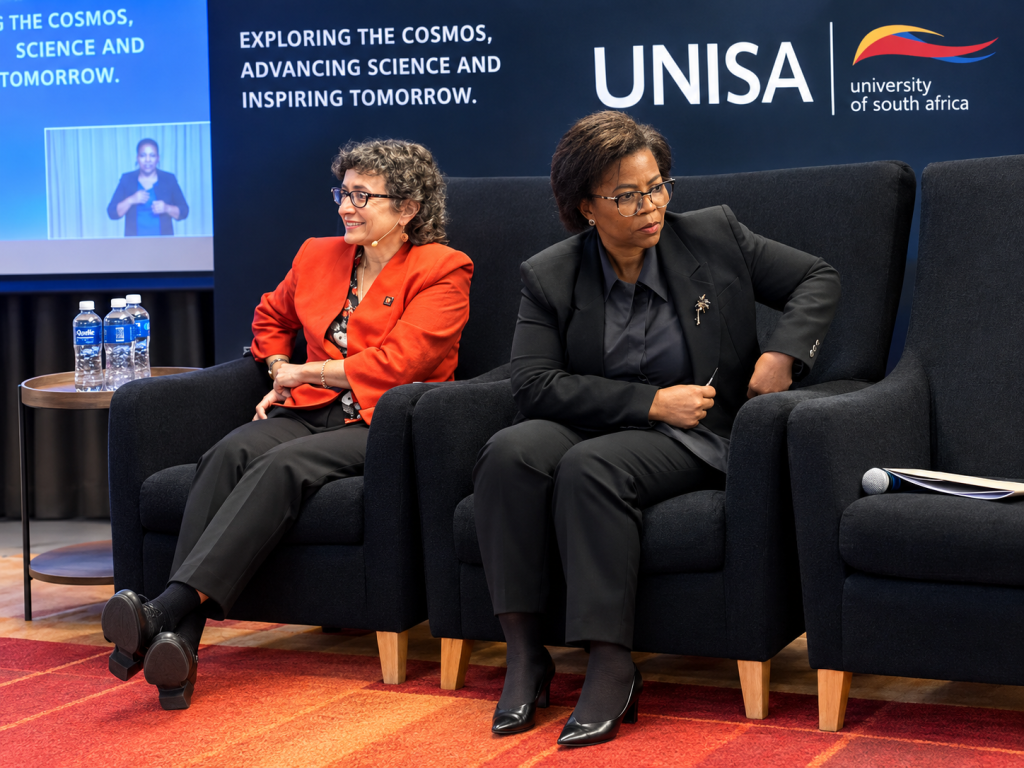
She said such partnerships are particularly important in fields such as astronomy, where major research projects require specialised expertise, sophisticated infrastructure and access to international scientific networks.
One of the projects at the centre of this effort is the Africa Millimetre Telescope.
Unisa’s involvement extends beyond academic participation. In February 2026, LenkaBula led a delegation of senior management, academics and student astrophysics researchers to Namibia, where Unisa and the University of Namibia signed an agreement to advance the AMT project.
Under the agreement, Unisa committed a foundational contribution of NAD4 million, approximately US$243,000, and pledged technical expertise during the telescope’s commissioning and operational phases. The partnership also places emphasis on postgraduate training, skills transfer and public science outreach.
A telescope with continental significance
The AMT is an international consortium project led by Radboud University in the Netherlands, in partnership with the University of Namibia, the University of Oxford, the University of Amsterdam and Unisa, with the University of Turku as an associated member.
The telescope is planned for construction on Gamsberg mountain in Namibia, where it will observe the universe at millimetre wavelengths.
This part of the electromagnetic spectrum can provide information about cold gas, dust and other astronomical objects that can be difficult to study using visible light. Such observations can help scientists investigate how stars, galaxies and other structures form and evolve.
Its significance extends beyond what the telescope will observe on its own.
Once operational, the AMT is expected to become the first African node in the EHT network. Its location will help strengthen the geographic coverage of the global array and improve its ability to study rapid changes around black holes.
The project passed its critical design review this year, with site preparation and telescope manufacturing scheduled to begin in 2026. Installation is planned for 2027 near the H.E.S.S. gamma-ray observatory site in Namibia.
ALSO READ: From Waste Tyres to Shoe Polish: Unisa Professor Turns Waste into Opportunity
For Africa, however, the telescope represents more than another piece of scientific infrastructure.
It offers an opportunity to train researchers, develop technical expertise and expose students to international research programmes while strengthening the continent’s contribution to global astronomy.
LenkaBula stressed the importance of ensuring that major facilities such as the AMT do not operate in isolation, but form part of a wider scientific ecosystem.
That ecosystem can build on existing African capabilities, including South Africa’s involvement in the Square Kilometre Array and the broader African Very Long Baseline Interferometry Network.
Together, such facilities can create stronger links between African researchers and global scientific collaborations.
Investing in people, not just infrastructure
For Professor Bhekie B. Mamba, Executive Dean of Unisa’s College of Science, Engineering and Technology, infrastructure alone will not transform Africa’s position in global science.
Researchers need networks that connect universities, institutions and scientists across national borders.
These networks allow researchers to share knowledge, data, equipment and expertise while creating opportunities to participate in large-scale projects that may be beyond the capacity of individual institutions.
Mamba said greater access to international scientific projects is essential to developing the expertise and research capabilities needed to advance cutting-edge science.
“Such opportunities are essential for developing the expertise, experience and research capabilities required to contribute to cutting-edge science,” Mamba said.
He also highlighted the importance of human capacity development, particularly in ensuring that African researchers and students are equipped not only to participate in major scientific projects but eventually to lead them.
“Human capacity development is particularly significant for Africa,” he said, referring to the need to develop the knowledge, skills and expertise required to sustain scientific and technological initiatives.
From participants to contributors
Markoff’s engagement at Unisa came at a significant moment for African astronomy.
The continent is already home to major scientific investments and research programmes, while projects such as the AMT are creating opportunities to expand its role in global astronomical research.
The challenge is ensuring that these investments translate into lasting scientific capacity.
That means connecting infrastructure with researchers, universities with international networks and students with opportunities to work on some of the biggest scientific questions of their generation.
The discussion at Unisa ultimately went beyond black holes.
It was about who gets to participate in the next era of discovery, and whether Africa can move from being a place where major scientific facilities are located to becoming a continent whose researchers help shape the questions, technologies and discoveries emerging from them.
As astronomy pushes deeper into the universe, Africa is positioning itself not merely to observe that journey, but to help drive it. The lecture provided a practical example of how the CNA can move beyond being an institutional research category and become a platform for intellectual engagement. By bringing an internationally recognised astrophysicist into conversation with an African university community, the event contributed to the broader question of how African institutions can participate in, produce and lead scientific knowledge rather than simply consume knowledge generated elsewhere.