CAPE TOWN – As Africa grapples with the growing gap between climate ambition and real-world delivery, a major continental gathering in Cape Town next month aims to tackle a question that has become increasingly urgent: how to turn climate plans into projects that investors are actually willing to fund.
Africa’s Green Economy Summit (AGES) 2026 will take place from 24 to 27 February in Cape Town under the theme “From Ambition to Action: Scaling Investment in Africa’s Green and Blue Solutions.” The summit comes at a time when climate impacts are intensifying across the continent, but funding for mitigation and adaptation remains stubbornly limited.
According to the Africa Climate Finance Tracking Report 2025, current climate finance flows cover only about 25% of Sub-Saharan Africa’s annual climate financing needs. The shortfall has sharpened attention on delivery, particularly as governments face tighter budgets and concessional finance becomes harder to secure.
Rather than centring on new pledges or declarations, AGES 2026 is designed to focus on implementation. The summit will bring together policymakers, investors, project developers and development partners to interrogate what it actually takes to move climate and green economy projects from planning to financial close.
ALSO READ: The Road To Ruin Is When Transport Emissions Kill Our Communities
“Global climate discussions often focus on commitments and coordination, but delivery ultimately depends on where capital decisions are made,” said Emmanuelle Nicholls, Group Director for Green Economy at VUKA Group, the summit organiser. “AGES creates a space to look honestly at which projects, in which markets, are ready to meet today’s financial realities.”
Closing the delivery gap
Africa continues to receive a disproportionately small share of global climate finance, despite being among the regions most exposed to climate shocks, energy insecurity and water stress. At the same time, competition for private capital is increasing, forcing governments and developers to rethink how projects are structured, de-risked and presented to investors.
AGES 2026 is structured around these realities. Sessions will examine where capital is flowing, where it is stalling, and what regulatory, financial and institutional conditions are needed to unlock investment across green and blue economy sectors.
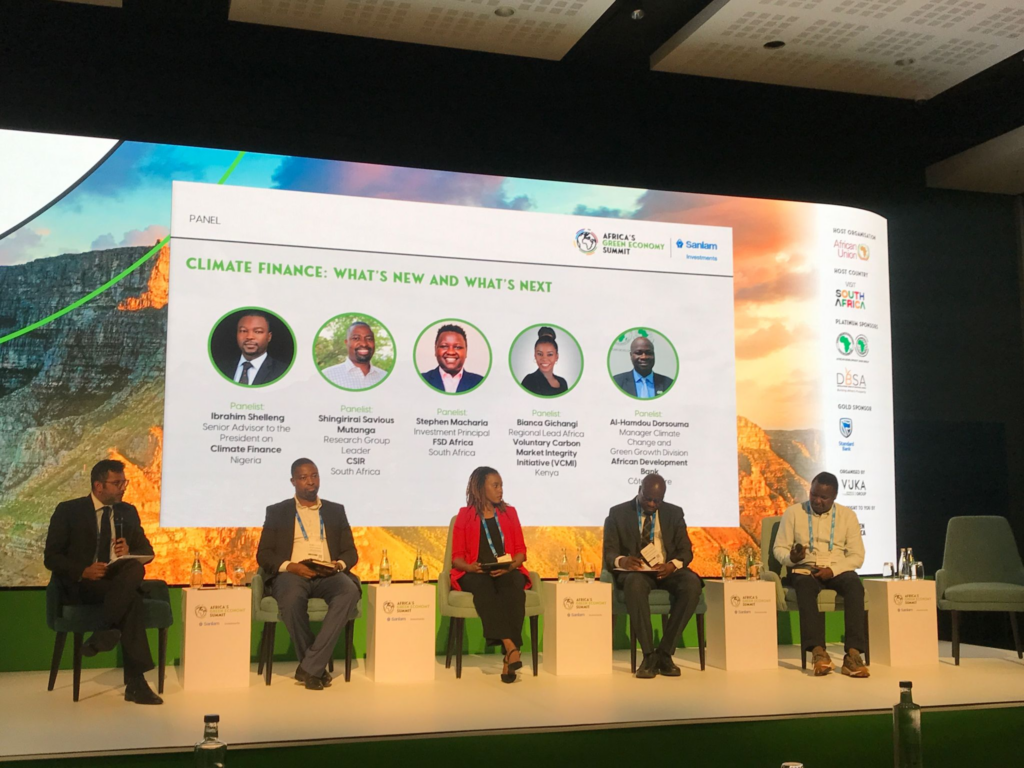
“The real constraint is not a lack of projects, but a lack of financing structures that can meet projects where they are,” said Teboho Makhabane, Head of ESG and Impact at Sanlam Investments. “Platforms like AGES matter because they bring the right partners together to design solutions that can unlock viable projects and deliver both impact and returns.”
African Union role and continental coordination
Reinforcing its continental mandate, the African Union will once again host the summit. AGES 2026 will also feature the AU–Green Recovery Action Plan (AU-GRAP) Grand Finale Roundtable, marking the close of Phase I of the programme.
The session will reflect on outcomes from five Green Investment Roundtables held under AU-GRAP and outline priorities for Phase II implementation. Organisers see AU-GRAP as a key continental mechanism for mobilising climate and nature finance in a more coordinated and strategic way.
ALSO READ: Cameroon could be turning waste to energy: study uncovers why it’s not, and sets out solutions
“We can only close the climate and nature finance gap if we understand the real movements of capital,” said Barbara Buchner, Global Managing Director of the Climate Policy Initiative. “There is progress, but it is uneven. Finance is still not reaching the regions and sectors that need it most.”
From pitches to pipelines
A central feature of the summit will be its Investment Pitch and Showcase, which will present more than 50 vetted African projects to investors. The pipeline spans renewable energy, battery storage, climate-resilient water infrastructure, electric mobility, waste-to-value solutions, circular manufacturing, climate-smart agriculture and resilience technologies.
Organisers say the emphasis on vetted, investment-ready projects reflects a broader shift in Africa’s climate agenda, away from abstract ambition and toward measurable economic activity.
AGES 2026 is supported by a growing coalition of public and private partners, including Sanlam Investments, Standard Bank, UNOPS, UNEP, FSD Africa, Wesgro, the City of Cape Town, AFD and the Atlantis Special Economic Zone, among others.