Cameroon is positioning itself for a major influx of American capital as Washington and Yaoundé unveil an investment pipeline worth about $7 billion across energy, critical minerals, infrastructure, technology and logistics.
US, Cameroon Unveil $7 Billion Investment Pipeline as Economic Ties Enter New Phase
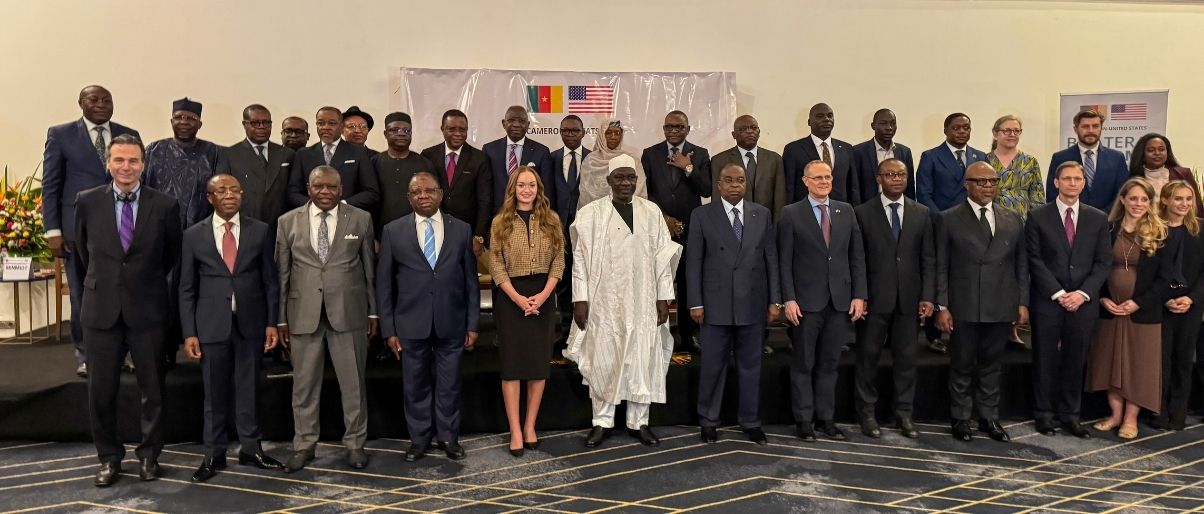
YAOUNDE, Cameroon – The United States and Cameroon are seeking to reset their economic relationship, unveiling an investment pipeline worth approximately $7 billion as Washington looks to expand its commercial footprint in Central Africa.
The figure was announced following the inaugural US-Cameroon Bilateral Economic and Commercial Dialogue, held in Yaoundé on August 27, and covers projects at various stages of development in sectors ranging from energy and critical minerals to infrastructure, technology, forestry and logistics.
According to a joint statement issued by the US Embassy in Cameroon, the proposed investments amount to nearly 4 trillion CFA francs.
The dialogue, hosted by the Cameroonian government, brought together senior officials and private-sector representatives from both countries in an effort to deepen trade and investment ties.
The relationship has a long institutional history. The two countries signed a Bilateral Investment Treaty in 1986, which entered into force in 1989.
Yet bilateral trade remains relatively modest compared with the scale of the new investment pipeline. Figures from the Office of the US Trade Representative show that two-way trade reached about FCFA 395 billion in 2025, an increase of 1.7% from the previous year.
The new dialogue is intended to change that equation.
Energy and critical minerals at the heart of the push
The largest project in the pipeline is a proposed $3.5 billion Grand Eweng Hydropower Project on Cameroon’s Sanaga River.
New York-based infrastructure investor Hydromine is advancing the 1,040-megawatt project, which could become one of the largest private power investments in Central Africa if it reaches construction.
For Cameroon, additional generation capacity could help address persistent electricity constraints while supporting industrial expansion and economic growth.
Critical minerals are another major component of the proposed US investment drive.
ALSO READ: Protest erupts in Cameroon’s Douala as opposition leader rejects Biya victory
Connecticut-based Tronox and Australia’s Lion Rock are progressing a $500 million rutile project, while Washington-based ARM is in discussions to develop a cobalt-nickel-manganese project at Nkamouna.
The latter is expected to begin with an initial investment of $85 million.
The projects place Cameroon within a wider Central African push to develop mineral resources needed for batteries, renewable energy and advanced manufacturing.
They also align with Washington’s broader effort to diversify critical-mineral supply chains and reduce dependence on China for strategic inputs.
Infrastructure ambitions extend beyond energy
The investment pipeline also includes major infrastructure projects.
Illinois-based A. Epstein and Sons International, together with financial partner ITF, is in discussions over a proposed $2 billion airport serving the Douala metropolitan area.
The group is also discussing a separate $230 million project to construct modern theatre halls in Yaoundé, Douala and Bamenda.
If realised, the airport project would represent one of the most significant infrastructure investments announced under the new bilateral economic framework.
But as with several other projects in the pipeline, the proposal remains at the discussion stage.
Technology, logistics and diaspora investment
Technology and digital infrastructure are also emerging as important areas of cooperation.
Virginia-based Cybastion plans to invest $75 million in an artificial intelligence-powered data centre and power plant in Douala.
New York fintech company Azamra is meanwhile working on mechanisms to channel investment from Cameroon’s diaspora and accelerate cross-border digital payments.
The initiative comes as digital financial services and remittance platforms expand rapidly across African markets, creating new channels for diaspora capital to reach domestic economies.
ALSO READ: In Yaoundé, Communities Take the Fight Against Cholera Into Their Own Hands
Logistics is another area where US companies are looking to establish a deeper presence.
FedEx, through its Global Service Participant Globex Cameroun S.A.R.L., is developing plans for a warehouse facility at Douala International Airport.
New Jersey-based Hoffman Equipment has an $83 million equipment sale in the pipeline to support infrastructure development and technical training.
California-based Taylor Guitars is also sourcing ebony sustainably from Cameroon through local partner Crelicam, providing an example of how American consumer companies are becoming directly involved in Cameroon’s forestry value chain.
From announcements to investment
The dialogue was not limited to individual projects.
Officials also discussed reforms aimed at making Cameroon more attractive to US investors, including taxation, shipping and logistics, and changes to the mining sector.
The two governments agreed to establish joint working groups to maintain momentum and institutionalise the dialogue.
The next edition will be hosted by the United States in 2027.
Speaking ahead of the dialogue at the PROMOTE 2026 trade forum in Yaoundé, US Chargé d’Affaires John G. Robinson said Washington wanted to become “a reliable partner for economic growth” in Cameroon, with the relationship focused on trade, investment and technology transfer.
That ambition will now be tested by implementation.
The $7 billion figure represents a pipeline of proposed and developing projects rather than $7 billion in capital already committed or disbursed. Some projects are still being discussed, while others remain in development.
For Cameroon, that distinction matters.
The country is heading into 2027 with growing fiscal pressures and is reportedly preparing for conditional IMF-linked budget support of about CFA300 billion amid uncertainty over a follow-on IMF programme.
Against that backdrop, attracting private investment could provide an important source of capital for infrastructure and productive sectors.
But the real measure of the US-Cameroon dialogue will not be the size of the headline figure.
It will be whether the projects move from proposals and negotiations to signed agreements, construction, investment and, ultimately, jobs and economic growth.
For now, Washington and Yaoundé have established the pipeline. The harder task begins with delivering it.
Subscribe to Our Newsletter
Keep in touch with our news & offers
Thank you for subscribing to the newsletter.
Oops. Something went wrong. Please try again later.