Former Hawks head Lieutenant-General Dr Godfrey Lebeya says South Africa’s fight against crime must extend beyond policing, calling for stronger coordination across the criminal justice system and a dedicated prosecutorial capacity to tackle corruption effectively.
Lebeya Calls for Stronger Fight Against Crime Through Justice System
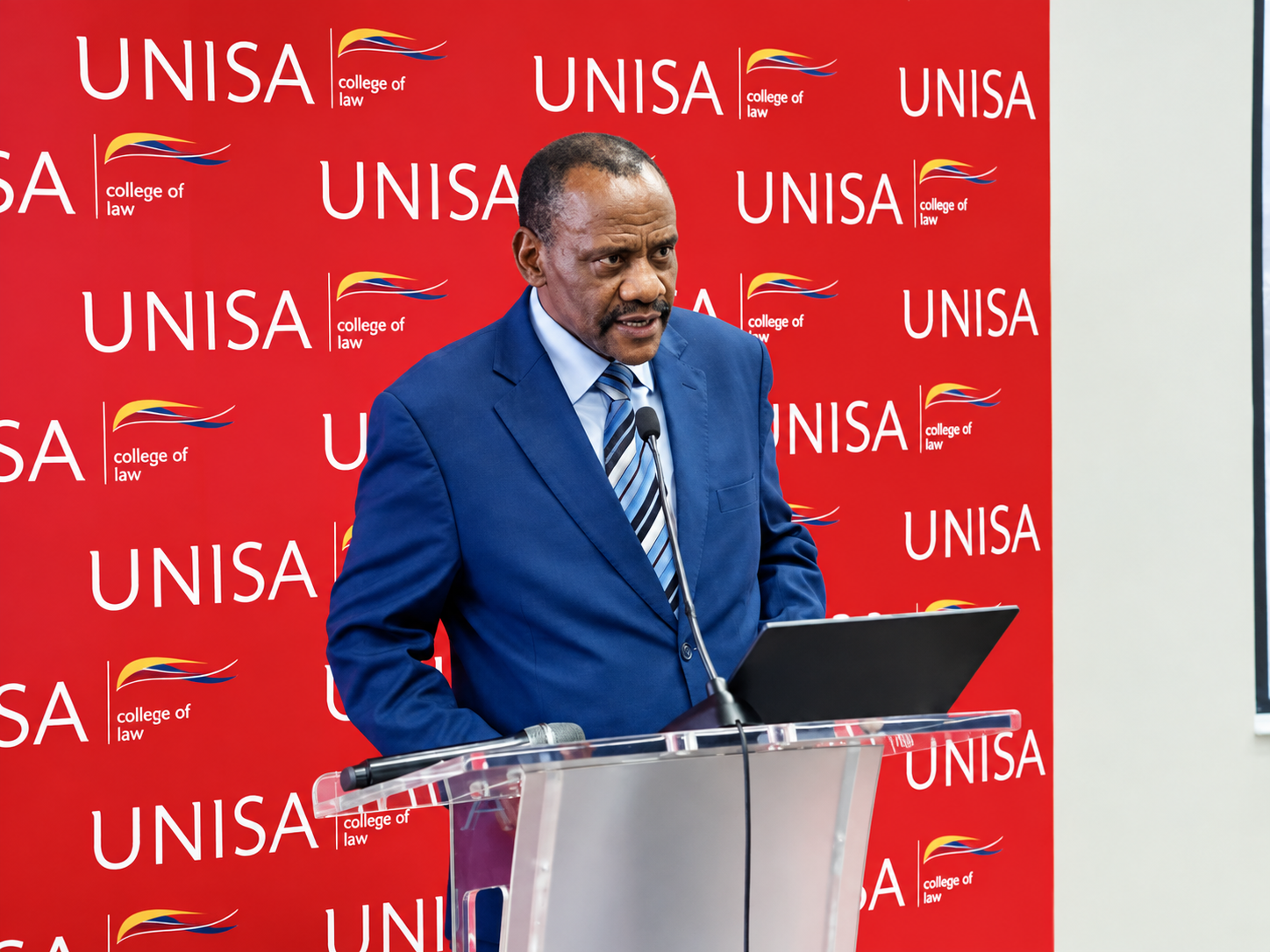
PRETORIA — Former Hawks national head Lieutenant-General Dr Godfrey Lebeya has called for a more coordinated approach to fighting crime in South Africa, arguing that effective policing depends on an equally strong criminal justice system capable of investigating, prosecuting and successfully concluding cases.
Lebeya was speaking on Tuesday at a University of South Africa (Unisa) symposium at the university’s Muckleneuk campus in Pretoria, where academics, community representatives and other stakeholders discussed how research and knowledge can be applied to challenges facing South African society.
Drawing on his experience in law enforcement, Lebeya said the criminal justice system should be viewed as an interconnected chain in which police, investigators, prosecutors and courts must work together.
“Today, I invite every scholar, researcher and practitioner to embrace a new version of justice, one that is participatory, humane and deeply rooted in South Africa’s realities,” he said.
He said the justice system’s effectiveness should ultimately be measured by whether it protects human dignity, delivers meaningful outcomes and contributes to stronger communities, rather than simply processing cases.
Lebeya targets corruption
Asked which single intervention he would prioritise to improve justice and community safety, Lebeya identified corruption as a key issue.
“My view is that if I was to prioritise, I was going to say let’s deal with corruption effectively. And to deal with corruption effectively, we must establish an entity of prosecutors to prosecute corruption. Until we do that, we will keep on asking questions about why it continues to happen,” he said.
His remarks come amid an ongoing debate over South Africa’s institutional response to corruption.
The country already has a dedicated prosecution-led anti-corruption unit, the Investigating Directorate Against Corruption (IDAC), which operates within the National Prosecuting Authority. The NPA Amendment Act, signed into law in 2024, made the unit permanent, replacing the temporary Investigating Directorate established in 2019.
IDAC’s future and independence have nevertheless remained subjects of political debate.
The Democratic Alliance has called for an independent anti-corruption commission, while the uMkhonto weSizwe Party has proposed legislation seeking to dismantle IDAC.
The Institute for Security Studies has argued that IDAC’s specialist capabilities should be strengthened rather than discarded, while also warning against simply transferring its functions to the Hawks without addressing capacity constraints within the crime-fighting unit.
Lebeya’s law-enforcement record under scrutiny
Lebeya’s comments come as his own record as head of the Hawks has received renewed scrutiny during proceedings at the Madlanga Commission of Inquiry.
Lebeya led the Directorate for Priority Crime Investigation, commonly known as the Hawks, from 2018 until his retirement in 2025.
He appeared before the commission in late August and again in early September, where he faced questions about alleged links to individuals identified in testimony as part of an organised crime network referred to as the “Big Five”.
Among those mentioned was businessman Katiso “KT” Molefe, who is facing a murder charge.
Lebeya was also questioned about the 2021 theft of 541 kilograms of cocaine, valued at about R200 million, from a Hawks storage facility in Port Shepstone, as well as conflicting testimony surrounding a 2024 arrest operation at Molefe’s Sandton home.
Lebeya disputed the allegations raised during his testimony.
At the conclusion of his evidence, he described himself as “incorruptible” and said he had “conducted clean policing for over 40 years”.
He also urged law-enforcement officials who continue to fight corruption from within their institutions not to be discouraged by what he described as “the behaviour of a handful of corrupt individuals”.
The allegations and testimony before the Madlanga Commission remain subject to the inquiry’s ongoing investigation and findings.
Universities and the fight against crime
At the Unisa symposium, the discussion extended beyond law enforcement to the role universities and researchers can play in addressing social problems.
Academics and other participants considered how research and evidence can be translated into practical interventions that benefit communities.
Lebeya’s contribution placed the criminal justice system at the centre of that discussion, arguing that crime cannot be addressed effectively by focusing on policing alone.
His remarks highlighted the need for stronger coordination between investigators, prosecutors and the courts, while also emphasising the importance of public institutions responding to the realities experienced by communities.
The symposium comes as South Africa continues to grapple with questions around crime, corruption, accountability and the effectiveness of its criminal justice institutions.
For Lebeya, addressing those challenges requires a broader view of justice, one that connects law enforcement with prosecution, the courts, researchers and the communities they are ultimately expected to serve.
Subscribe to Our Newsletter
Keep in touch with our news & offers
Thank you for subscribing to the newsletter.
Oops. Something went wrong. Please try again later.