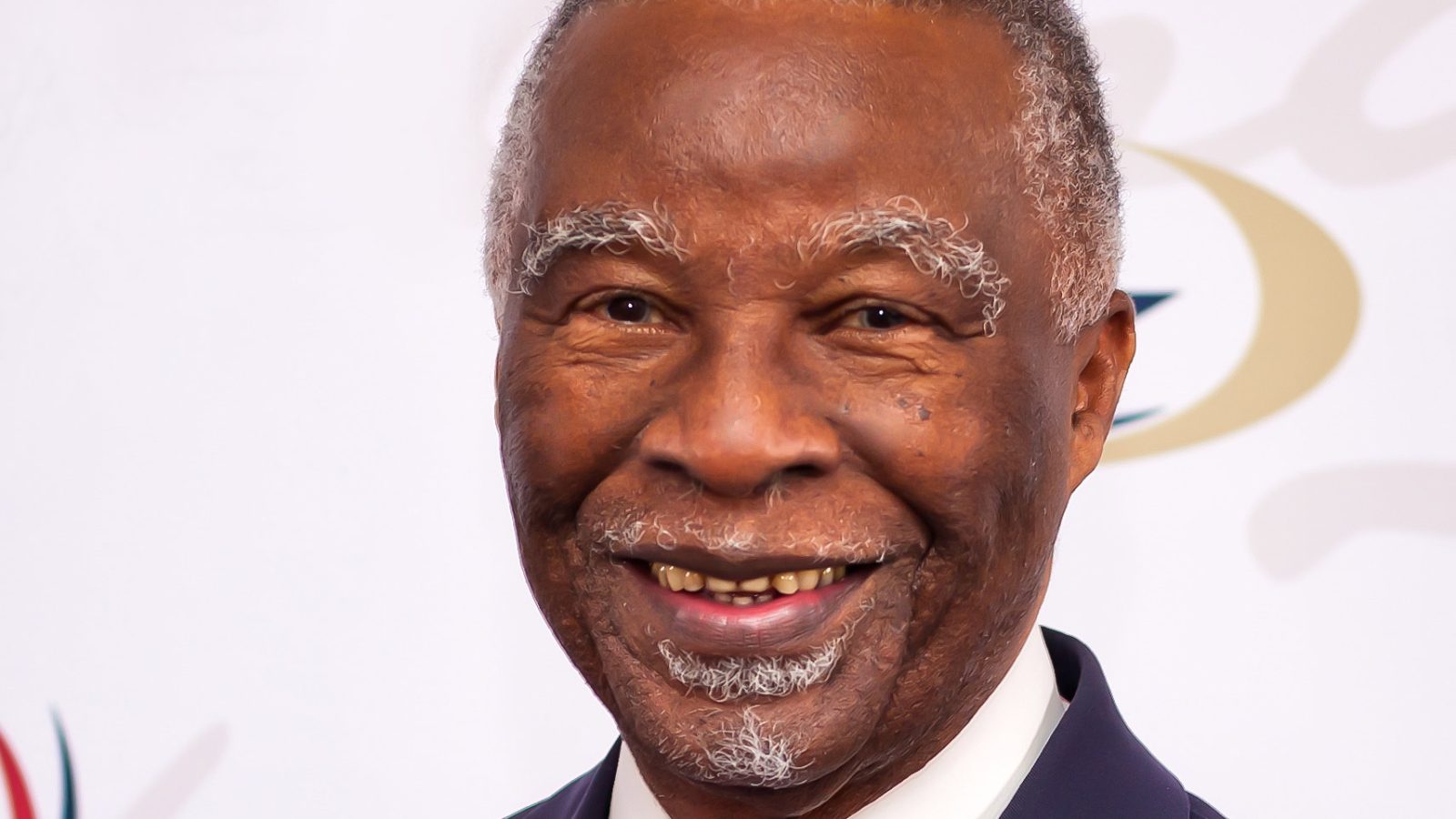
PRETORIA: Former South African President Thabo Mbeki has called for women to play a more prominent role in Africa’s political leadership and peace processes, recalling how Congolese women helped overcome divisions that threatened to derail negotiations aimed at ending one of the continent’s deadliest conflicts.
Speaking at the University of South Africa’s (Unisa) Muckleneuk Campus in Pretoria, Mbeki said the experience of the Democratic Republic of the Congo (DRC) demonstrated that women were not merely participants in peacebuilding but could be decisive forces in bringing opposing parties together.
Mbeki, who serves as Unisa’s Chancellor, reflected on the Inter-Congolese Dialogue held at Sun City in 2002, when South Africa facilitated negotiations between rival Congolese political and armed groups seeking to end years of conflict.
He said women, frustrated by their exclusion from important decisions, organised themselves into an unofficial delegation and demanded that their voices be heard.
Their intervention, he recalled, helped overcome disagreements that had frustrated negotiations between the predominantly male representatives.
For Mbeki, the experience offered a lesson that remains relevant more than two decades later: sustainable peace cannot be achieved while women are excluded from the structures responsible for shaping political settlements.
His remarks formed part of a biannual dialogue series hosted by Unisa’s Thabo Mbeki African School of Public and International Affairs, which brings together students, alumni, academics and members of the university community to discuss pressing African and international issues.
How Congolese women helped break the Sun City deadlock
The 2002 Inter-Congolese Dialogue was a crucial stage in efforts to end the Second Congo War, a conflict involving multiple African countries, armed movements and competing political interests.
South Africa, under Mbeki’s leadership, played a central role in facilitating the negotiations.
Although the talks brought together representatives of the Congolese government, rebel movements, political parties and civil society, women initially struggled to secure meaningful representation.
Rather than accept their marginalisation, Congolese women mobilised across political and organisational divisions to influence the negotiations.
According to an account published by the Council on Foreign Relations, women constituted approximately 12% of delegates at Sun City, with 40 women among 340 participants. That represented a substantial increase from the roughly 2% female representation recorded during earlier negotiating rounds.
A women’s caucus, supported by Congolese and regional civil society leaders, worked to build consensus, encouraged parties to remain committed to negotiations and kept communities informed about developments.
Their determination was particularly evident when delegates threatened to abandon negotiations over procedural disagreements.
Approximately 40 women reportedly formed a human chain across the exits of a committee room, insisting that participants remain until progress could be made.
The intervention became a powerful illustration of how women could exercise influence even when formal political structures limited their authority.
“Women were able to break through many of the deadlocks that [the men] otherwise could not,” said Noeleen Heyzer, then executive director of the United Nations Development Fund for Women (UNIFEM).
Women also advocated for a 30% representation quota in decision-making institutions, helping advance a principle that would later be reflected in the DRC’s constitutional framework.
Mbeki said their mobilisation demonstrated the importance of women’s independent agency in negotiations.
Although external pressures ultimately prevented a final agreement from being signed at Sun City, the process contributed to subsequent efforts to establish a transitional political arrangement in the DRC.
Lessons from Zimbabwe and Sudan
Mbeki contrasted the participation of Congolese women with his experiences mediating political disputes in Zimbabwe and Sudan.
In those negotiations, he said, women were largely excluded from the central decision-making processes.
The comparison highlighted a persistent weakness in African peace initiatives: political settlements are often negotiated by powerful political and military actors, while women and other affected communities remain underrepresented.
Mbeki argued that this exclusion undermines the inclusiveness of peace processes and limits opportunities to address the broader social consequences of conflict.
ALSO READ: Opinion | More than a trophy: Africa’s moment to champion women’s football
His reflections also reinforced the importance of moving beyond symbolic representation towards ensuring that women have genuine influence over decisions affecting governance, security and development.
Women remain excluded from global peace negotiations
More than two decades after the Sun City talks, women’s participation in formal peace negotiations remains limited.
This is despite the adoption of United Nations Security Council Resolution 1325 in 2000, which recognised women’s essential role in conflict prevention, peace negotiations, peacebuilding and post-conflict reconstruction.
The UN Secretary-General’s latest Women, Peace and Security report found that women accounted for an average of only 7% of negotiators worldwide in the preceding year.
Nearly nine out of every 10 negotiation tracks had no women negotiators, while women occupied just 14% of mediation roles.
The figures underscore the continuing gap between international commitments to gender equality and the realities of diplomatic negotiations.
For Africa, where several countries continue to grapple with armed conflict and political instability, the limited participation of women raises questions about the inclusiveness and long-term sustainability of peace agreements.
Mbeki’s reflections on Sun City therefore offered more than a historical account. They challenged contemporary African leaders to reconsider who is represented when decisions about peace and political transitions are made.
Mbeki calls for deliberate action against patriarchy
Turning to the broader question of gender equality, Mbeki said centuries of entrenched patriarchy could not be dismantled through declarations of principle alone.
He called for deliberate institutional reforms to remove barriers preventing women from participating fully in political, academic and public life.
Among his proposals was the mainstreaming of gender considerations across governance structures, ensuring that women’s participation becomes an integral part of institutional decision-making rather than an occasional intervention.
He also emphasised the need for inclusive academic policies, including practical measures that accommodate breastfeeding mothers and allow women to pursue education and professional development without unnecessary obstacles.
Within political organisations, Mbeki called for greater female representation in executive committees and other structures where important decisions are taken.
His argument was that meaningful equality requires changing the systems that determine who has access to power.
The former president has raised similar concerns at previous Unisa dialogues.
In 2024, he argued that resistance to electing women into leadership positions “necessitates the use of quotas”.
He also cautioned that appointing or electing a woman president would not, on its own, eliminate the structural inequalities experienced by women.
For Mbeki, genuine transformation requires sustained institutional commitment, political will and practical measures that enable women to exercise authority.
Africa must secure its place on the UN Security Council
Mbeki also used the dialogue to renew calls for reform of the United Nations Security Council, arguing that Africa’s exclusion from permanent membership remains inconsistent with the principles of fairness and sovereign equality.
He reaffirmed support for the Ezulwini Consensus, the African Union’s common position on Security Council reform adopted in 2005.
Under the consensus, Africa seeks at least two permanent seats with full privileges, including veto rights, and five non-permanent seats on an expanded Security Council.
The position reflects longstanding African concerns that decisions affecting international peace and security are frequently taken without adequate representation from the continent.
Mbeki acknowledged that achieving reform would be difficult, particularly because the five existing permanent members, China, France, Russia, the United Kingdom and the United States, are unlikely to surrender their exclusive privileges easily.
However, he argued that the changing international balance of power made reform increasingly necessary.
ALSO READ: Stop shielding the corrupt and killing women, church tells Southern Africa’s leaders
He situated the debate within the gradual emergence of a multipolar world, in which economic and political influence is no longer concentrated exclusively in the United States and its traditional allies.
For Mbeki, that transition should create opportunities to strengthen international institutions and give greater practical effect to the UN Charter’s principle of sovereign equality.
Growing international support for Africa’s demands
Africa’s campaign for greater representation has increasingly attracted support from major international powers.
Last week, Chinese Foreign Minister Wang Yi called for reform of the Security Council to prioritise Africa’s longstanding demands.
Wang said it should be “a priority to meet Africa’s aspiration through special arrangements”.
His remarks reflected China’s stated support for greater representation of developing countries and the Global South in international decision-making.
However, expressions of support have yet to produce the structural changes sought by African governments.
The principal obstacle remains agreement among UN member states, particularly the existing permanent members, on the size, composition and veto powers of a reformed Security Council.
Mbeki argued that Africa’s campaign could not be separated from broader efforts to reshape international relations to reflect contemporary geopolitical realities.
Diplomacy, intelligence and the changing world order
Drawing on his experience as chairperson of the Non-Aligned Movement, Mbeki also reflected on tensions involving the United Kingdom, the United States and Israel over allegations concerning Iran’s nuclear weapons capabilities.
He recalled disputes over intelligence claims that he said had not been supported by sufficiently solid evidence.
The experience, he suggested, demonstrated the complexities of international diplomacy and the dangers of allowing contested intelligence assessments to shape major geopolitical decisions.
His reflections formed part of a wider argument that international relations require stronger mechanisms for accountability, fairness and the peaceful resolution of disputes.
For African countries, he maintained, greater influence within global institutions would be essential to ensuring that the continent’s interests are properly represented.
Mbeki’s continued involvement in the DRC
Mbeki remains an influential voice in discussions about peace and political stability in the DRC, although his involvement has also attracted controversy.
In September 2025, the Congolese government declined to participate in a peace and security dialogue organised by the Thabo Mbeki Foundation.
Government spokesperson Patrick Muyaya described the initiative as “inappropriate”, while Congolese officials accused Mbeki of previously favouring the M23 rebel movement and Rwanda.
Those allegations illustrate the sensitivities surrounding diplomatic interventions in the DRC, where regional rivalries, armed conflict and questions of political legitimacy continue to complicate peace efforts.
Nevertheless, Mbeki’s reflections at Unisa returned to a principle that has shaped much of his continental engagement: lasting peace requires inclusive political processes and institutions capable of accommodating competing interests.
The former president concluded that reforming Africa’s representation on the UN Security Council could not be approached as an isolated demand.
Instead, he argued, it must form part of a broader restructuring of international relations to reflect the realities of the modern world.
His message on women’s leadership carried a parallel argument.
Just as Africa seeks meaningful representation in institutions that determine global affairs, women must have a meaningful voice in the political structures and negotiations that determine the continent’s future.
The experience of Congolese women at Sun City, he suggested, remains a reminder that those excluded from formal power can nevertheless become decisive agents of peace, and that Africa’s institutions should no longer depend on extraordinary interventions to ensure their voices are heard.