MIDRAND: South Africa must manufacture more of the replacement vehicle parts it consumes, strengthen its automotive skills base and position itself as a leading supplier to African markets if it wants to unlock the full economic potential of its R933 billion automotive aftermarket industry.
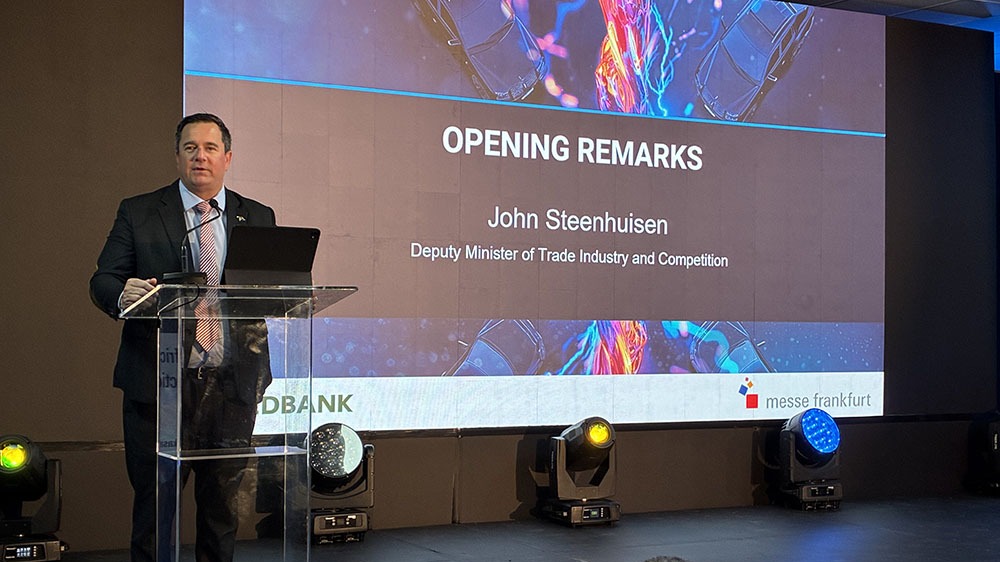
That was the message from Deputy Minister of Trade, Industry and Competition John Steenhuisen, who called for a broader approach to automotive industrial development that extends beyond vehicle assembly plants to the thousands of businesses responsible for keeping South Africans on the road.
Speaking at the Automechanika Johannesburg 2026 CEO Breakfast at the Gallagher Convention Centre on Tuesday, Steenhuisen said the automotive aftermarket represented a significant but often overlooked opportunity for industrial growth, job creation and small business development.
The sector, which includes replacement parts manufacturers, distributors, vehicle repair workshops, panel beaters, tyre specialists and fuel retailers, recorded approximately R933 billion in trade during 2025 and contributed R202.6 billion to South Africa’s gross domestic product.
It supports more than 310,000 jobs, accounting for approximately 70% of automotive employment, across more than 23,000 businesses, most of them small and medium-sized enterprises.
“These are not peripheral activities. They are central to South Africa’s economic resilience, industrial capability, and mobility,” Steenhuisen said.
His remarks come as government reviews the country’s principal automotive industry support programme, with growing calls for policies that recognise the economic contribution of businesses operating beyond the traditional vehicle manufacturing sector.
R107.5 billion import bill exposes local manufacturing opportunity
Steenhuisen identified South Africa’s dependence on imported replacement vehicle parts as one of the clearest opportunities for expanding domestic manufacturing.
In 2025, the country imported approximately R107.5 billion worth of replacement automotive components.
The figure highlights the scale of demand that could potentially be met by local manufacturers, particularly in product categories where South Africa already possesses industrial capabilities.
“Every additional percentage point of localisation in replacement parts represents jobs created, industrial capability strengthened, foreign exchange retained, and value added within South Africa,” Steenhuisen said.
He argued that increasing domestic production would not only reduce reliance on imports but also strengthen industrial supply chains and create opportunities for emerging manufacturers.
The potential market is substantial.
South Africa has approximately 13 million vehicles on its roads, with an average vehicle age approaching 11 years.
An estimated 76% of these vehicles are no longer covered by manufacturer warranties, meaning their owners increasingly depend on independent workshops and aftermarket suppliers for maintenance and repairs.
The ageing vehicle fleet creates sustained demand for replacement parts, diagnostics, servicing and specialised repair work.
However, much of that demand continues to be met through imports rather than domestic production.
Industry analysts have already identified several areas where localisation could be expanded.
At an earlier Automechanika engagement, EY partner Duane Newman highlighted lead-acid batteries, automotive glass and brake pads as some of the strongest opportunities for local manufacturing.
“Lead-acid batteries, automotive glass and brake pads offer the strongest localisation opportunities,” Newman said.
He identified low-cost imports, limited production scale and inconsistent enforcement of product standards as obstacles to expanding domestic manufacturing.
The shift towards longer vehicle ownership is also reshaping demand.
Brandon Cohen, national chairperson of the National Automobile Dealers’ Association, has noted that longer vehicle finance agreements and ownership cycles are contributing to an ageing national vehicle fleet.
As motorists retain their vehicles for longer, spending increasingly shifts from new vehicle purchases towards maintenance, servicing and replacement components.
For Steenhuisen, this creates an opportunity to strengthen local manufacturing while supporting the businesses that serve motorists throughout a vehicle’s lifespan.
Automotive policy must look beyond vehicle factories
A central focus of Steenhuisen’s address was the ongoing review of the Automotive Production and Development Programme (APDP2), South Africa’s principal automotive industry incentive framework.
ALSO READ: Ghana secures US$10m to advance its 24-hour economy projects
The programme, which runs until 2035, has traditionally focused on supporting vehicle assembly and component manufacturing.
Steenhuisen argued that the review should consider the entire automotive value chain, including businesses involved in maintaining and repairing vehicles after they leave factory floors.
The aftermarket, he said, should not be treated as a secondary industry when it supports such a significant share of employment and economic activity.
His comments reflect growing pressure from industry organisations for a more inclusive automotive development strategy.
The Retail Motor Industry Organisation (RMI), which represents a substantial portion of the aftermarket sector, has consistently argued that independent workshops, parts distributors and related businesses deserve greater recognition in industrial policy.
RMI chief executive Ipeleng Mabusela has previously pointed out that the aftermarket accounts for more than half of the automotive industry’s value added.
The debate comes as government and vehicle manufacturers continue negotiations over how to strengthen domestic production and competitiveness.
In May, Peter van Binsbergen, president of the vehicle manufacturers’ association naamsa and chief executive of BMW Group South Africa, acknowledged that industry and government had not yet reached agreement on the most effective measures.
“We are not there yet and I can say that clearly,” he said.
Steenhuisen’s intervention adds another dimension to those discussions by arguing that industrial incentives should recognise the economic opportunities presented by the growing market for replacement parts and automotive services.
African markets offer opportunities for expansion
Beyond meeting domestic demand, Steenhuisen encouraged South African aftermarket businesses to explore opportunities across the African continent.
He identified the African Continental Free Trade Area (AfCFTA) as a potential catalyst for expanding exports of replacement components, remanufactured parts and specialised automotive services.
South Africa already possesses established automotive engineering capabilities, distribution networks and an industrial manufacturing base that could support greater regional trade.
Steenhuisen argued that these strengths could position the country as a leading automotive aftermarket hub for Africa.
Expanding into continental markets would allow South African businesses to reach customers beyond the domestic vehicle fleet while creating opportunities for manufacturers to increase production volumes.
This could be particularly important for smaller manufacturers that struggle to achieve the scale necessary to compete with imported products.
Greater regional integration could also strengthen supply chains and support the development of specialised automotive manufacturing capabilities.
However, realising these opportunities would require improvements in competitiveness, production capacity, trade facilitation and the ability of South African businesses to meet international quality standards.
Shortage of qualified artisans threatens growth
Steenhuisen warned that the industry’s growth ambitions could be undermined by a shortage of qualified automotive artisans.
South Africa has approximately 31% fewer qualified automotive artisans than it had in 2009, despite an increase in apprenticeship enrolments.
The decline raises concerns about the country’s ability to maintain its ageing vehicle fleet while preparing workers for increasingly sophisticated automotive technology.
Modern vehicles require technical expertise extending beyond traditional mechanical repairs.
Electronic systems, advanced diagnostics, electric drivetrains and computer-controlled components are becoming increasingly important across the industry.
Steenhuisen called for stronger collaboration between government, industry and training institutions to ensure that skills development programmes keep pace with technological change.
He identified electric vehicles, advanced vehicle diagnostics and systems incorporating artificial intelligence as areas requiring greater attention.
The challenge is not simply to increase the number of apprentices entering training programmes, but to ensure that more complete their qualifications and acquire skills relevant to the industry’s changing needs.
ALSO READ: Steenhuisen urges France and South Africa to build, not just trade
For independent workshops and smaller businesses, access to appropriately trained technicians will be essential to remaining competitive.
Improving artisan training could also create employment opportunities for young South Africans in a sector already responsible for hundreds of thousands of jobs.
Vehicle maintenance is also a road safety issue
Steenhuisen linked the importance of the automotive aftermarket to South Africa’s continuing road safety challenges.
An ageing vehicle fleet requires regular maintenance, reliable replacement components and competent repair services to remain safe.
Poorly maintained vehicles can contribute to road accidents, placing additional pressure on households, emergency services and the broader economy.
According to the Road Traffic Management Corporation (RTMC), road crashes cost South Africa approximately R198.3 billion in 2025.
The estimated cost includes fatalities, injuries, lost productivity, vehicle damage and other economic consequences associated with collisions.
The corporation recorded 11,485 road deaths during the year, equivalent to more than 31 fatalities a day.
Although the figure represented a 5.6% decline from 2024, it remained approximately 1,200 deaths above the level projected under the National Road Safety Strategy.
The figures underline the wider importance of maintaining vehicles to appropriate safety standards.
For Steenhuisen, supporting the automotive aftermarket is therefore not only an industrial development priority but also part of ensuring that vehicles remain safe and roadworthy.
A stronger network of qualified technicians, reputable repair businesses and reliable component suppliers could contribute to safer roads while supporting economic activity.
From investment announcements to implementation
Steenhuisen’s address was among his most detailed statements on automotive industrial policy since his appointment as Deputy Minister of Trade, Industry and Competition.
President Cyril Ramaphosa appointed him to the position on 30 June 2026, following his departure from the agriculture portfolio.
His intervention comes at a time when South Africa is seeking ways to strengthen manufacturing, support small businesses and expand employment opportunities amid persistent economic pressures.
The automotive aftermarket presents a particularly significant opportunity because its economic activity extends across manufacturing, retail, logistics, technical services and informal and formal enterprises.
However, turning that potential into sustained industrial growth will require more than policy commitments.
Businesses need access to competitive production inputs, skilled workers, reliable infrastructure and markets capable of supporting local manufacturing.
Steenhuisen said government must work with industry to remove barriers to investment, improve competitiveness and ensure that economic development initiatives translate into practical results.
“South Africa must move from investment announcements to practical implementation,” he said.
He committed to working with the industry to strengthen local production, support small enterprises and create employment.
“Localisation must extend beyond the factory gate. It must include the businesses that keep South Africans moving every day,” Steenhuisen said.
His message places the automotive aftermarket firmly within the debate about South Africa’s industrial future.
With millions of ageing vehicles requiring ongoing maintenance, billions of rands spent on imported replacement components and thousands of businesses already operating in the sector, the opportunity is considerable.
The challenge now is whether government and industry can translate that demand into stronger domestic manufacturing, better skills development and sustainable employment.
Automechanika Johannesburg 2026 continues at the Gallagher Convention Centre in Midrand until Thursday, 29 October.