Steenhuisen tells French investors South Africa is open for business, but says the real test is whether investment pledges become factories, jobs, exports and stronger local supply chains.
Steenhuisen Urges France and South Africa to Build, Not Just Trade
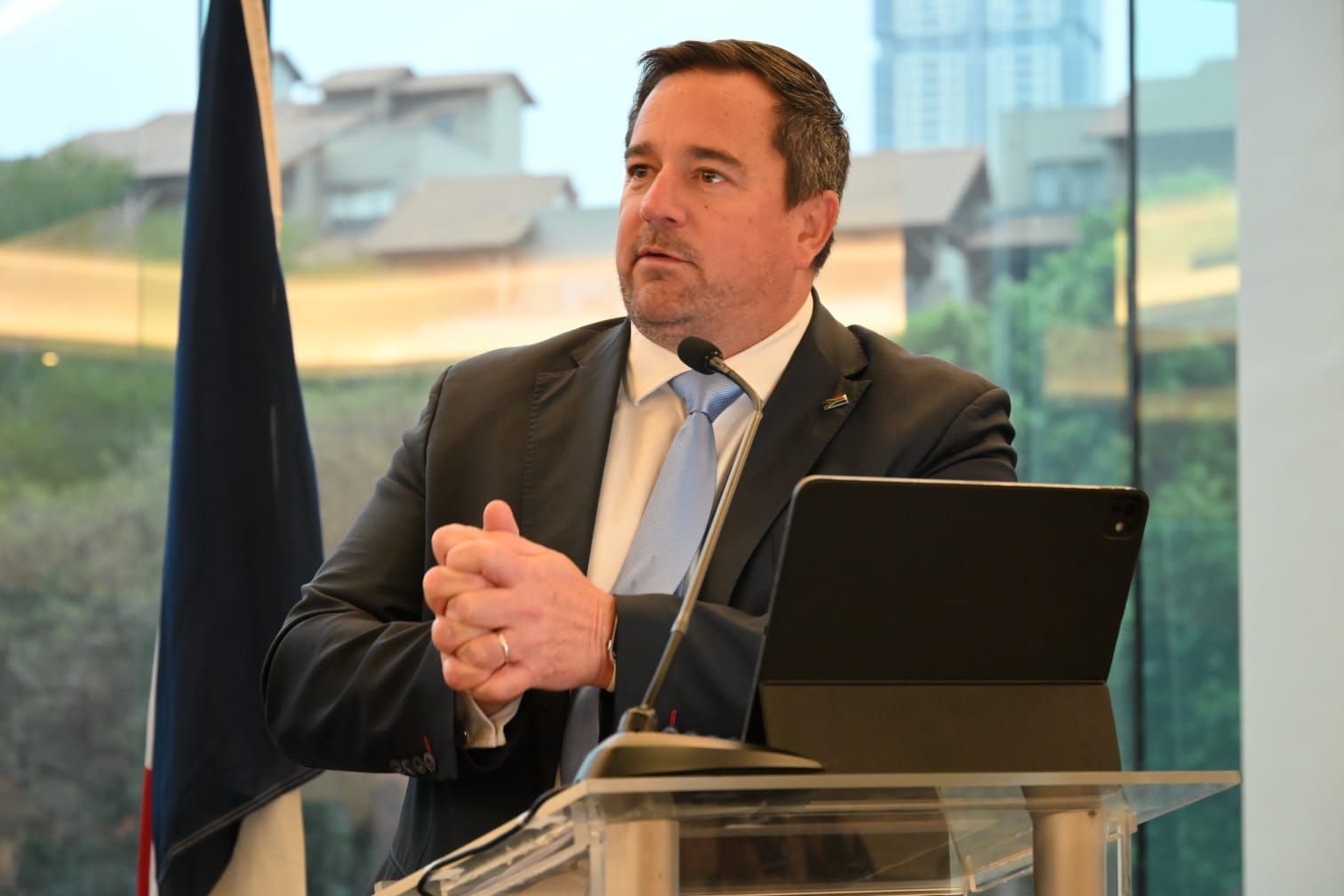
PRETORIA – Deputy Minister of Trade, Industry and Competition John Steenhuisen has called on French and South African businesses to turn investment pledges into factories, jobs and exports, saying the next phase of the bilateral economic relationship must be measured by what the two countries build together.
Speaking at the 5th France-South Africa Business Forum in Johannesburg on Tuesday, Steenhuisen said South Africa was open for business and ready to work with French companies to convert investment opportunities into productive projects, stronger local value chains and increased exports.
“Our ambition today should be to move from investment announcements to implementation, from commercial relationships to deeper industrial partnerships, and from individual projects to integrated value chains,” he said.
The two-day forum, held on 29 and 30 September at the Sandton Hotel, was hosted by the French South African Chamber of Commerce and Industry (FSACCI), Business France, the French Embassy in South Africa, Lesotho and Malawi, and the French Foreign Trade Advisors South Africa (CCEF).
Discussions covered energy security, infrastructure, sustainable cities, water, manufacturing, logistics, digital transformation and skills development.
A relationship with depth
Steenhuisen said the economic relationship between the two countries already had a substantial base, with bilateral trade reaching about €3.2 billion in 2024.
French companies have established more than 480 operations in South Africa and created almost 100,000 jobs, he said.
“French companies have built a substantial presence here in South Africa with over 480 establishments and almost 100 000 jobs created here in South Africa. Most importantly, this relationship continues to generate the investment that we need,” Steenhuisen said.
Figures released ahead of the forum point to the scale of that investment. Edouard Chretien, head of the regional economic department at the French embassy, said about €8.9 billion, or roughly R165 billion, in French investment stock had entered South Africa since 2019.
Chretien also noted that President Cyril Ramaphosa identified France as South Africa’s leading investor at the country’s investment conference in March.
Steenhuisen highlighted the same conference, where 30 French companies pledged about R20.7 billion.
The 2026 South Africa Investment Conference recorded total commitments of R889.8 billion, the highest value since the conference series began in 2018. The government also launched a new drive targeting R3 trillion in investment by 2030.
For Steenhuisen, however, the challenge now is converting those commitments into projects that have a measurable impact on the economy.
From malt to manufacturing
One example he cited was French malt producer Soufflet Malt’s R2 billion malting facility being built in Gauteng.
Steenhuisen said the project demonstrated how the relationship was moving beyond conventional trade towards industrialisation, technology, infrastructure and the green economy.
“They are evolving from the traditional mode of trade towards industrialisation, technology, innovation, infrastructure, and importantly, the green economy,” he said.
The facility is being built next to Heineken Beverages’ Sedibeng Brewery in Midvaal and is expected to produce about 100,000 tonnes of malt a year.
ALSO READ: South Africa’s Tourism Sector Booms in 2025
Once fully operational, it is expected to source all of its barley from local growers and replace about 4,500 containers of imported malt annually.
The project is expected to create 55 permanent jobs and support another 200 to 300 jobs in agriculture, logistics and related sectors. Soufflet Malt estimates that it will support between 200 and 250 farms and contribute about R750 million to local agricultural GDP.
Construction began in February, with the company targeting commissioning in mid-2027.
Soufflet Malt chief executive Jorge Solis described the project at the time as “a strong vote of confidence in South Africa’s agricultural sector”.
For Steenhuisen, projects such as the Midvaal plant demonstrate the type of investment that can deepen local production rather than simply increase imports or financial flows.
France as a gateway to Europe
Steenhuisen also encouraged South African companies to use France as a gateway into European markets, technology and capital.
At the same time, he said South Africa could provide French companies with a platform into the Southern African Development Community and broader African markets.
“We had a very interesting discussion panel that I attended on looking at corridors and how we could enhance corridor development because South Africa as a springboard into SADC is going to be massively important going forward,” he said.
The emphasis on regional corridors reflects the broader push to position South Africa not only as an investment destination but also as a base from which companies can access markets across southern Africa.
Investment hurdles remain
The investment pitch, however, comes against a backdrop of challenges that businesses say still need to be addressed.
Ahead of the forum, organisers identified slow visa processes and inadequate municipal infrastructure among the obstacles facing investors. Broad-based black economic empowerment requirements and water shortages were also expected to feature in discussions.
The issues underline the gap between attracting investment and creating the conditions needed for projects to move from announcements to construction and operation.
Steenhuisen’s appearance at the forum also marked one of his first major engagements in his new trade portfolio.
He served as Minister of Agriculture in the Government of National Unity from 2024 until a reshuffle in late June 2026. He took up the deputy trade post on 1 July.
The move followed a request from DA federal leader Geordin Hill-Lewis, who credited Steenhuisen with expanding export market access and making progress on vaccine procurement during the foot-and-mouth disease crisis.
Closing his address, Steenhuisen returned to the central message of the forum.
“The next chapter of South Africa’s and France’s economic relationship must be defined not simply by what we trade, but what we build on together.”
Subscribe to Our Newsletter
Keep in touch with our news & offers
Thank you for subscribing to the newsletter.
Oops. Something went wrong. Please try again later.