JOHANNESBURG: Two weeks after police found a suspected drug factory on a farm in Hekpoort, outside Krugersdorp, the five men arrested there have been remanded in custody and police have put a price of about R100 million on the operation. What the raid has not yet shown is who paid for it, who bought what it made and whether the business behind it has been shut down.
The Hekpoort raid on Thursday, 8 October, came two days after officers arrested four people at a suspected Mandrax laboratory near Hartbeespoort Dam and seized a rifle and three handguns. Eight days later, Gauteng police arrested four relatives at a suspected Mandrax operation behind a family home in Meadowlands, Soweto.
On the day of the Hekpoort bust, the Hawks told EWN that 11 drug laboratories had been found in the country so far this year.
The African Chronicle reviewed five years of police announcements, prosecution statements, court records and research on South Africa’s drug economy. The review found a gap between what the state counts and what the public needs to know. Authorities publish laboratory closures, arrests and headline valuations. Those figures do not, on their own, show how many organisers were convicted, how much criminal wealth was permanently recovered or whether supply was reduced.
There are completed trafficking prosecutions and substantial asset-recovery proceedings in the record. There are also conflicting seizure figures, disputed valuations and a laboratory case whose evidence reached the Supreme Court of Appeal nine years after the raid.
This month, The African Chronicle put detailed questions to the South African Revenue Service and eight other state bodies, including SAPS, the Hawks, the National Prosecuting Authority and its Asset Forfeiture Unit. By Thursday, 22 October, only SARS had answered them.
Two weeks after the Hekpoort raid
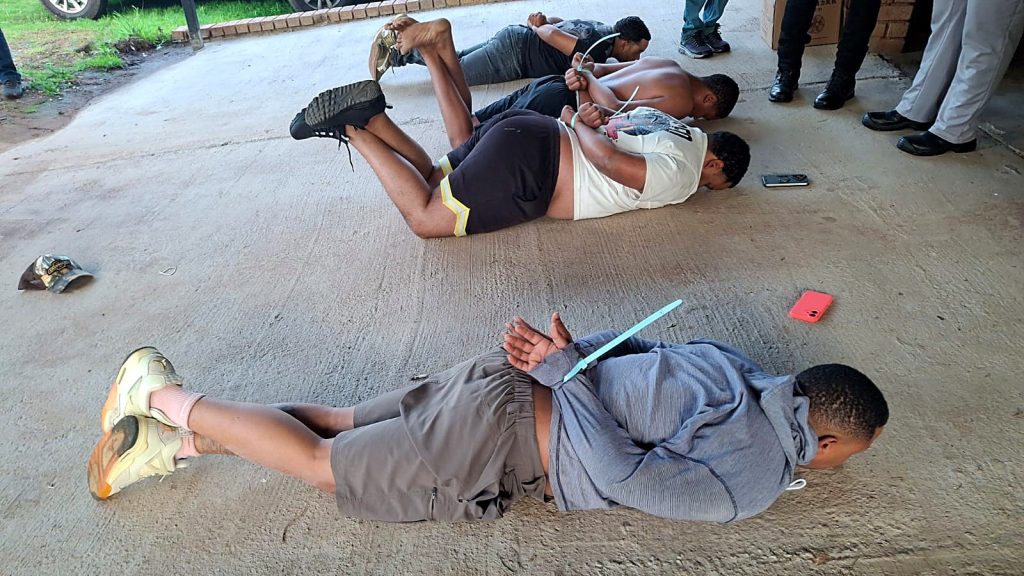
The Hawks’ South African Narcotics Enforcement Bureau led the Hekpoort operation with SAPS Crime Intelligence, the Special Task Force and the West Rand K9 Unit. Police reported finding Mandrax and ecstasy tablets on the property and arrested five South African men aged between 21 and 44.
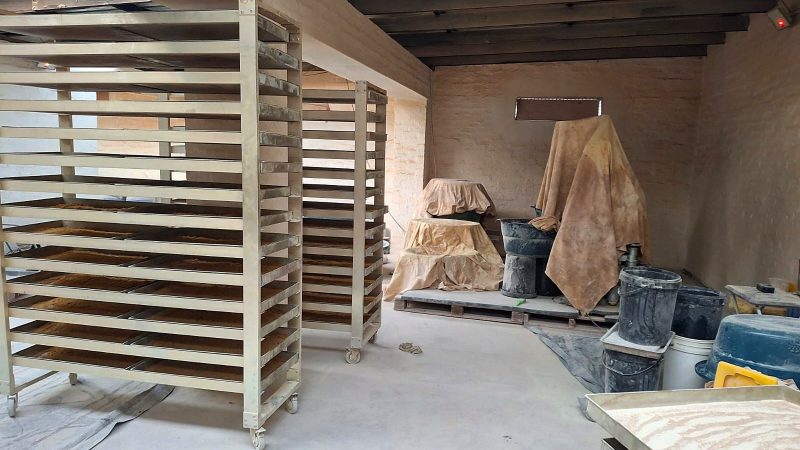
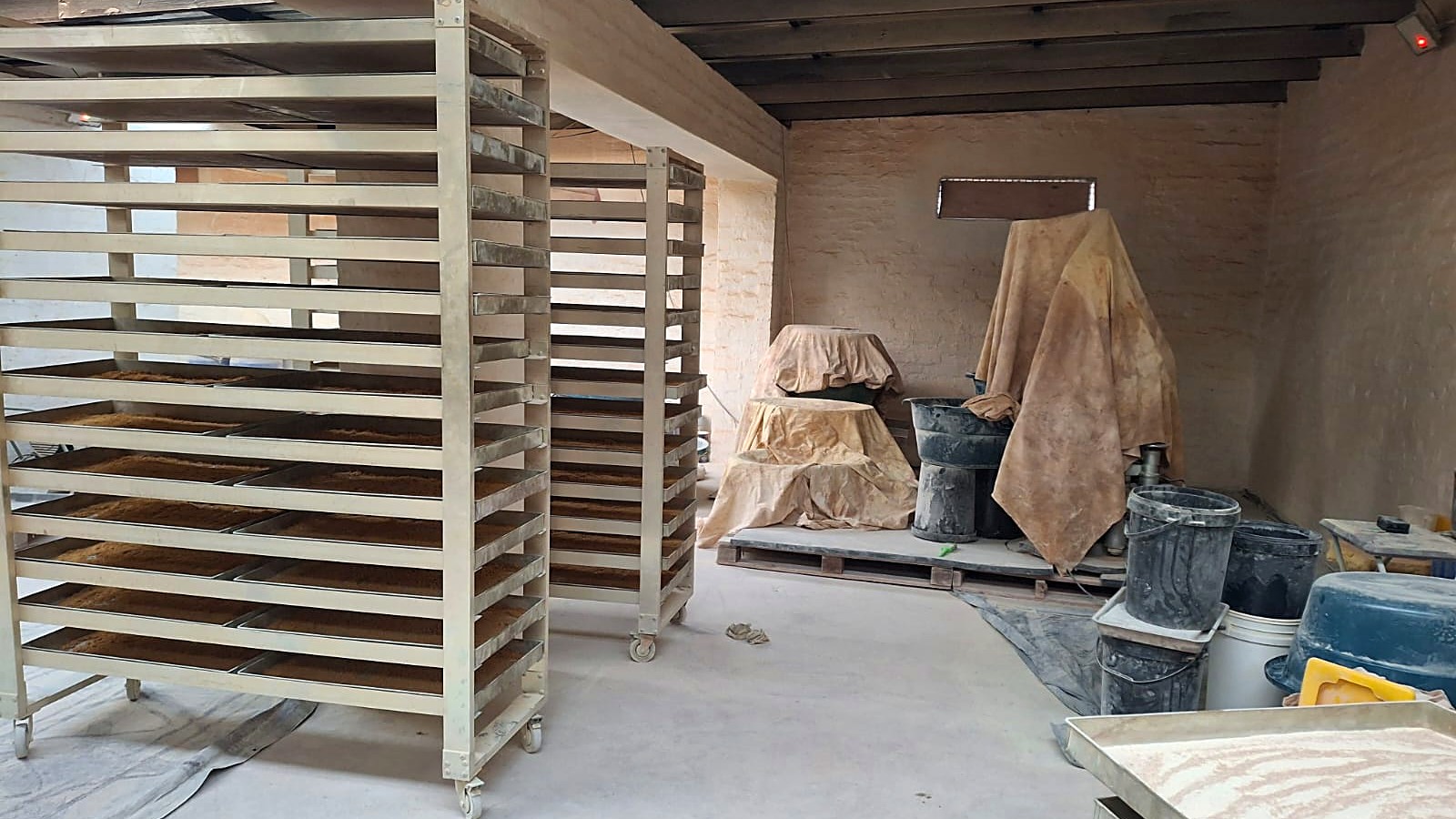
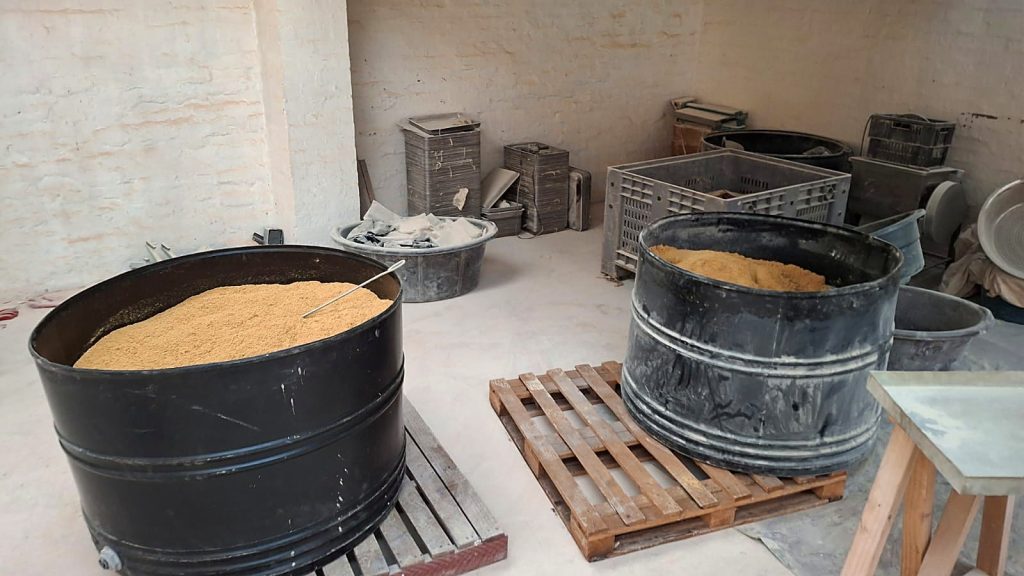
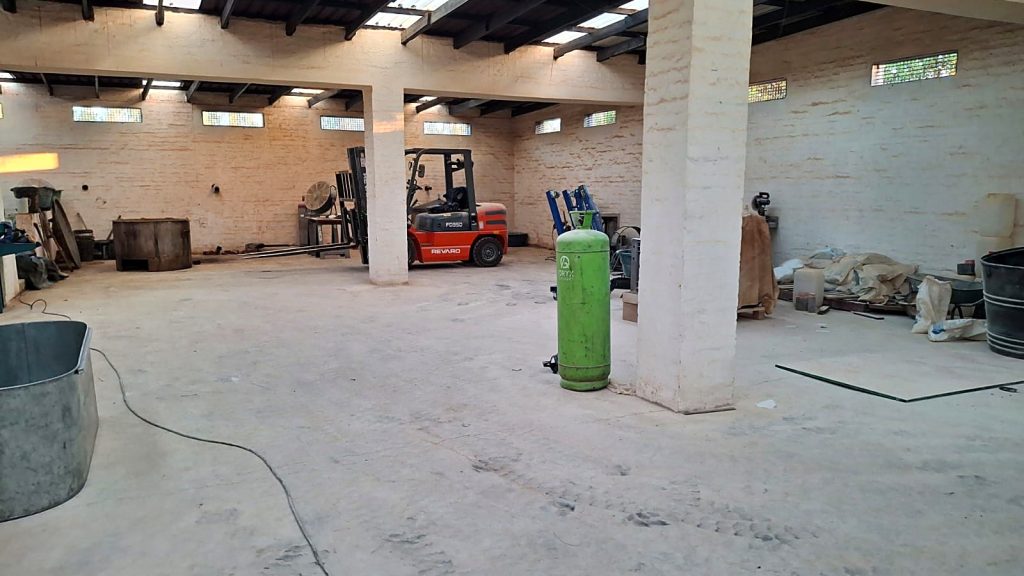
Police pictures taken at the farm shortly after 6am on 8 October show a large shed fitted out for production: rows of steel drying racks on wheels loaded with trays, open drums filled with a yellow-brown granular substance, sacks, a gas cylinder and a forklift.
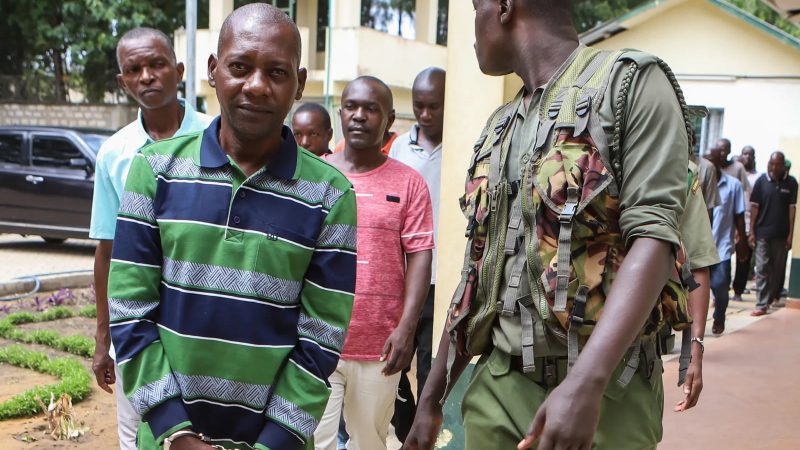
The five accused, Trent Coetzer, 36, Nakedi Makwesi, 44, Evan-Lee Mohapi, 25, Donell Coetzer, 28, and Lyle Johnson, 21, appeared in the Krugersdorp Magistrate’s Court on Monday, 12 October, on charges related to the manufacture of and dealing in drugs. They have not pleaded, and they are presumed innocent.
“The matter was postponed to 21 October 2026 for the verification of the accused’s residential addresses,” NPA spokesperson Magaboke Mohlatlole told EWN. “All five accused remain in custody.”
The African Chronicle could not establish the outcome of the 21 October proceedings by Thursday.
EWN reported on the day of the raid that the suspects were allegedly renting the premises and that the property’s owner was also set to face criminal charges. No charge against an owner had been publicly confirmed by Thursday.
Hawks spokesperson Colonel Katlego Mogale said the bureau was trying to trace the people and the chemicals behind the operation, and who owned the land. “SANEB is working around the clock to connect as to where do these people come from,” Mogale told EWN.
Gauteng police commissioner Tommy Mthombeni told EWN that investigators were working with international counterparts to establish whether the drugs were meant for local or overseas buyers. That question sits at the centre of every raid in this review. The production site is only one part of the business.
The Hartbeespoort case is at an earlier stage. Police arrested three women and a man and seized processed drugs, a drug production mixture and manufacturing equipment, along with the four firearms. They face charges under the Drugs and Drug Trafficking Act and for possessing unlicensed firearms and ammunition, and were due to appear in the Brits Magistrate’s Court.
“Police investigations into the matter and to determine the value of the seized drugs are continuing,” the Hartbeespoortdam police said.
In Soweto, Gauteng police spokesperson Brenda Muridili described what officers found as a household business. “It’s a family house, and then we know that all the people that have been arrested are related to one another,” she told EWN. “It is a family house, they are conducting this drug manufacturing behind the main house.”
The factories behind five years of raids
The manufacturing cases range from rooms behind suburban houses to industrial-scale operations on rural farms. The problem predates the recent prominence of Mexican nationals in methamphetamine investigations.
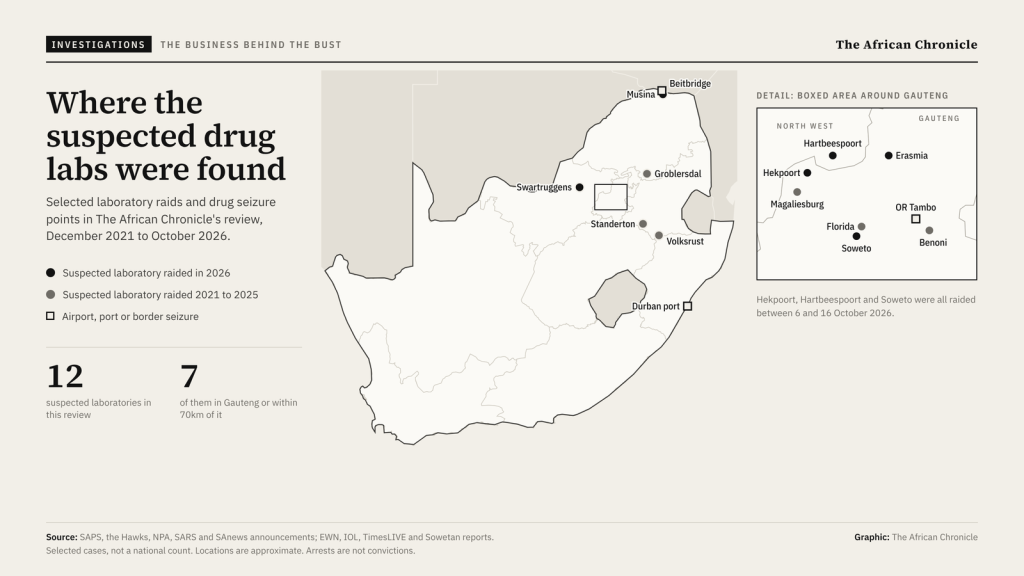
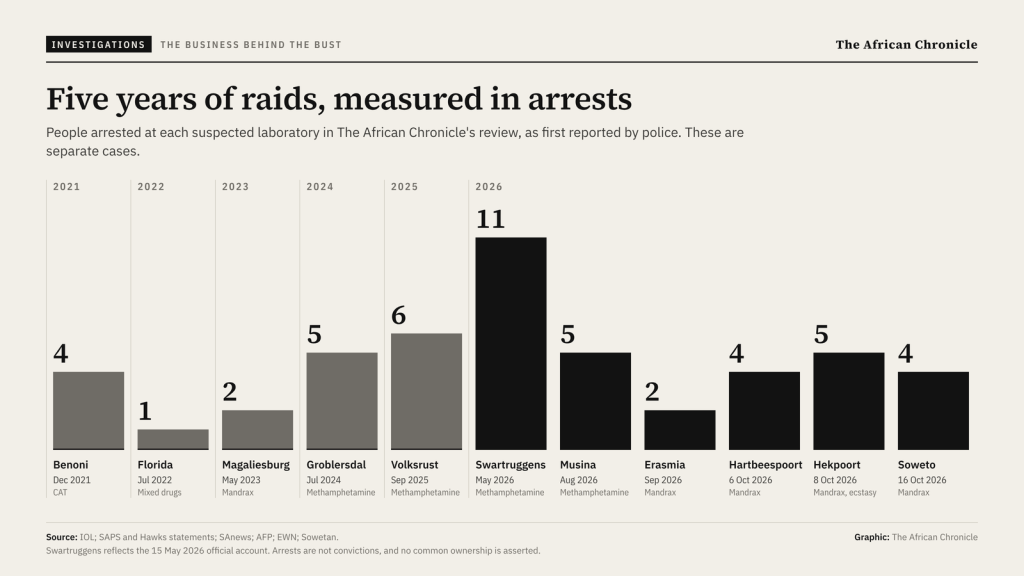
In December 2021, the Hawks arrested four men at a suspected laboratory in Benoni’s Lakefield area. Officers reported suspected CAT, a street name for methcathinone, valued at about R3 million, and seized equipment, chemicals and two vehicles.
In July 2022, police arrested a woman at a property in Florida, on the West Rand, where they reported manufacturing equipment, crystal meth, cannabis oil and mushroom products.
A May 2023 raid in rural Magaliesburg was more revealing about distribution. The Hawks said it followed an investigation into drugs supplied to the Western Cape. Two suspects were arrested, and police reported Mandrax tablets, manufacturing material and equipment with an estimated combined value of R150 million.
On 19 July 2024, police raided a Groblersdal farm and announced a laboratory and material valued at an estimated R2 billion. Four suspects were arrested at first, including the farm owner and two Mexican nationals. The Hawks reported a fifth arrest on 22 July.
In September 2025, police uncovered a suspected laboratory near Volksrust. Six people were arrested: five Mexican nationals and a South African described by the Hawks as the farm’s caretaker. An October update said the five Mexicans had abandoned their bail applications and the caretaker had been granted R50,000 bail.
The pattern continued in 2026. Eleven people were arrested at a suspected methamphetamine laboratory in Swartruggens on 13 May. In its 15 May account, the Hawks reported about 481kg of methamphetamine and an estimated laboratory value of more than R1 billion. Those were police estimates made while the scene was still being processed.
On 20 August, a raid near Musina led to five arrests, including two Mexican nationals, two Zimbabweans and a Malawian. Authorities put the drugs and equipment at about R600 million. In September, officers found a suspected Mandrax operation in Erasmia, west of Pretoria, and arrested two foreign nationals.
These discoveries establish repeated suspected manufacturing across several provinces. They do not establish that every site belonged to one organisation, or that every person found at a site played the same role.
From an inland laboratory to a distant market
The Magaliesburg investigation supplies an important clue: police linked an inland Mandrax operation to supply in the Western Cape. A raid address is a starting point for following distribution, not a boundary around the market it serves.
Magaliesburg, Florida, Erasmia, Hartbeespoort, Hekpoort and now Soweto put repeated suspected manufacturing in and around Gauteng. That proximity warrants a comparison of suppliers, vehicles, phones and money transfers. It does not establish that the sites were controlled by one organisation.
The border provides a view of the inputs. On 27 May 2026, authorities intercepted a truck travelling from Malawi through Zimbabwe at Beitbridge. They reported about 713kg of methaqualone, the drug in Mandrax tablets, and arrested three people. The official announcement said investigators were still establishing the consignment’s destination and any wider network.
That seizure is evidence of an alleged regional supply route. It is not evidence that the consignment belonged to any particular South African laboratory.
The Mexican question and the local partners
The international dimension deserves scrutiny, but nationality alone cannot prove cartel membership or responsibility for a particular task.
The Volksrust announcement identified an alleged local caretaker. Groblersdal involved a farm owner. The Swartruggens accused included South Africans and nationals of several other countries. The Hekpoort accused are all South African. These accounts raise questions about how production sites obtain property, labour and logistical support.
ALSO READ: Brazilian National Nabbed in R8.7 Million Cocaine Bust at OR Tambo
Julian Rademeyer, a senior adviser to the Global Initiative Against Transnational Organised Crime (GI-TOC), told TimesLIVE in August that investigators had described a pattern of Mexican technical specialists working alongside local or regional participants who supplied premises, transport, labour and cover. That is an expert assessment, not a court finding against any accused.
GI-TOC analyst Michael McLaggan told EWN on 7 October that South Africa was emerging as a production base for high-quality methamphetamine destined for more lucrative markets, including Australia and New Zealand. He also warned that domestic supply continued despite the raids.
The question is wider than who was standing beside a machine when police arrived. Investigators need to establish who paid for the operation, arranged the premises, controlled distribution and received the proceeds.
Trafficking arrests show how the product moves
Manufacturing cases show where some drugs originate. Trafficking investigations show how consignments enter, cross or leave the country, and who allegedly helps move them.
In November 2021, the Hawks arrested a man after monitoring a consignment near Kempton Park that allegedly contained 11.6kg of crystal meth destined for Australia.
In August 2022, the Hawks announced three arrests linked to a large cocaine consignment transported towards Cape Town, concealed in wooden boards. The police estimate exceeded R400 million. That case produced documented convictions. In October 2023, the Hawks reported that Meshack Mzungezi Ngobese and Elias Radebe had entered plea agreements and received effective prison terms of six years and one year respectively.
Those convictions show punishment in one distribution case. They do not supply a national conviction rate for trafficking arrests.
Beyond the mule: access, recruitment and cargo
One of the most instructive cases involved allegations that workers used legitimate access at OR Tambo International Airport to help move cocaine abroad.
An Australian Federal Police (AFP) statement said Operation Lucian began after an airline reported suspicious activity near the cargo area of a Sydney-bound flight in Johannesburg. Australian investigators later intercepted 100kg of cocaine and arrested five men in Sydney. Evidence shared through the AFP’s Pretoria liaison office helped South African investigators arrest five men on 15 November 2023. The AFP alleged that their jobs with aircraft logistics providers gave them access to restricted airside areas.
There is an inconsistency in the public record. The Hawks’ 17 November 2023 statement described five bags of 100kg each, while the Australian account put the total at 100kg. The two agencies have not publicly reconciled the figures.
In October 2024, SAPS announced its fourteenth airport courier arrest in a matter of weeks. That was an account of interceptions, not of fourteen convictions or fourteen dismantled syndicates.
A December 2025 NPA announcement offers a completed prosecution: Vuyisekha Miranda Mzwakhe received 15 years for drug dealing, and Victor Ikechukwu Udoh received 20 years for dealing plus two years for an immigration offence. The NPA described evidence that couriers were recruited through social media.
Arresting a courier interrupts a journey. The recruitment evidence shows why investigators must also establish who arranged the journey, gave the instructions and stood to profit.
The cargo routes remain active
On 25 August 2026, SARS announced the interception of more than 333kg of cocaine from a flight arriving at OR Tambo from São Paulo. Officials found 83.10kg in two suitcases and another 250kg in four boxes of unmanifested cargo. Both consignments carried similar branding.
Durban’s port was also in use. SARS reported on 9 June that officials had seized 30 bricks of cocaine from a vessel arriving from South America, three days after about 90kg was found hidden in excavators from Brazil.
These cases show criminals exploiting ordinary trade and travel channels. They also show detection capacity, through profiling, inspections and detector dogs. They cannot tell us how much passed undetected.
What SARS says happens after a seizure
SARS replied to The African Chronicle’s questions in writing on Friday, 16 October. It said it worked with law enforcement and border management partners to detect and prevent the cross-border movement of illicit goods, including narcotics.
The revenue service declined to disclose its risk assessment methods, intelligence capabilities, enforcement strategies or information about past and present investigations, citing the need to protect the integrity of its operations.
It set out where its role ends and the criminal investigation begins: “As per the SARS legislative framework, all detections and crime scenes are handed over to SAPS for extraction, forensic analysis and further investigations leading up to prosecutions.”
SARS referred further questions to the SAPS communications team and said it would communicate significant seizures and enforcement outcomes “where operationally appropriate”.
The response explains the handover after a customs detection. It does not provide case-by-case arrest, prosecution or conviction outcomes. Following a shipment from interception to the people behind it requires answers from the police and prosecutors.
The questions that went unanswered
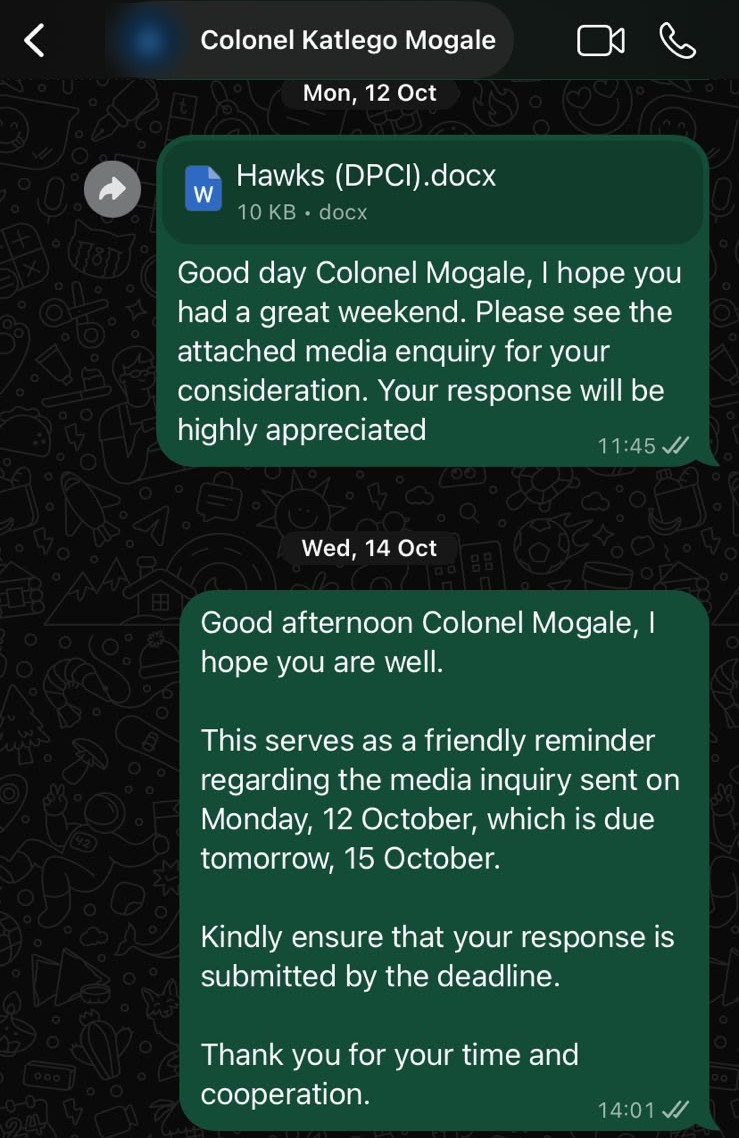
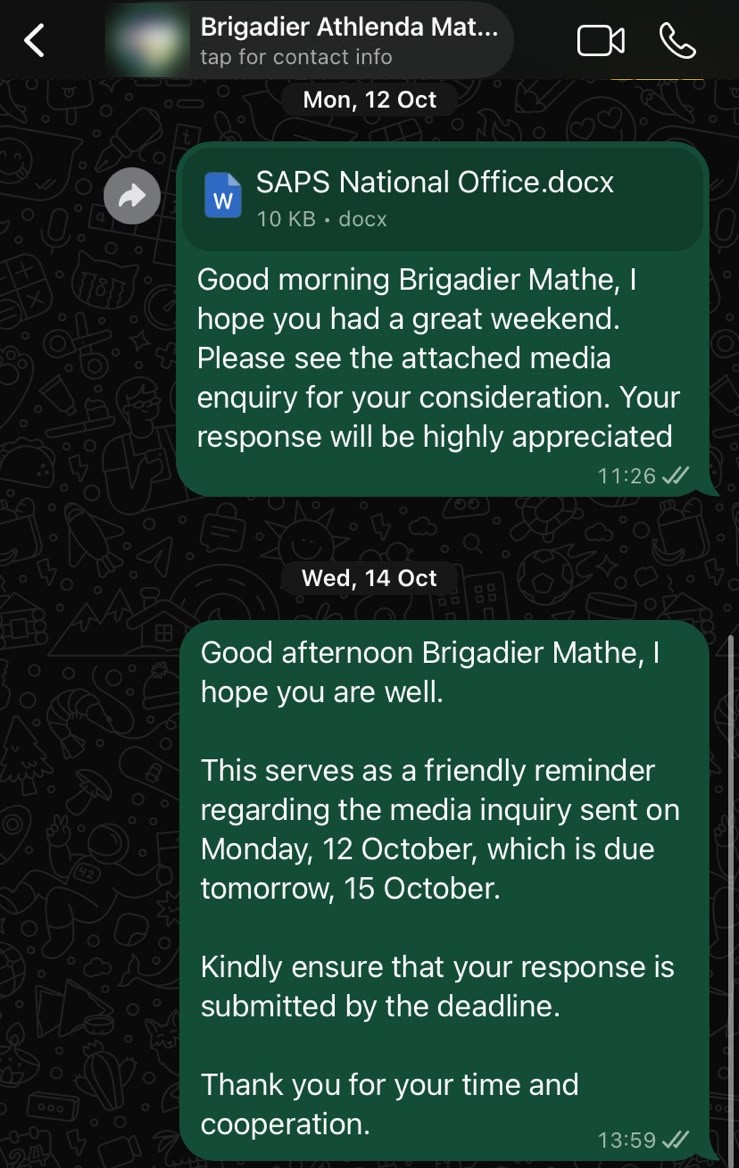
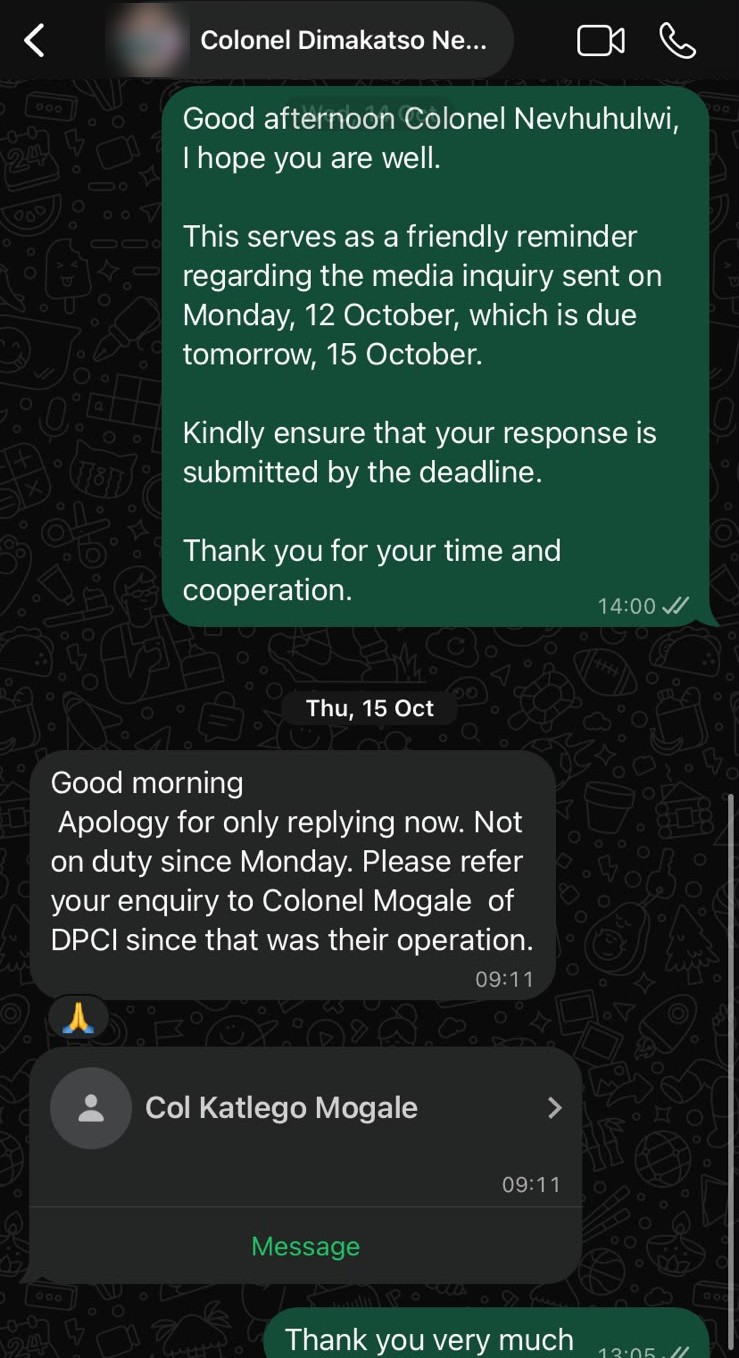
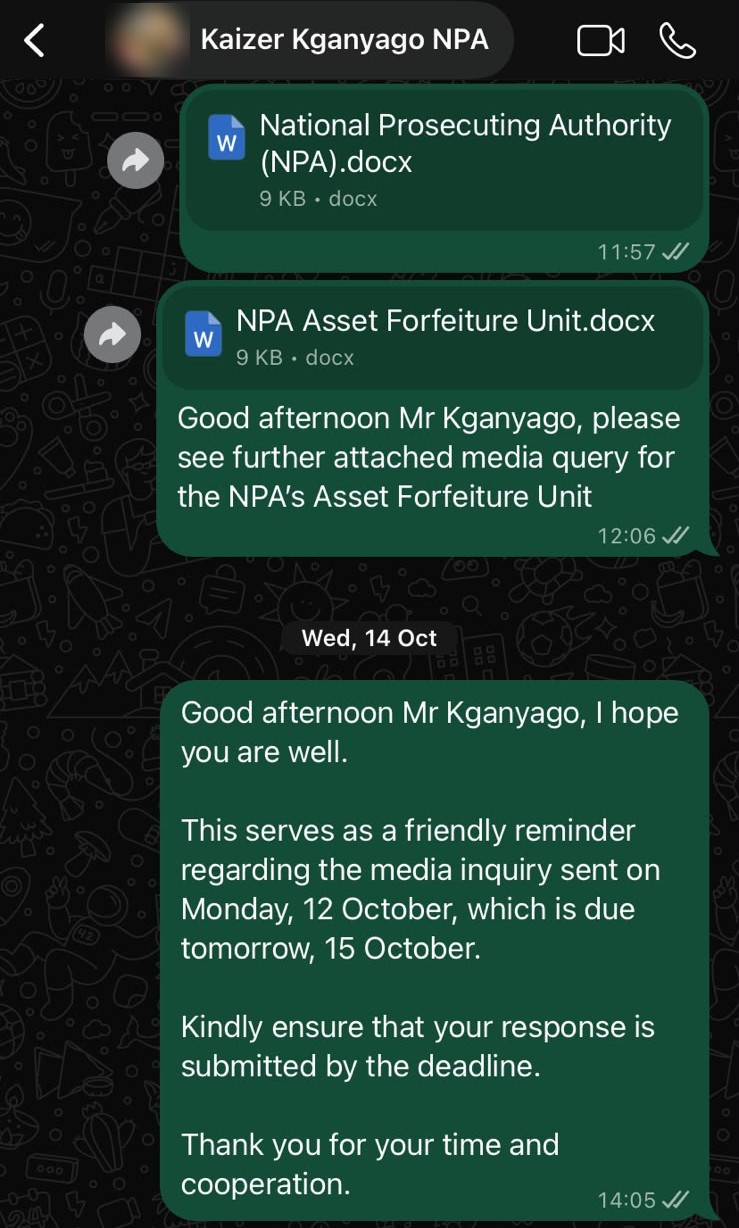
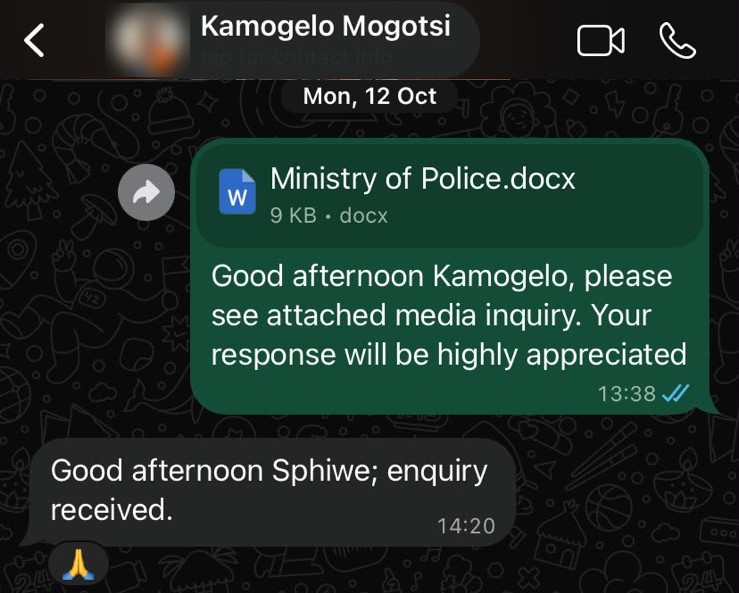
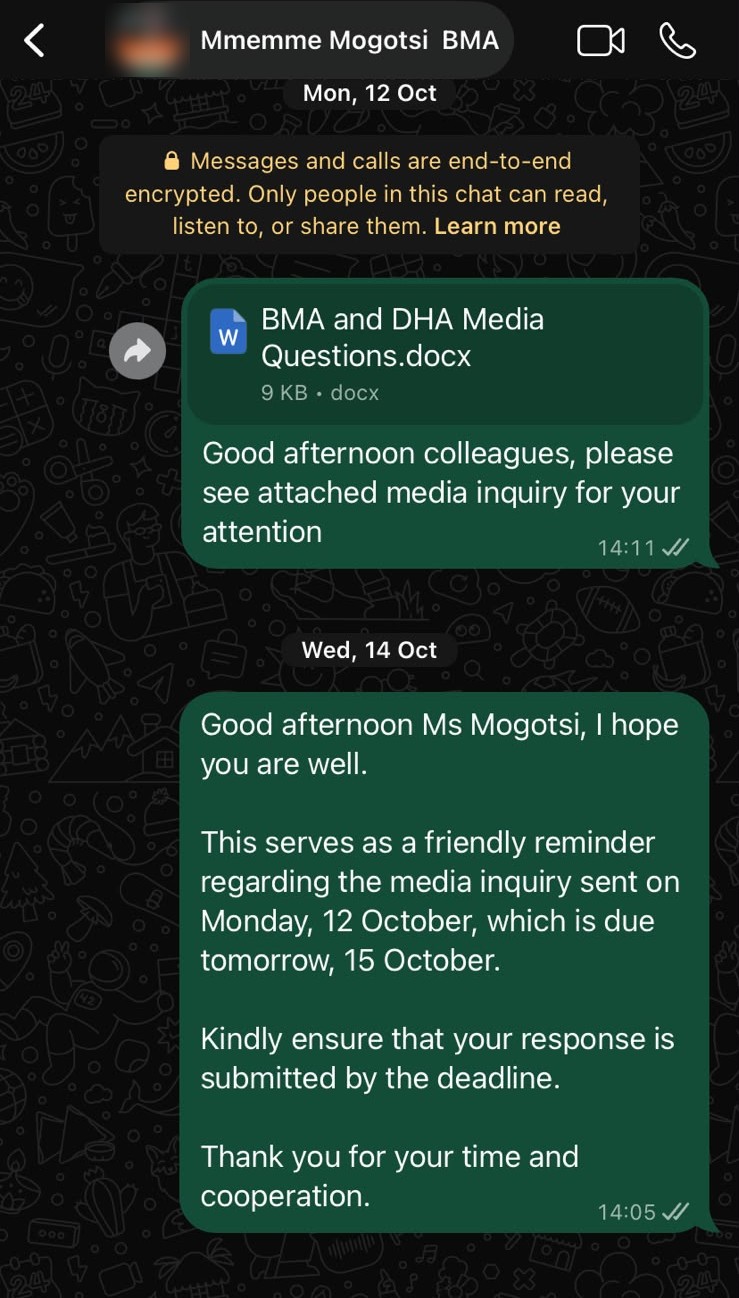
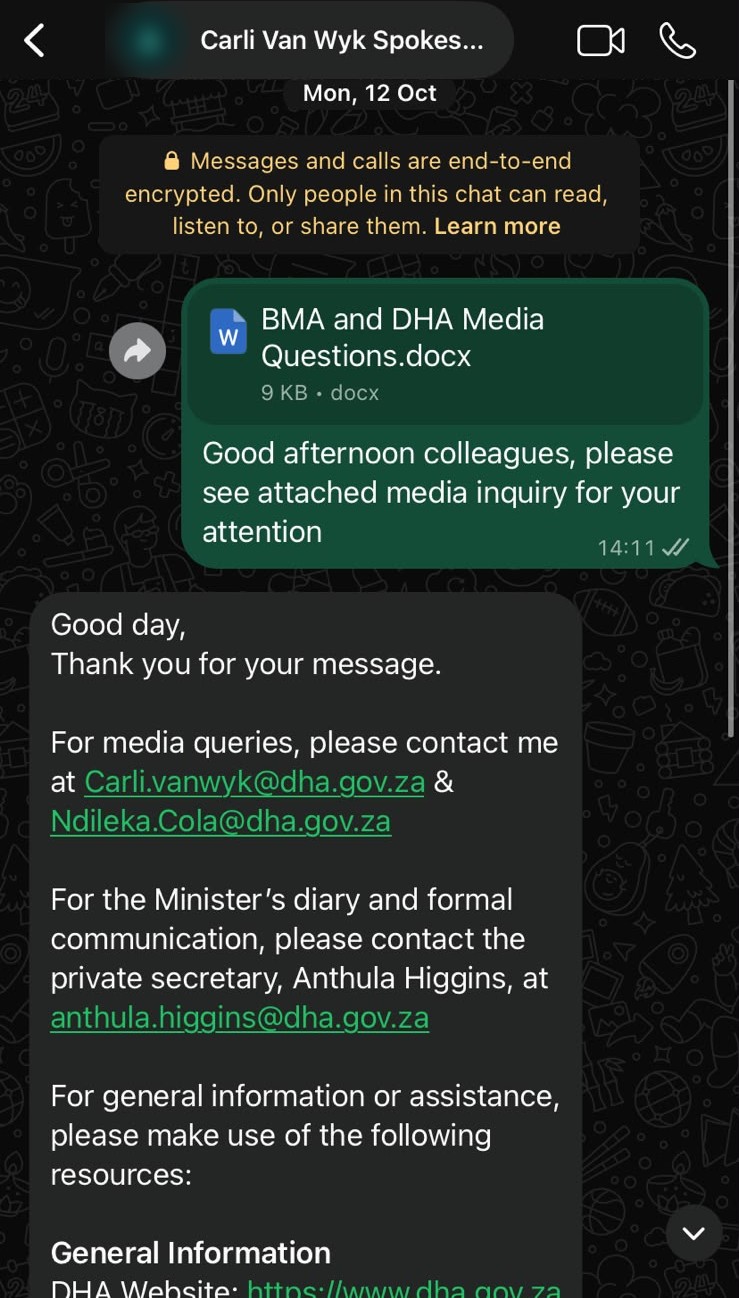
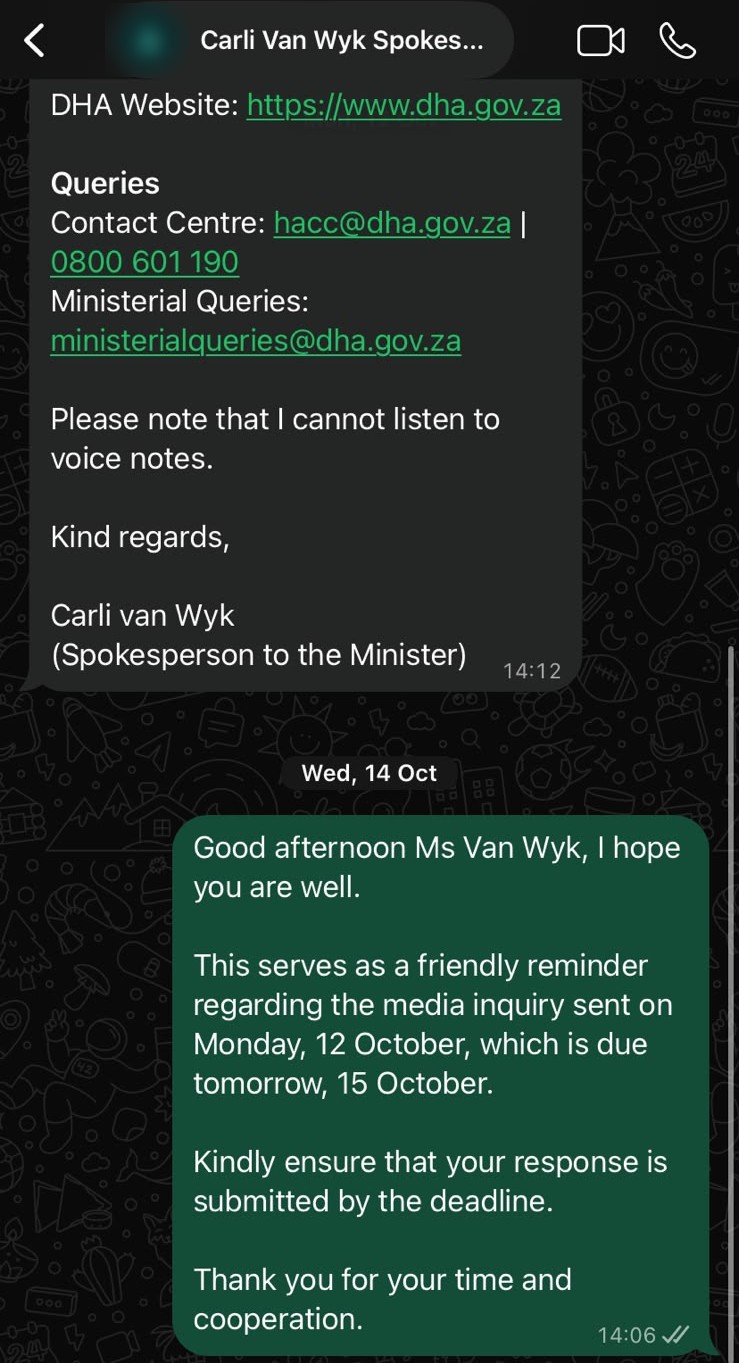
On Monday, 12 October, The African Chronicle sent written questions to SAPS national spokesperson Brigadier Athlenda Mathe, Gauteng police spokesperson Colonel Dimakatso Nevhuhulwi, Hawks spokesperson Colonel Katlego Mogale, NPA spokesperson Kaizer Kganyago, the NPA’s Asset Forfeiture Unit, the Ministry of Police through Kamogelo Mogotsi, Mmemme Mogotsi at the Border Management Authority and Carli van Wyk, spokesperson to the Minister of Home Affairs. Each was asked to respond by Thursday, 15 October.
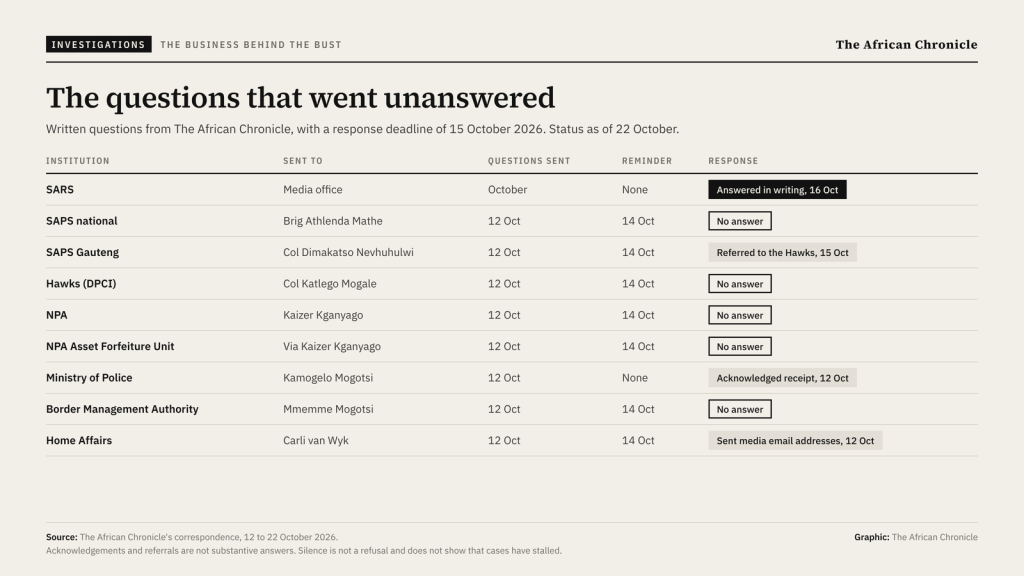
The Ministry of Police acknowledged receipt the same afternoon. Van Wyk’s office replied with the email addresses to which media queries should be sent. Reminders went to SAPS nationally and in Gauteng, the Hawks, the NPA, the Border Management Authority and Home Affairs on Wednesday, 14 October.
Colonel Nevhuhulwi replied on 15 October and referred the questions to the Hawks’ Colonel Mogale, “since that was their operation”. Mogale had received the same questions on 12 October.
The questions concerned the outcomes of the laboratory and trafficking cases in this review, the basis for official valuations, asset forfeiture and any evidence linking the sites.
By Thursday, 22 October, ten days after the questions were sent, none of these bodies had provided a substantive answer. Their silence does not establish that investigations have stalled or that prosecutions have failed. It does mean that the questions at the heart of this investigation remain unanswered by those responsible for answering them.
What the laboratory totals actually measure
The SAPS annual reports record 23 clandestine laboratories dismantled in 2021/22, 28 in 2022/23, 20 in 2023/24 and 18 in 2024/25. Together, those four years account for 89 recorded dismantlings and 172 associated arrests. These are sums of annual figures, not a count of unique offenders or convictions.
SAPS includes hydroponic cannabis facilities in this category, so the total cannot be presented as 89 methamphetamine or Mandrax factories.
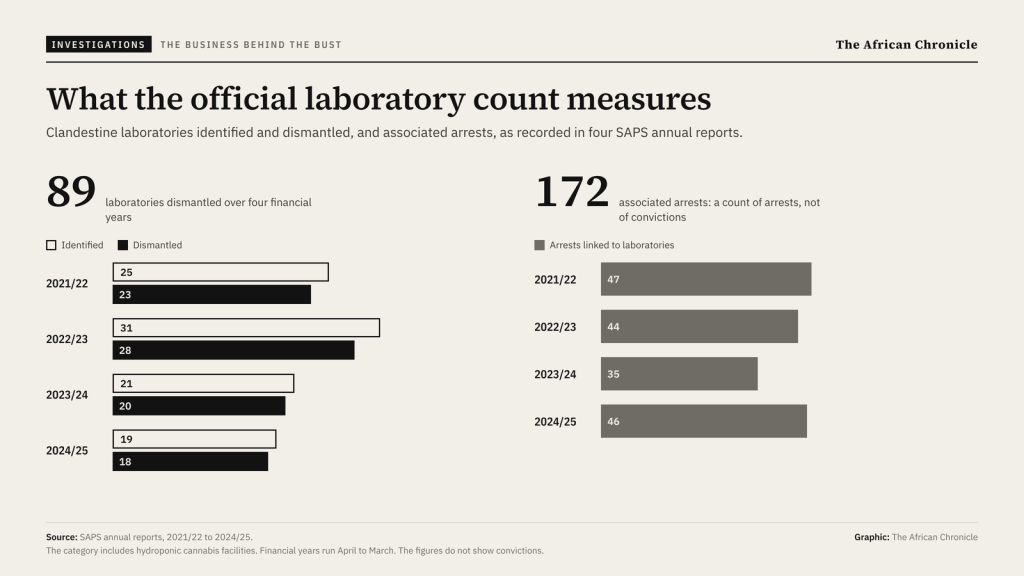
The denominator matters as much. In 2024/25, SAPS reported dismantling 18 of 19 identified laboratories, or 94.74%. That measures what happened to known sites. It does not mean police found or closed 94.74% of all clandestine laboratories in the country.
For 2026, the Hawks’ count of 11 laboratories found by 8 October was given before the Soweto discovery. It is a calendar-year figure and cannot be compared directly with the financial-year series.
When a billion-rand headline meets the court record
The Beitbridge case exposes a second measurement problem. Authorities announced an estimated street value of R998.2 million for the 713kg consignment. EWN’s report on the three accused’s appearance in the Musina Magistrate’s Court on 29 May put the value stated in court at about R34 million.
ALSO READ: Five arrested as police uncover Krugersdorp farm drug lab
Those figures describe the same seizure but differ by a factor of about 29. The discrepancy needs a documented explanation from the Border Management Authority and prosecutors.
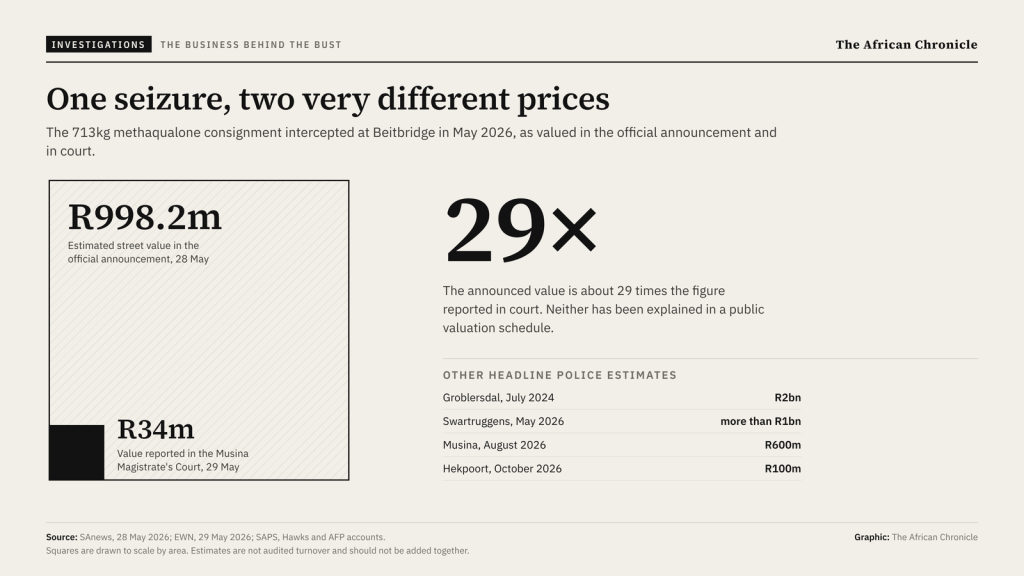
Valuations may refer to finished drugs, bulk material, equipment or projected production. Wholesale and retail assumptions produce very different estimates. For that reason, the R2 billion announced at Groblersdal, the more than R1 billion at Swartruggens, the R600 million at Musina and the R100 million at Hekpoort should not be added together as a measure of the drug economy. They are agency estimates for different raids, not audited turnover.
A defensible announcement would separate the laboratory-confirmed weight of a substance from its estimated value, and equipment from finished product. The public should be able to follow the calculation from the scene to the courtroom.
Where the arrest numbers point
The wider arrest figures show how heavily enforcement falls on possession. At the release of the April to June 2026 crime statistics, acting national police commissioner Puleng Dimpane reported 29,548 arrests for possession of drugs and 4,594 for dealing. That is about 6.4 possession arrests for every dealing arrest.
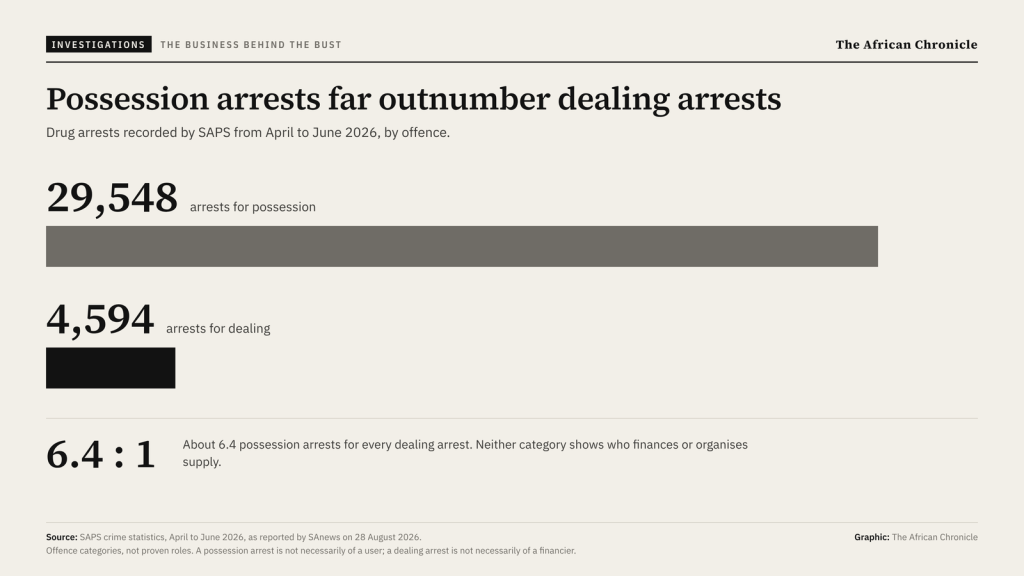
A possession arrest cannot automatically be described as the arrest of a user, and a dealing arrest cannot automatically be described as the arrest of a financier. Even so, the imbalance raises a question about priorities: how much investigative effort reaches the people arranging supply, controlling distribution and receiving payment? The published totals do not answer it.
Follow the properties, vehicles and money
A recent Standerton case gives a more detailed view of alleged criminal infrastructure than a single raid photograph.
The NPA announced on 2 October that the Middelburg High Court had granted an asset-preservation order on 28 September. It covered a farm, two residential properties, twelve vehicles, more than R3.1 million in cash and equipment allegedly linked to a Mandrax manufacturing operation, with the targeted assets put at about R178.6 million. The NPA also reported forensic confirmation of methaqualone in seized exhibits.
A preservation order freezes property while the legal process continues. It is not a criminal conviction or proof that the assets will be finally forfeited.
In the Groblersdal matter, Sowetan reported in November 2025 that the NPA had obtained a forfeiture order for the farm and planned to auction it. That was an announced asset-recovery step. It does not establish the eventual sale price or a criminal verdict.
The case after the cameras leave
In September 2026, the Hawks were reported to be looking for Cardoso Missuque after he allegedly failed to attend the Standerton Regional Court in July while out on bail. The report linked him to the April 2025 Rooikoppen laboratory case. His alleged absence does not establish guilt, but it shows why tracking court attendance is part of tracking what a raid achieved.
The legal handling of evidence can be decisive. On 26 May 2025, the Supreme Court of Appeal ruled in Director of Public Prosecutions v Molefe and Another, a laboratory prosecution arising from a June 2016 raid in De Deur, where drugs and equipment were valued at about R26 million.
Lower courts had excluded the evidence because the search warrant contained an incorrect address and did not name the officers authorised to search, which led to acquittals. The SCA held that exclusion was not automatic, found the evidence admissible, set aside the acquittals and sent the case back for trial. Nine years after the raid, the case had still not reached a verdict.
SAPS itself acknowledged in its 2023/24 annual report that organised-crime work was hampered by staff shortages, reliance on detectives trained for routine investigations and budget constraints.
Seized drugs still need to be protected
Enforcement does not end when a consignment enters police custody. In May 2026, Hawks organised-crime head Hendrik Flynn testified at the Madlanga Commission, the judicial inquiry into allegations of criminality and political interference in the criminal justice system, about the alleged theft of 541kg of cocaine from Hawks offices in Port Shepstone. Those were allegations before an inquiry, not a final finding against any individual.
On the day of the Hekpoort raid, the Activists and Citizens Forum welcomed the recent busts and raised the same concern. “We urge the police leadership to make sure that these drugs must not be stolen again by corrupt police officers,” the forum’s spokesperson, Dennis Bloem, said in a statement.
The forum also claimed that “most of the corrupt senior police officers who were exposed at the Madlanga Commission are either fired from the police or face serious charges in court”. The African Chronicle has not verified that claim.
“The drug problem in the country is very serious, especially among the youth. It destroys the future of the youth and destroys families,” Bloem said. The forum called on the courts not to grant bail to anyone facing drug-dealing charges. Bail decisions remain for the courts, based on the facts of each case.
Secure storage, access records, verified exhibit quantities and a reliable chain of custody protect both the prosecution and the public from seized drugs finding their way back onto the streets.
A regional response
On Friday, 16 October, SAPS announced that Angola and Uganda had joined South Africa, Mozambique and Tanzania in the Trilateral Planning Cell, a regional mechanism set up in Maputo in 2019, with the support of the United Nations Office on Drugs and Crime, to target drug trafficking along the so-called Southern Route.
The ministers met in Pretoria under the theme “Strengthening Transnational Coordination to Better Identify External Factors Contributing to Organised Crime in the Trilateral States”. SAPS said the mechanism had already recorded successes, including the discovery of clandestine laboratories, seizures of drug consignments and arrests.
“The expansion of the Trilateral Planning Cell demonstrates our collective resolve to confront organised crime through a coordinated regional response,” acting police minister Firoz Cachalia said. “Criminal networks operate across borders, and our law enforcement agencies must be equally connected, responsive and decisive.”
He added: “Through strengthened police-to-police cooperation, intelligence sharing and joint planning, we can improve our ability to identify criminal networks, disrupt their operations and bring those responsible to justice.”
The meeting agreed a new framework for direct police-to-police engagement, faster exchange of intelligence, profiling of trafficking syndicates and better detection at border posts. South Africa and Mozambique also discussed a proposed Regional Joint Counter-Narcotics and Organised Crime Fusion Centre.
The commitment to “bring those responsible to justice” is the measure this investigation applies. Cross-border intelligence can identify networks. Only completed prosecutions and final forfeiture orders show that they have been dismantled.
The market’s human cost
The manufacturing and trafficking cases are one side of the story. Treatment data offer a view of the harm in the communities these markets serve.
The South African Medical Research Council’s SACENDU update for July to December 2025 recorded methamphetamine as the main substance of use in 34% of admissions at participating Western Cape treatment centres, 20% in the Eastern Cape and 18% in Gauteng. These are treatment figures, not the share of residents using the drug, but they show that the consequences reach far beyond the farms where production is detected.
The accountability test for police and prosecutors
The cases point to a practical change in how drug enforcement should be reported. SAPS, the Hawks and the NPA could publish a joint register linking each major laboratory and trafficking case to its court and financial outcome.
For every case, such a register would show the confirmed substance and quantity, the charges and alleged roles, the court stage, any convictions or withdrawals, and the assets preserved, finally forfeited and actually sold. It would separate organisers and financiers from couriers and workers where the evidence supports it.
That would let Parliament and the public judge whether a series of raids had disrupted an enterprise, rather than infer success from a pile of tablets or a total number of arrests. It would also make successful investigations more visible and show where cases stall.
For Hekpoort, Hartbeespoort and Soweto, the questions are concrete. Who owned and rented the properties? Who ordered and paid for the equipment and chemicals? What do forensic tests show about the substances found? Who were the buyers? What evidence connects these operations to the other laboratories found this year?
The guilt or innocence of those arrested in October must be decided in court. For the state, the larger test is whether its investigations reach those who financed, supplied and profited from these operations.
Finding a drug factory is a police breakthrough. Proving that its owners, customers, suppliers and money can no longer keep the business running is the result South Africa needs to be able to measure.