The province’s economy reached R2.4 trillion in 2024, accounting for “R33 out of every R100 the country’s economy produces.”
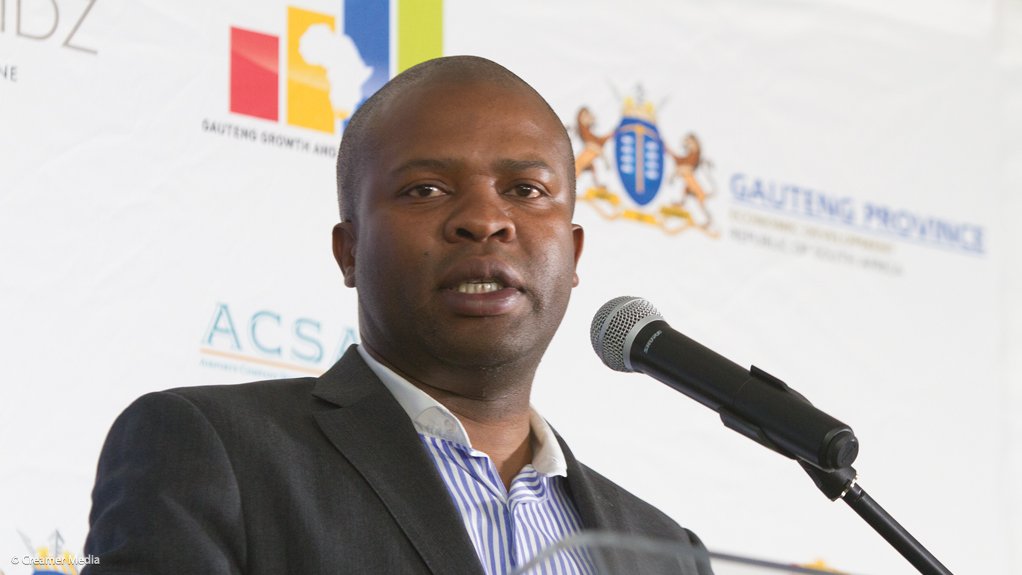
Gauteng MEC for Finance and Economic Development Lebogang Maile has unveiled a sweeping fiscal plan aimed at stabilising the province’s finances, revamping procurement systems, and fast-tracking infrastructure delivery, warning that the province can no longer afford inefficiency or unfunded promises.
Tabling the 2025 Medium-Term Budget Policy Statement (MTBPS) and the provincial Adjustment Budget at the Gauteng Legislature, Maile said the administration was operating in a fragile economic environment where slow growth, high demand for services and constrained budgets were colliding.
“This is the 20th edition of the MTBPS of the Gauteng Provincial Government,” he said, adding that the 7th Administration, under Premier Panyaza Lesufi, was determined to demonstrate fiscal discipline and a renewed commitment to delivery.
A warning on the cost of gender-based violence
Maile opened his address by grounding the budget in a sobering national crisis: gender-based violence and femicide. With the country marking 16 Days of Activism, he noted that GBV carries not only a social cost but a measurable economic one.
“GBV is not only a social, political and public health emergency, it is also an economic crisis,” he said. He cited global research showing that violence against women can drain economies of up to 3.7% of GDP. South Africa, he noted, loses between “0.9 per cent and 1.3 per cent of GDP annually.”
“These figures,” he stressed, “do not take into account other factors that can affect the economy.”
R1bn boost from hosting the G20 Summit
Gauteng’s role in hosting the historic 2025 G20 Summit also featured prominently, with Maile highlighting the event’s direct impact on the provincial economy.
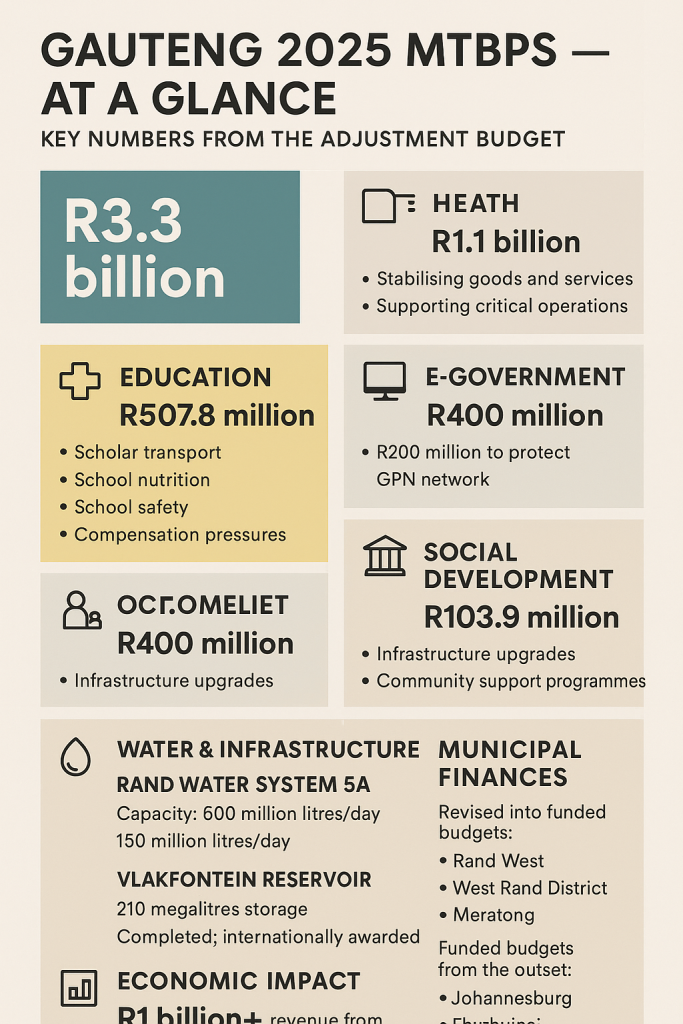
“Early data indicates that the province generated more than R1 billion from hosting the G20 Summit,” he said, adding that Johannesburg, Ekurhuleni and Tshwane had demonstrated “that this province can successfully provide the infrastructure, services and logistics necessary for a global event.”
READ MORE: Bribery in South Africa: law now puts a duty on companies to act
He argued that hosting major international events must now form part of Gauteng’s economic strategy, with targeted investment in conferences and exhibitions likely to “create much-needed jobs for the people of Gauteng.”
Economy stabilising, but growth still too weak
While the global and national economy has steadied after years of shocks, Maile warned that Gauteng’s growth levels remain insufficient to meet the needs of its expanding population.
The province’s economy reached R2.4 trillion in 2024, accounting for “R33 out of every R100 the country’s economy produces.” Gauteng’s economy, he reminded the House, is “larger than the economies of KwaZulu-Natal and the Western Cape combined.”
But growth rates remain too low. As a result, the provincial executive recently approved the Gauteng City Region Economic Growth and Development Plan (GCR EGDP), built on 10 pillars ranging from reindustrialisation and trade promotion to spatial integration and innovation.
“The provincial government is confident that the effective implementation of this strategy will set Gauteng on a positive economic growth path,” he said.
A tight fiscal path – and warnings for municipalities
A major portion of the MTBPS focused on improving financial governance.
Maile confirmed that only three municipalities, Rand West, West Rand District and Merafong, had managed to revise their budgets into funded positions, while several others continued to table unfunded budgets.
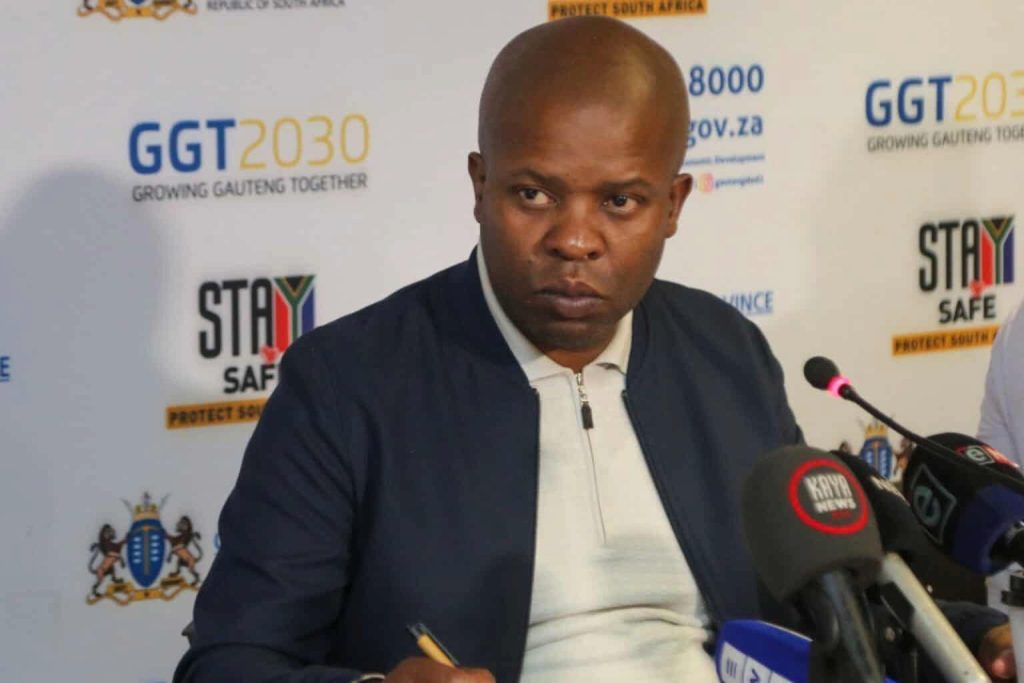
“The implications… cannot be minimised,” he warned. “Unfunded budgets are a primary cause of the non-delivery and deterioration of essential services.”
He commended Johannesburg, Ekurhuleni, Tshwane, Midvaal and Mogale City for tabling funded budgets from the outset.
R3.3bn in adjustments – with health and education as top priorities
The Adjustment Budget totals R3.3 billion, incorporating rollovers and new injections.
The biggest allocations include:
- R1.1 billion for the Department of Health, mainly to stabilise goods and services.
- R507.8 million for Education, addressing compensation pressures and supporting scholar transport, nutrition and school safety.
- R400 million for e-Government, including R200 million to prevent Gauteng Provincial Network equipment failures.
- R103.9 million for Social Development, including infrastructure support.
The Office of the Premier receives R40.8 million specifically for outstanding Life Esidimeni compensation claims.
“These allocations,” Maile said, “equip GPG to continue responding to the provincial imperatives underpinning the 2024–2029 MTDP and the G13 priorities.”
Digital overhaul: TendaSwift and automated procurement
One of the sharpest shifts in Gauteng’s fiscal governance is its technological overhaul of procurement.
Maile officially launched TendaSwift, a new e-procurement system developed with the Gautrain Management Agency to replace paper-based tendering.
“This is not merely a technological upgrade,” he said. “It is a strategic intervention aimed at ensuring that every supplier, regardless of size or location, has equal access to opportunities.”
The system, he added, will reduce corruption by ensuring procurement processes are “transparent, traceable, and accountable.”
Complementary reforms include:
- Automation of RFQ and RLS01 processes
- A Market Research Price Data Solution to counter overpricing
- A widely used Invoice Management System, which processed R35.6 billion worth of invoices this year, with “83 per cent paid within 30 days”
These tools, Maile said, illustrate that digital modernisation “goes a long way in enhancing transparency, improving compliance, and driving operational efficiency.”
Water security: Rand Water’s System 5A to ease long-running shortages
Water shortages have triggered wave after wave of frustration in the province this year. Maile framed water security as one of Gauteng’s most urgent infrastructure priorities.
He welcomed Rand Water’s construction of System 5A, a bulk purification facility expected to add 600 million litres a day to the network, with 150 million litres already in use.
READ MORE: Africa nears record $1 trillion in state-owned assets under management
“Of significance about System 5A,” he said, “is that it will ensure that there is enough water in Gauteng and the parts of surrounding provinces… that have been water-stressed for decades.”
He also praised the now-complete 210-megalitre Vlakfontein Reservoir, calling it a “multi-million-rand investment” that has already won international engineering awards.
Maile urged municipalities to fix their own water governance systems, warning that Rand Water’s progress alone will not end the crisis.
In his conclusion, Maile quoted Finance Minister Enoch Godongwana, who recently declared: “We are choosing growth, stability, and reform.”
He said Gauteng shares this approach and must ensure that “every Rand derives tangible value.”
From municipal finances to procurement to water infrastructure, he emphasised that the province has no choice but to operate smarter, faster and more transparently.
“The responsibility for good government,” he reminded the House, repeating the words of public policy scholar Geoff Mulgan, “lies not just with governments themselves but also with every other part of the system they operate in.”