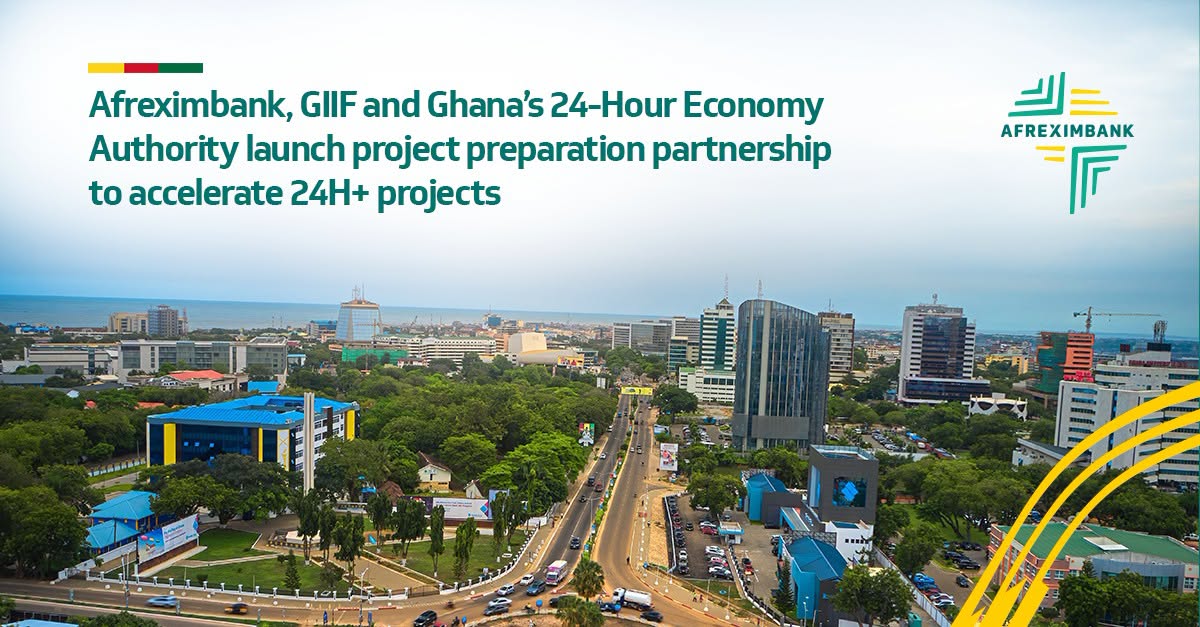
CAIRO, Egypt – Ghana’s push to build an economy that operates around the clock has secured US$10 million to help turn priority development plans into projects investors can finance. The African Export-Import Bank (Afreximbank) and the Ghana Infrastructure Investment Fund (GIIF) will each contribute an initial US$5 million under an agreement signed with Ghana’s 24-Hour Economy Authority in Cairo.
The Joint Project Preparation Facility (JPPF) will support selected projects under the country’s 24-Hour Economy and Accelerated Export Development Programme, known as 24H+. According to the Authority, the wider investment pipeline is valued at about US$11.5 billion.
What the US$10 million facility will finance
The funding will cover the technical, financial, legal and advisory work needed to prepare projects for lenders and investors. Construction will require separate financing. Projects must undergo joint screening and approval by the three institutions before receiving support. The aim is to resolve issues that could prevent otherwise promising proposals from attracting investment, including their commercial structure, financial viability and legal arrangements.
The facility will target energy and infrastructure, logistics and digital connectivity, industrial parks, manufacturing, agro-processing and minerals beneficiation. Tourism, the creative industries and healthcare are also included.For Ghana, the agreement addresses a critical stage in its economic programme: converting development priorities into credible investment proposals.
Afreximbank and GIIF share project preparation roles
Under the agreement, the 24-Hour Economy Authority will identify strategic projects and coordinate the government departments and agencies involved. GIIF will contribute its local project development and infrastructure investment experience, while Afreximbank will provide expertise in preparing projects and mobilising capital.
Kanayo Awani, Afreximbank’s Executive Vice President for Intra-African Trade and Export Development, said the partnership would help turn Ghana’s economic ambitions into investments that expand exports and create jobs. “This JPPF will play a catalytic role in translating Ghana’s 24H+ vision into projects that attract capital, expand exports and create jobs,” she said.
Awani said combining the institutions’ expertise would accelerate priority projects, strengthen Ghana’s project preparation capacity and build a sustained pipeline of investment-ready transactions. She added that the arrangement could provide a model for other African countries. The agreement was signed by Awani on behalf of Afreximbank; GIIF Chief Executive Officer Nana Dwemoh Benneh; and Augustus Obuadum Tanoh, Presidential Adviser on the 24-Hour Economy and Accelerated Export Development, representing the Authority.
Partnership strengthens Ghana’s infrastructure investment capacity
Beyond financing individual projects, the facility will support training, knowledge transfer and staff secondments to strengthen GIIF’s project preparation expertise. Benneh said this institutional support was a significant part of the agreement’s value, giving the fund’s staff access to Afreximbank’s experience in developing projects for investment.“The partnership reinforces GIIF’s role as an infrastructure finance partner to the 24-Hour Economy and strengthens our ability to advance priority projects from concept to investment readiness,” he said.
GIIF was established by an Act of Parliament in 2014 and is wholly owned by the Government of Ghana. Its mandate is to develop and invest in critical infrastructure. The partnership is intended to strengthen the fund’s ability to prepare a continuing flow of projects, alongside the immediate assignments financed through the facility.
Ghana’s 24-hour economy moves towards implementation
The 24-hour economy programme is a central plank of President John Dramani Mahama’s economic agenda. It seeks to expand production, increase exports and create employment through round-the-clock activity in manufacturing, agro-processing, logistics and services.
A key objective is to increase domestic processing and manufacturing so Ghana earns more from its agricultural and mineral resources, while reducing its dependence on imported finished goods.
Mahama signed the 24-Hour Economy Authority Bill into law on 19 February 2026, establishing the body responsible for overseeing the programme. At that signing, he called for a move “from strategy to implementation” and said businesses were waiting for incentives to support investment and employment.
Ghana’s 2026 Budget envisaged drawing on GIIF, the Development Bank of Ghana and private capital to support the programme, intending to keep financing largely off the sovereign balance sheet. That approach makes the quality of project preparation particularly important to attracting investors.
From project preparation to construction and jobs
Tanoh said the new facility would help bridge the gap between Ghana’s development priorities and the capital needed to deliver them.
“The 24H+ Programme is delivered through transformational projects, and a project attracts capital only when it is properly prepared,” he said. He said the Authority would submit priority projects in energy, agro-industry, manufacturing and logistics, with the aim of expanding productive capacity, improving workforce productivity and increasing exports.
“We are confident that, working with Afreximbank and GIIF, we will take them from concept to construction and deliver tangible opportunities for Ghanaians,” Tanoh said. The partners expect the facility to support Ghana’s development as a production and export hub and deepen its participation in the African Continental Free Trade Area.
The immediate task is to prepare selected projects well enough to secure investment. Turning the wider US$11.5 billion pipeline into operating factories, reliable infrastructure and lasting jobs will depend on obtaining the larger financing commitments needed for construction and delivery.