Ghanaian President John Dramani Mahama has renewed his call for greater health and economic self-reliance across the Global South, unveiling a new report in New York that proposes stronger domestic pharmaceutical production, regional supply chains and a rethink of the global health system.
Mahama Launches ‘Sovereign Future’ Health Report, Renews Call for Global South to Break Aid Dependency
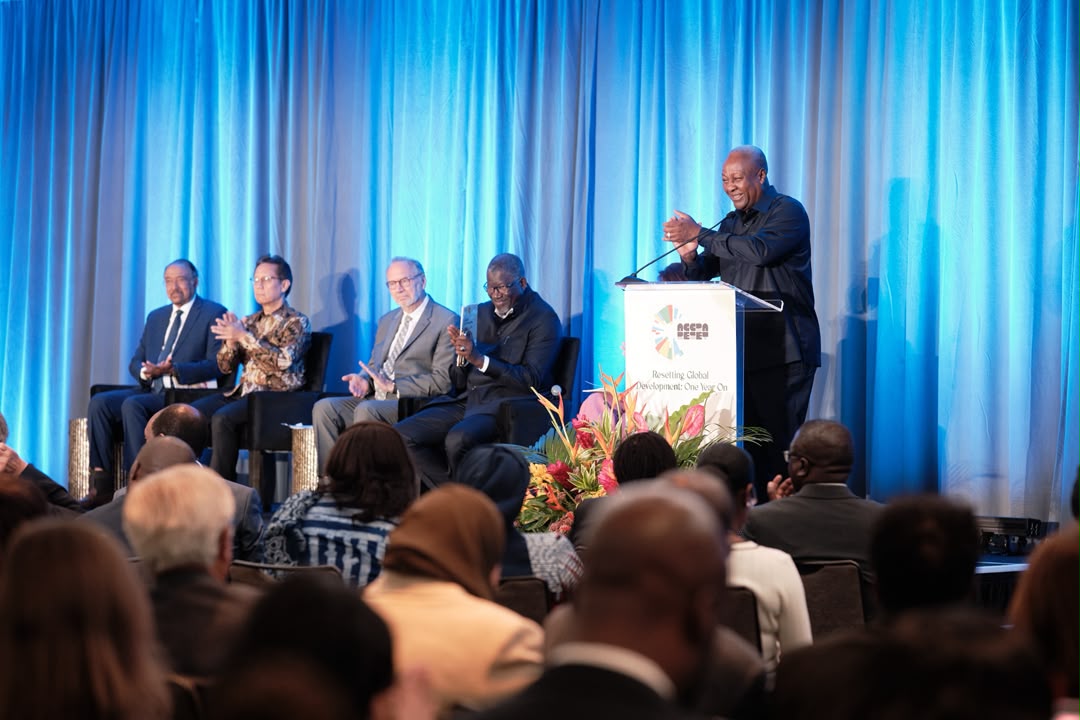
ACCRA/NEW YORK — Ghanaian President John Dramani Mahama has called on developing countries to reduce their dependence on foreign aid, arguing that political independence has not translated into genuine control over the systems that shape health, finance and trade.
Mahama made the remarks in New York at a high-level event marking the first anniversary of his Accra Reset initiative, where he launched a new report titled “A Sovereign Future for Health”.
The report, produced by an Accra Reset panel, sets out a roadmap for greater health sovereignty across the Global South, with a focus on domestic production, stronger regional supply chains and reduced reliance on external funding.
Addressing an audience that included current and former heads of state, senior international officials and business leaders, Mahama said African countries had achieved political independence but remained heavily dependent on institutions and systems shaped outside the continent.
“We won political independence; we raised our national flags and sang our anthems. Yet, the levers of global trade, finance, and health governance remained firmly anchored elsewhere,” he said.
From Accra summit to global health agenda
The Accra Reset emerged from the Africa Health Sovereignty Summit convened by Mahama in Accra in August 2025, following major reductions in US health assistance under the administration of President Donald Trump.
Ghana was among the countries affected by the cuts, with a reported $156 million funding gap emerging across health programmes, including initiatives supported by the US President’s Emergency Plan for AIDS Relief.
The funding disruption prompted the Ghanaian government to look more closely at domestic health financing.
One of its responses was to lift the cap on Ghana’s National Health Insurance Levy and redirect revenue that had previously been diverted to general government expenditure back towards health financing.
Mahama has since presented that approach as an example of the domestic fiscal measures needed to reduce dependence on external assistance.
ALSO READ: Ghana Completes Evacuation Of Nearly 1,900 Citizens From South Africa
The new report takes the Accra Reset beyond its original policy discussions, setting out proposals for implementation.
These include expanding domestic pharmaceutical manufacturing, developing local industrial capacity and establishing state-backed purchasing arrangements to strengthen medicine supply chains across Africa and Asia.
The report also proposes changes to the international health architecture.
According to reporting on its contents, it identifies organisations including the Medicines for Malaria Venture, the Drugs for Neglected Diseases Initiative, the TB Alliance, the International Vaccine Institute and the Coalition for Epidemic Preparedness Innovations for possible restructuring, consolidation or closure.
The proposals signal a broader challenge to how global health institutions are organised and financed, rather than simply calling for increased aid to existing programmes.
Ghana presented as a test case
Mahama pointed to Ghana’s own domestic policies as evidence of the principles underpinning the Accra Reset.
He cited initiatives focused on local value addition, increased healthcare investment and the country’s 24-hour economy policy as examples of efforts to strengthen domestic capacity.
At the same time, he stressed that greater self-reliance should not mean withdrawing from international cooperation.
“Stronger, self-reliant Southern partners are not a threat to the Global North,” Mahama said. “On the contrary, resilient health systems in Africa and Asia make the entire world safer for all of us.”
He described the proposed model as “pragmatic interdependence”, based on more equal relationships between countries and institutions.
Mahama also outlined what he called a new principle for development partnerships: “No ownership without control, and no control without absolute accountability.”
Push for African Union adoption
Mahama said Ghana intends to elevate the Accra Reset when it assumes the African Union chairmanship in 2027.
That could give the initiative a platform beyond Ghana and potentially turn what began as a national and regional response to changes in health financing into a broader continental policy agenda.
The New York launch brought together a high-profile group of political, diplomatic, business and health leaders.
ALSO READ: Ghana’s President Challenges Football Association To Invest In Youth Football
Among those attending or participating were former UK Prime Minister Gordon Brown, former Nigerian President Olusegun Obasanjo, Barbados Prime Minister Mia Mottley, UN Under-Secretary-General Amina Mohammed, Kenyan President William Ruto and businessman Aliko Dangote.
Gavi CEO Sania Nishtar also addressed the gathering, highlighting parallels between the Accra Reset and Gavi’s own reform programme, known as Gavi Leap.
She pointed to efforts to strengthen country ownership and regional leadership, alongside Gavi’s investment in the African Vaccine Manufacturing Accelerator.
Brown praised Mahama and Obasanjo for their leadership on health sovereignty and said the report could contribute to efforts to improve health outcomes across Africa.
The test will be implementation
The ambition of the Accra Reset has nevertheless attracted scrutiny in Ghana, where questions remain about the country’s ability to translate its international agenda into improvements in its own health system.
Critics have pointed to continued resource shortages at some regional hospitals, raising concerns that the initiative’s global ambitions could move faster than the domestic systems it seeks to strengthen.
That creates a central test for the next phase of the Accra Reset: whether greater control over health financing, production and supply chains can ultimately translate into more reliable services for patients.
For Mahama, the initiative is not a call for the Global South to isolate itself from international partners. Instead, he is arguing for a different model of cooperation, one in which African and other developing countries have greater control over the resources, institutions and decisions that shape their health systems.
Subscribe to Our Newsletter
Keep in touch with our news & offers
Thank you for subscribing to the newsletter.
Oops. Something went wrong. Please try again later.