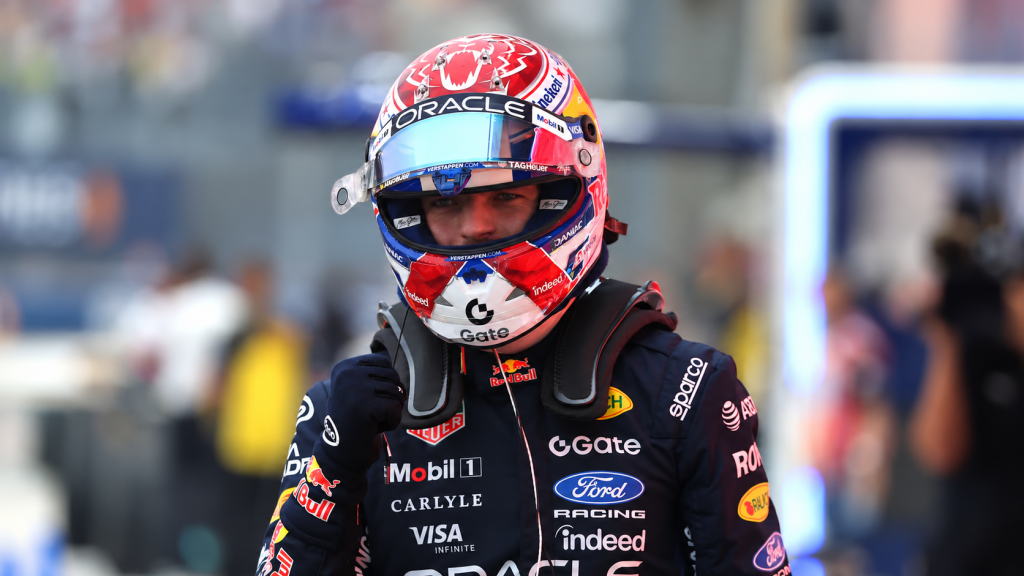
SINGAPORE, Singapore: Max Verstappen won a rain-disrupted Singapore Sprint on Saturday, but the most significant championship gain belonged to Kimi Antonelli, whose fourth place extended his lead over Mercedes teammate George Russell to 89 points after Russell crashed out on the opening lap.
Verstappen finished 2.591 seconds ahead of Ferrari’s Lewis Hamilton, with Charles Leclerc completing the podium. Behind them, a final-lap collision between McLaren teammates Lando Norris and Oscar Piastri changed the points distribution and left the team with one point from a race in which both cars had been running inside the top five.
The result brought together three different stories: Verstappen’s first victory at Marina Bay, Ferrari’s 13-point return and Antonelli’s increasingly strong championship position. McLaren, meanwhile, faced questions about how a late fight between its drivers had undone a promising team result.
Singapore’s first Sprint also provided a sharp illustration of the format’s wider stakes. A short race may offer fewer points than a Grand Prix, but mistakes still carry consequences for the championship and the weekend’s remaining sessions.
Russell Takes The Lead Then Loses It
Heavy rain shortly before the scheduled start delayed proceedings by around half an hour. Conditions varied across the circuit, with some sections soaked and others considerably drier, leaving drivers to judge grip from corner to corner.
All drivers started on intermediate tyres after formation laps behind the Safety Car. Russell then made the better getaway from second on the grid, passing polesitter Verstappen into Turn 1. Hamilton also made a strong start, moving from sixth to third.
Russell’s advantage lasted less than a lap. At the exit of the final corner, he lost control and struck the wall, ending his Sprint and returning the lead to Verstappen.
The incident was particularly costly because Russell needed to close the gap to Antonelli. Instead, he scored nothing while his teammate collected five points.
Verstappen controlled the restart and managed his tyres as the track dried. Hamilton stayed closest, but the Red Bull driver retained enough of a margin to secure the eight points available for victory.
McLaren Turns A Podium Chase Into Damage Control
The decisive late incident came as McLaren’s drivers closed on Leclerc, whose intermediate tyres were deteriorating. Piastri was fourth and Norris fifth, putting both cars in position to challenge for a podium.
ALSO READ: Lando Norris seals F1 world title after tense Abu Dhabi finale
Norris attempted a move at Turn 5 on the final lap. The cars made contact and spun, with Piastri subsequently stopping and Norris recovering to eighth.
The points arithmetic shows the immediate cost. Fourth and fifth would have delivered nine points if those positions had been maintained. Norris’s eighth place yielded one, while Piastri scored none: an eight-point difference between the positions McLaren occupied before the contact and its final return.
That calculation does not assume a podium was guaranteed. It shows how much the team had at stake even without passing Leclerc.
The clash also benefited drivers behind. Antonelli moved into fourth, followed by Liam Lawson, Oliver Bearman and Nico Hulkenberg. The incident therefore affected several teams’ scores, rather than merely rearranging the two McLarens.
The official report records Piastri as classified 14th despite stopping before the finish. That distinction matters: a driver can appear in the classification after completing sufficient distance without reaching the chequered flag.
Ferrari Converts Its Opportunity Into Points
Hamilton’s start laid the foundation for second place. Once Russell retired, the Ferrari driver became Verstappen’s nearest challenger and finished comfortably ahead of Leclerc.
Ferrari’s second and third places produced 13 points, more than any other team earned from the Sprint. Mercedes collected five through Antonelli, Red Bull eight through Verstappen and McLaren one through Norris.
For Ferrari, the result rewarded both the opening-lap opportunity and the ability to keep both cars in scoring positions as conditions changed. Leclerc’s worn tyres left him vulnerable late on, but the McLaren collision removed the immediate threat.
Further down the field, Lawson earned four points for Racing Bulls, Bearman three for Haas and Hulkenberg two for Audi. In a race dominated by the leading teams’ incidents, those returns were important gains in their own right.
Antonelli Benefits Without Winning
Antonelli left the Sprint with 325 championship points, ahead of Russell on 236. Hamilton stood third on 221, followed by Leclerc on 197 and Verstappen on 196.
The Mercedes leader did not need to win to strengthen his position. His closest challenger’s retirement meant that finishing fourth was enough to extend an already substantial advantage by five points.
ALSO READ: Norris won’t ask Piastri to gift him F1 title in Abu Dhabi
Verstappen’s eight-point haul moved him ahead of Norris, who reached 189. The Red Bull driver’s result was a personal milestone at a circuit where he had not previously won, but a Sprint victory remains distinct from winning the Singapore Grand Prix itself.
Verstappen acknowledged that his poor start still needed attention before the main race. His priorities were clear in Formula 1’s post-race report: “I want to win tomorrow, not today.”
Why A Short Race Still Carries A Long Cost
The Sprint covers approximately 100km, around a third of a conventional Grand Prix distance. It awards points to the first eight drivers, from eight for the winner to one for eighth, and has no mandatory pit stop.
Its qualifying session determines the Sprint grid. Separate Grand Prix qualifying sets the starting order for Sunday, so winning the Sprint does not automatically secure pole for the main race.
That separation protects the Grand Prix’s sporting identity, but it cannot eliminate the practical consequences of Saturday’s racing. Teams still have to inspect and repair cars, manage replacement parts and prepare for the next competitive session.
Sprint weekends also provide only one practice session, increasing the importance of arriving with a workable setup. Singapore added changing weather and closely positioned walls to that pressure.
The argument for the format is equally visible: competitive action across the weekend gives spectators more than practice running. Singapore delivered a win, a championship shift and a late team collision before Grand Prix qualifying had even begun.
Formula 1 plans to increase the number of Sprints from six in 2026 to 10 in 2027. That makes the balance between additional competition and additional risk increasingly important.
Marina Bay’s lesson is that Sprint points cannot be treated as a harmless bonus. Verstappen converted control into victory, Ferrari turned opportunity into a strong team score, and Antonelli strengthened his title position by finishing. Russell and McLaren showed how quickly the same opportunity can become a costly setback.
Singapore Sprint Points Finishers
| Position | Driver | Team | Gap | Points |
| 1 | Max Verstappen | Red Bull | Winner | 8 |
| 2 | Lewis Hamilton | Ferrari | 2.591s | 7 |
| 3 | Charles Leclerc | Ferrari | 16.871s | 6 |
| 4 | Kimi Antonelli | Mercedes | 17.238s | 5 |
| 5 | Liam Lawson | Racing Bulls | 20.632s | 4 |
| 6 | Oliver Bearman | Haas | 24.321s | 3 |
| 7 | Nico Hulkenberg | Audi | 27.525s | 2 |
| 8 | Lando Norris | McLaren | 28.272s | 1 |
Sprint points: Ferrari 13; Red Bull 8; Mercedes 5; Racing Bulls 4; Haas 3; Audi 2; McLaren 1. Team totals calculated from the finishing positions.