ENTEBBE: Ugandan President Yoweri Museveni has called on Somalia’s political leaders and citizens to unite against Al-Shabaab, warning that ideological divisions and a failure to address the country’s underlying problems have undermined efforts to restore peace and stability.
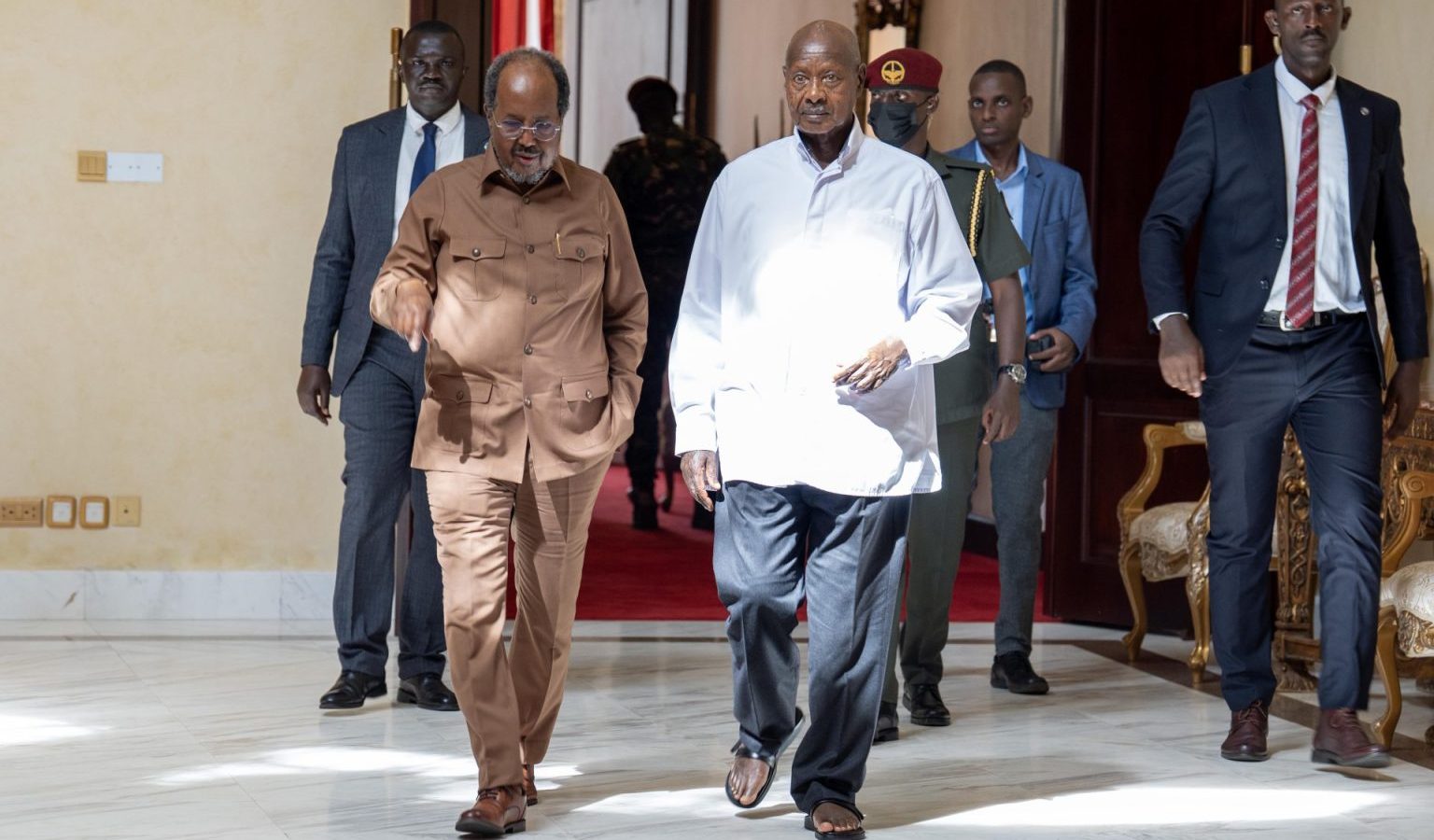
Museveni made the remarks during talks with Somali President Hassan Sheikh Mohamud at State House in Entebbe on Monday, where the two leaders discussed Somalia’s security challenges, the future of Uganda’s military presence and opportunities to strengthen bilateral trade.
The meeting also produced plans to establish a direct route for processed Ugandan coffee into Somalia, potentially opening a new market for exporters while reducing reliance on intermediaries.
“The problem of Somalia is ideological and a misdiagnosis of problems,” Museveni said.
He argued that political and sectarian divisions had weakened efforts to confront the country’s security challenges, drawing comparisons with other African countries, including Sudan, where he said exclusionary approaches to governance had contributed to instability.
“All the problems you’re talking about, we know them. We need to be organised and stand with the main problem,” Museveni said.
“Unite the many to defeat the few, but some Africans want to annoy the many to stay with the few.”
His remarks come as Somalia continues its nearly two-decade struggle against Al-Shabaab, an al-Qaeda-linked militant group that has retained the ability to launch major attacks despite sustained military operations by Somali forces and African Union troops.
Somalia seeks longer Ugandan military presence
During the meeting, Mohamud briefed Museveni on Somalia’s security situation and acknowledged Uganda’s longstanding contribution to the fight against Al-Shabaab.
According to Uganda’s State House, the Somali leader expressed hope that Ugandan troops would remain in his country for an extended period to support efforts towards full pacification and lasting stability.
Uganda was the first country to deploy troops to the African Union peacekeeping operation in Somalia in 2007 and has remained one of the most significant contributors to successive missions.
It currently has approximately 4,500 soldiers serving under the African Union Support and Stabilisation Mission in Somalia (AUSSOM), according to Military Africa, alongside a separate contingent operating under a bilateral agreement with Mogadishu.
Ugandan troops have played a central role in securing strategic locations, supporting Somali security forces and conducting operations against Al-Shabaab.
However, the security gains remain fragile.
Although Somali and African Union forces have pushed the militants out of several urban centres, Al-Shabaab continues to control significant rural territory and regularly launches attacks against government forces, security installations and civilian targets.
The group also recaptured several strategically important towns during offensives in 2025, highlighting the difficulties facing Somalia as it attempts to assume greater responsibility for its own security.
Funding crisis threatens African Union mission
Mohamud’s request for Uganda to maintain its military presence comes as AUSSOM faces mounting financial uncertainty.
ALSO READ: Uganda’s Parliament halts charcoal ban enforcement as MPs question cost of alternatives
The mission, which replaced the previous African Union operation in January 2025, has struggled to secure sufficient funding to sustain its deployment and operational commitments.
According to the International Peace Institute’s Global Observatory, financial pledges covered only a fraction of AUSSOM’s $196 million budget for 2025, with outstanding arrears reaching approximately $93.9 million.
The uncertainty deepened in July when the United States informed the African Union that it would block the renewal of United Nations logistical funding for AUSSOM when the mission’s Security Council authorisation expires on 31 December.
The position has raised concerns about the future of the mission, particularly as Somali security forces continue to depend on international assistance to maintain territorial gains and counter militant operations.
Uganda, however, has indicated that its commitment to Somalia will not necessarily end if the African Union mission’s funding arrangements change.
In August, Defence Minister Kiryowa Kiwanuka said Ugandan troops would remain in Somalia under a bilateral agreement, regardless of the outcome of the mission’s funding negotiations.
For Mogadishu, continued Ugandan support could prove crucial as it attempts to strengthen national security institutions and prevent Al-Shabaab from exploiting gaps created by any reduction in international military assistance.
Somalia faces political tensions over elections
The security challenges are unfolding against a backdrop of political uncertainty in Somalia.
Mohamud’s presidential term was originally scheduled to end in May 2026, but lawmakers approved constitutional changes in March extending it by a year.
The decision drew criticism from opposition figures, who challenged the legitimacy of the extension and raised concerns about the country’s political direction.
Somalia’s electoral commission has since announced that parliamentary elections will take place on 15 April 2027, followed by a presidential election on 15 May 2027.
The political disagreements add another layer of complexity to efforts to build national unity against Al-Shabaab.
Museveni’s appeal for Somali leaders to overcome ideological and political divisions therefore comes at a time when the country’s security and constitutional challenges remain closely intertwined.
Uganda and Somalia pursue direct coffee trade
Beyond security, the two presidents discussed ways to expand economic cooperation, with coffee emerging as a priority.
Museveni welcomed Somalia’s decision to allow Uganda to establish a warehouse in the country, creating a direct channel through which processed Ugandan coffee can be marketed and sold to Somali consumers.
The arrangement could help Ugandan exporters reduce their dependence on foreign intermediaries and retain more value from their products.
Nelson Tugume, who recently returned from Somalia, told the presidents that the Somali market currently imports coffee from European countries, even though Uganda is one of Africa’s major coffee producers.
As a result, Ugandan coffee can reach Somali consumers indirectly after passing through international markets.
ALSO READ: Uganda hospitals under scrutiny as MPs uncover missing medicines and alleged illegal fees
Establishing a warehouse in Somalia would allow Uganda to market processed coffee more directly, potentially lowering distribution costs and creating new opportunities for Ugandan businesses.
The initiative also supports Kampala’s efforts to move beyond exporting raw agricultural commodities and increase the value earned through local processing.
Coffee remains Uganda’s leading export earner.
In the 12 months to April 2025, the country exported approximately 7.17 million bags of coffee valued at a record $1.97 billion.
Europe accounted for most of those exports, with Italy remaining the largest individual buyer.
However, weaker global coffee prices have since placed pressure on export earnings, increasing the importance of diversifying markets and expanding sales of processed coffee.
A direct trade arrangement with Somalia could provide another outlet for Ugandan producers while strengthening commercial links between the two East African countries.
Somali businesses and students strengthen bilateral relations
The two leaders also acknowledged the growing social and economic connections between their countries.
Mohamud thanked Uganda for hosting Somali nationals, including businesspeople and students who have established themselves in the country.
Somalia’s ambassador to Uganda, Fardowsa Mohamed Qanyare, told the meeting that approximately 8,000 Somalis operate businesses in Uganda, while an estimated 15,000 Somali students are enrolled at Ugandan universities.
Their presence reflects the importance of Uganda as both an education destination and a commercial centre for Somali nationals.
The figures also demonstrate that bilateral relations extend beyond military cooperation, encompassing education, entrepreneurship, investment and people-to-people exchanges.
For Uganda, expanding trade with Somalia could build on these existing connections and create additional opportunities for businesses in both countries.
For Somalia, stronger economic partnerships could support reconstruction and commercial development as the government works to stabilise the country.
The meeting was attended by Uganda’s Minister of State for Foreign Affairs, Haruna Kasolo; Minister of State for Defence and Veteran Affairs, Huda Abason Oleru; Permanent Secretary in the Ministry of Foreign Affairs, Vincent Bagiire; and Uganda’s Ambassador to Somalia, Professor Sam Tulya-Muhika.
The discussions underscored the two countries’ intention to strengthen a relationship that has long been defined by military cooperation but is increasingly expanding into trade and education.
For Museveni and Mohamud, the immediate priority remains Somalia’s security. Yet the proposed coffee trade arrangement signals a broader ambition to build economic ties that can endure beyond the current military mission.