JOHANNESBURG: South Africa’s labour market delivered a seemingly contradictory result in the third quarter of 2026: employment increased, but unemployment also climbed, exposing the scale of the challenge facing an economy struggling to create enough jobs for the people who need them.
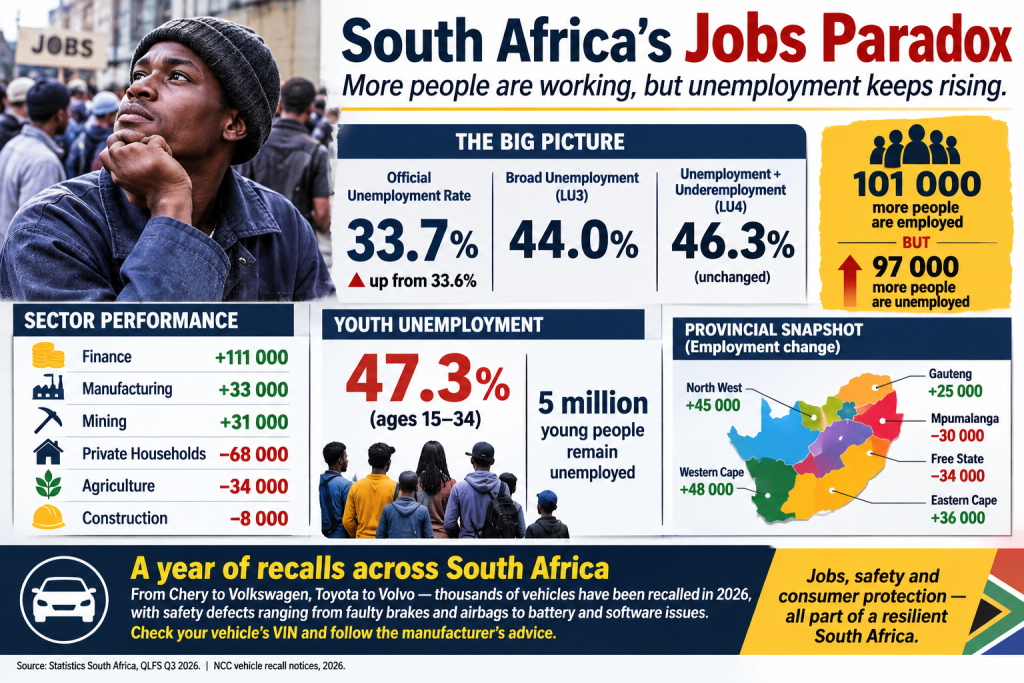
Statistics South Africa’s latest Quarterly Labour Force Survey, released on Tuesday, shows that the number of employed people increased by 101,000 to 16.8 million between the second and third quarters. But the number of unemployed people rose by a further 97,000 to 8.6 million.
The result was a marginal increase in the official unemployment rate, from 33.6% to 33.7%.
The figures point to a labour market in which job creation is failing to keep pace with the number of people entering or returning to the search for work. The labour force expanded by 198,000 during the quarter, almost twice the increase in employment.
In other words, the economy created more jobs, but the number of people seeking work grew faster.

That distinction matters in a country where millions of people remain locked out of employment and where a small movement in the official unemployment rate can obscure the much wider problem of people who want work but have stopped looking for it.
The unemployment figure tells only part of the story
The official unemployment rate counts people who are without work, available to work and actively looking for employment. It does not capture everyone who wants a job but has become discouraged by the lack of opportunities.
Stats SA’s broader measures provide a more complete picture of the pressure on households.

The number of discouraged job-seekers increased by 70,000 to 3.7 million in the third quarter. These are people who want employment and are available to work but are no longer actively searching.
The potential labour force, which includes discouraged job-seekers and other people who are available or seeking work but do not meet all the criteria for the official unemployment count, increased by 69,000 to 4.6 million.
When unemployment is combined with the potential labour force, the rate rises to 44%, up from 43.8% in the previous quarter.
This measure, known as LU3, is particularly important because it captures people whose attachment to the labour market is real even though they are excluded from the headline unemployment figure.
The broadest measure of labour underutilisation, LU4, remained unchanged at 46.3%. It includes unemployment, time-related underemployment and the potential labour force.

Meanwhile, the combined rate of unemployment and time-related underemployment declined slightly to 36.5%.
The figures suggest that the challenge is not simply that people cannot find jobs. Many who do have employment are also unable to secure the hours of work they need.
Formal jobs are growing, but other parts of the economy are losing ground
One of the most significant developments in the latest survey is the difference between formal and informal employment.
ALSO READ: Artisan entrepreneurs emerge as new front in South Africa’s unemployment battle

Formal-sector employment increased by 268,000 to 12.3 million. But the informal sector shed 98,000 jobs, while employment in private households declined by 68,000.
The gains in formal employment therefore came alongside substantial losses elsewhere.
The distinction is important because informal businesses and household employment provide livelihoods for millions of people, including workers who may have limited access to social protection and other benefits associated with formal employment.
The survey does not establish whether people who lost informal or household jobs moved into the formal positions recorded during the quarter. It does, however, show that employment growth was uneven and that the overall increase does not mean every part of the labour market improved.
At industry level, finance recorded the largest increase, adding 111,000 jobs. Manufacturing added 33,000, while mining employment increased by 31,000.
The gains were offset by losses in private households, which shed 68,000 jobs, agriculture, which lost 34,000, and construction, which recorded a decline of 8,000.
The pattern raises questions about the breadth of the recovery. Growth in finance, manufacturing and mining is welcome, but the losses in agriculture, construction and household employment show that the improvement has not been shared across the economy.
These figures also matter for household incomes. A job lost in a private household or on a farm can have an immediate effect on a worker and the family members who depend on that income.
Youth unemployment remains a national emergency

The latest figures offer little comfort to young South Africans.
The unemployment rate among people aged 15 to 34 declined marginally by 0.1 of a percentage point to 47.3%. The number of unemployed young people fell by 23,000 to five million.
But the number of employed young people also decreased, by 5,000 to 5.5 million.
That means the small improvement in the youth unemployment rate did not come from an increase in youth employment. It occurred alongside a contraction in the number of young people employed and unemployed.
The distinction is important. A declining unemployment rate can sometimes be interpreted as evidence that more people are finding work. In this case, the fall in the number of unemployed young people was accompanied by a fall in youth employment.

With five million young people still unemployed, the figures underline the difficulty facing a generation trying to enter a labour market that is not creating opportunities at the required scale.
The consequences extend beyond individual income. Prolonged unemployment can delay financial independence, make it harder for young people to gain work experience and deepen dependence on already stretched households.
Employment gains are uneven across provinces
The provincial figures show that the third-quarter improvement was not evenly distributed geographically.
ALSO READ: South Africa’s unemployment crisis is a national emergency

The Western Cape recorded the largest increase in employment, adding 48,000 jobs. North West followed with 45,000, while the Eastern Cape added 36,000 and Gauteng 25,000.
But employment declined in the Free State, which lost 34,000 jobs, and Mpumalanga, where the number of employed people fell by 30,000.
The differences matter because provincial employment conditions shape household prospects and local economic activity. A national improvement can conceal significant setbacks in particular regions.
The survey records changes in employment between quarters. It does not, by itself, explain all the reasons behind the differences between provinces or establish whether the gains will be sustained.
A fragile improvement after a difficult start to the year

The third-quarter increase also needs to be viewed against the employment losses recorded earlier in 2026.
Employment fell by 345,000 in the first quarter and declined by a further 16,000 in the second quarter before recovering by 101,000 in the third.
The latest increase is therefore a recovery from earlier losses, not yet evidence of a sustained turnaround.
The official unemployment rate has also moved upwards throughout the year, rising from 32.7% in the first quarter to 33.6% in the second and 33.7% in the third.

Economist Duma Gqubule cautioned against interpreting one quarter of employment growth as proof that the economy had turned a corner, telling the Mail & Guardian that the improvement would need to be confirmed over several quarters.
His warning reflects a central feature of the latest data: employment growth must be sustained and sufficiently broad to absorb both existing unemployed people and new entrants to the labour market.
The real test is whether jobs reach those who need them
The third-quarter survey presents a mixed picture. Formal employment increased, and several major industries recorded gains. But unemployment continued to rise, informal and household employment contracted, and the number of discouraged job-seekers grew.
The official rate of 33.7% is already severe. The 44% measure that includes the potential labour force shows how much wider the challenge becomes when people who have stopped searching are taken into account.
For policymakers, the figures point to a need to look beyond the number of jobs added in a single quarter. The type of employment being created, the sectors generating it, its geographical distribution and the ability of young people to access it are equally important.
The latest figures do not suggest that job creation has stopped. They show that the pace and distribution of employment growth remain inadequate against the scale of the country’s labour-market crisis.
South Africa has more people working than it did three months ago. But it also has more people unemployed, more discouraged job-seekers and millions of young people still unable to find work.
That is the contradiction at the heart of the country’s jobs crisis.