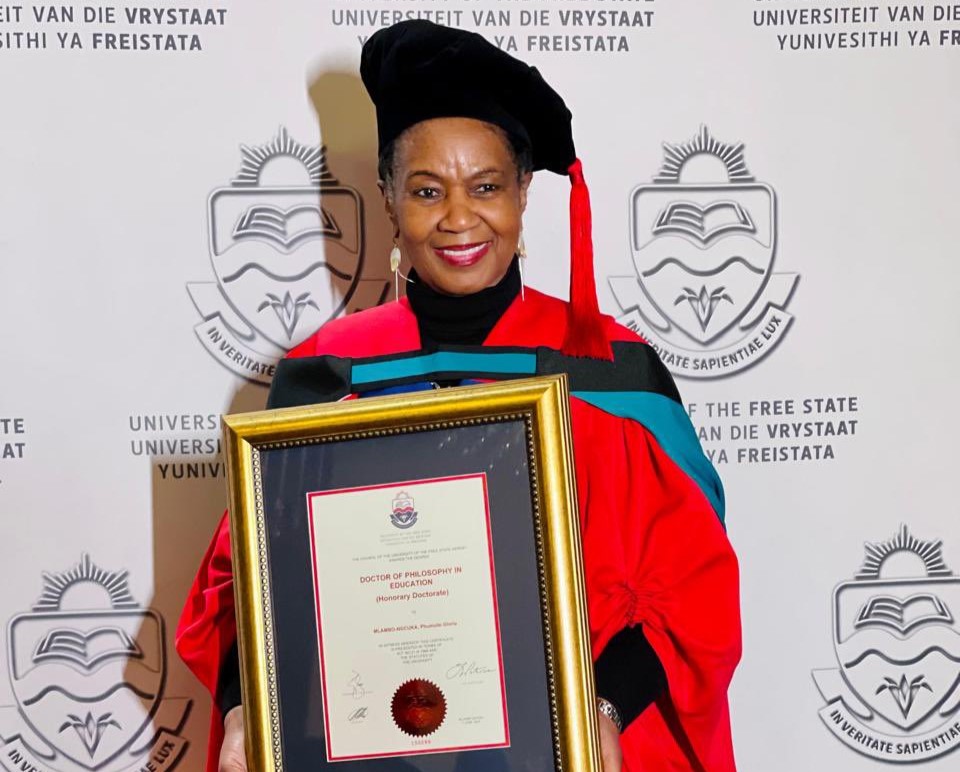
JOHANNESBURG: President Cyril Ramaphosa has remembered former deputy president Phumzile Mlambo-Ngcuka as a dedicated patriot and an unwavering champion of women’s rights, saying her death had deprived him of an opportunity to reflect with her on their shared experience in one of the country’s highest offices.
Mlambo-Ngcuka, South Africa’s first woman deputy president and former executive director of UN Women, died on Friday evening, 20 November, aged 71. Her family said she had died from complications following a medical procedure she underwent about two weeks earlier.
Speaking to journalists outside her family home in Morningside, Johannesburg, Ramaphosa said he had hoped to sit down with her to discuss their respective experiences as deputy president. He believed such a conversation could have offered valuable lessons for future leaders.
Ramaphosa was in the United States when she died. Acting President Paul Mashatile announced her passing on his behalf.
In an earlier statement, Ramaphosa said: “Our hearts are sad and broken at the loss of such a dynamic woman leader.”
He added: “She truly flew the flag of women; not only women in South Africa and Africa, but women of the world.”
‘That is politics’
Asked whether internal leadership contests within the ANC had prevented Mlambo-Ngcuka from becoming South Africa’s first woman president, Ramaphosa said political competition was an unavoidable part of party life.
He cautioned against viewing leadership contests as unusual, saying political parties inevitably experienced competing ambitions and differences over leadership and policy.
“Well, political parties have their ups and downs and issues of leadership are contested terrains. And it should never really come as a surprise if one leader is preferred over another because that is politics,” he said.
“Politics is about contestation for positions, for either wanting to foster your policies or your views. So that is par for the course, for those who play golf like me.”
Mlambo-Ngcuka was widely regarded as a close ally of former president Thabo Mbeki, who appointed her deputy president in June 2005.
Her time in government ended in September 2008, when she resigned alongside most of the Cabinet after the ANC recalled Mbeki. She briefly joined the breakaway Congress of the People in 2009 before returning to the ANC.
Ramaphosa also reflected on the ANC’s declining electoral support, saying the party’s performance would have saddened Mlambo-Ngcuka.
“The decline that we’ve suffered is a serious setback. It’s a setback that we are going to spend a considerable amount of time reflecting on and looking deeply at where the ANC is, what caused it, and what the future portends,” he said.
“So we are dealing with it very seriously and we will do so in due course.”
‘A leader who showed up’
Despite the political tensions of the past, Ramaphosa said Mlambo-Ngcuka had remained committed to the ANC’s renewal efforts.
ALSO READ: President Ramaphosa declares Special Provincial funeral for slain boxing icon
He said she and her husband, former National Director of Public Prosecutions Bulelani Ngcuka, continued to support the party’s election campaigns long after she had left active politics.
“She was part of the renewal process within the ANC. She and Comrade Bulelani had come because they wanted to make a contribution,” he said.
Ramaphosa described her as a leader who remained willing to serve whenever called upon.
“That’s why I said she was the type of leader who showed up, who always was willing and prepared to be called upon to participate and to play a role.”
He recalled being encouraged by seeing her at an ANC campaign rally, saying her presence demonstrated that she remained committed to contributing to the organisation despite having held senior positions in government.
“I was really heartened and really well touched that here is a person who played a role in the past, in the previous administration, and she was still there and willing to play a role. So that to me was a high point,” he said.
However, the deeper discussion he had hoped to have with her never materialised.
“We never really got that moment to discuss in depth, because when you meet at these places, it’s almost like two ships passing each other in the night,” he said.
Tributes from South Africa and abroad
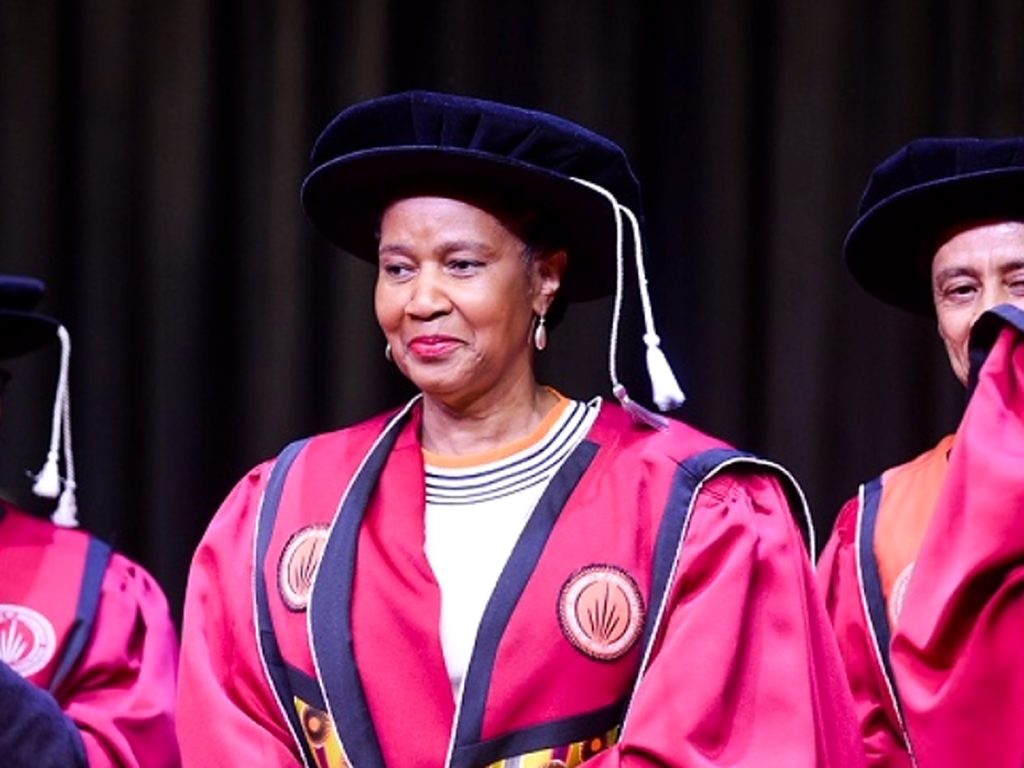
Tributes have poured in from political leaders, international organisations and institutions, reflecting Mlambo-Ngcuka’s influence in South Africa and her work on the global stage.
United Nations Secretary-General António Guterres remembered her as a lifelong advocate for women’s rights and empowerment.
“I am deeply saddened by the passing of Phumzile Mlambo-Ngcuka,” he said.
“Phumzile believed that gender equality is not a favour to be granted but a right to be claimed.”
Melinda French Gates, co-chair of the Gates Foundation, praised Mlambo-Ngcuka’s leadership in government and at UN Women.
“Phumzile exemplified the kind of unwavering, effective leadership we need so that every woman and every girl can chart their own course,” she said.
Cosatu spokesperson Zanele Sabela extended condolences to Mlambo-Ngcuka’s family and the ANC, saying her appointment as South Africa’s first woman deputy president had opened doors for other women aspiring to leadership.
ALSO READ: Babsy Mlangeni, the voice behind Sala Emma, dies at 83
The Kgalema Motlanthe Foundation described her as a distinguished South African whose contribution to democracy and international development would have a lasting impact.
Parliament’s presiding officers remembered her as “a courageous and principled activist”, while her family described her as “a giant in South African public life and a global citizen”.
University of Johannesburg vice-chancellor Professor Letlhokwa Mpedi also expressed sadness, describing her death as “an immeasurable loss to the university and to our country”. Mlambo-Ngcuka had served as the university’s chancellor since 2022.
From Clermont to the United Nations
Born on 3 November 1955 in Clermont, a township outside Durban, Mlambo-Ngcuka began her career as a teacher after completing her training. She taught at Ohlange High School in KwaZulu-Natal before moving to Geneva, where she worked for the World YWCA and established a global programme for young women.
Her political activism began during the anti-apartheid struggle. In 1983, she became the first president of the Natal Organisation of Women, an affiliate of the United Democratic Front.
Following South Africa’s first democratic elections in 1994, she entered Parliament and chaired the Portfolio Committee on Public Service.
She was appointed deputy minister of trade and industry in 1996 and became Minister of Minerals and Energy in 1999, a position she held until 2005. During her time in the portfolio, she promoted greater participation and ownership of the mining industry by women.
In June 2005, Mbeki appointed her deputy president, making her the first woman to hold the office in South Africa. She also served as Leader of Government Business.
After leaving government, she continued her work in development and women’s empowerment. In 2013, she was appointed United Nations Under-Secretary-General and executive director of UN Women, becoming one of the most prominent African women in international public service.
She served two terms in the position, until 2021.
Mlambo-Ngcuka also founded the Umlambo Foundation, which focuses on supporting teacher development. She obtained a doctorate from the University of Warwick in 2013.
She is survived by her husband, Bulelani Ngcuka, and their five children.
State funeral arrangements
A state memorial service is being held on Tuesday, 24 November, at Our Lady of Lourdes Catholic Church in Rivonia, Johannesburg.
Mlambo-Ngcuka will be laid to rest on Saturday, 28 November, in a Category 2 State Funeral at eXesi, near Middledrift in the Eastern Cape, her husband’s home area.
The funeral will include ceremonial elements provided by the South African National Defence Force.
Ramaphosa has ordered that the national flag be flown at half-mast at all flag stations until Saturday evening in her honour.