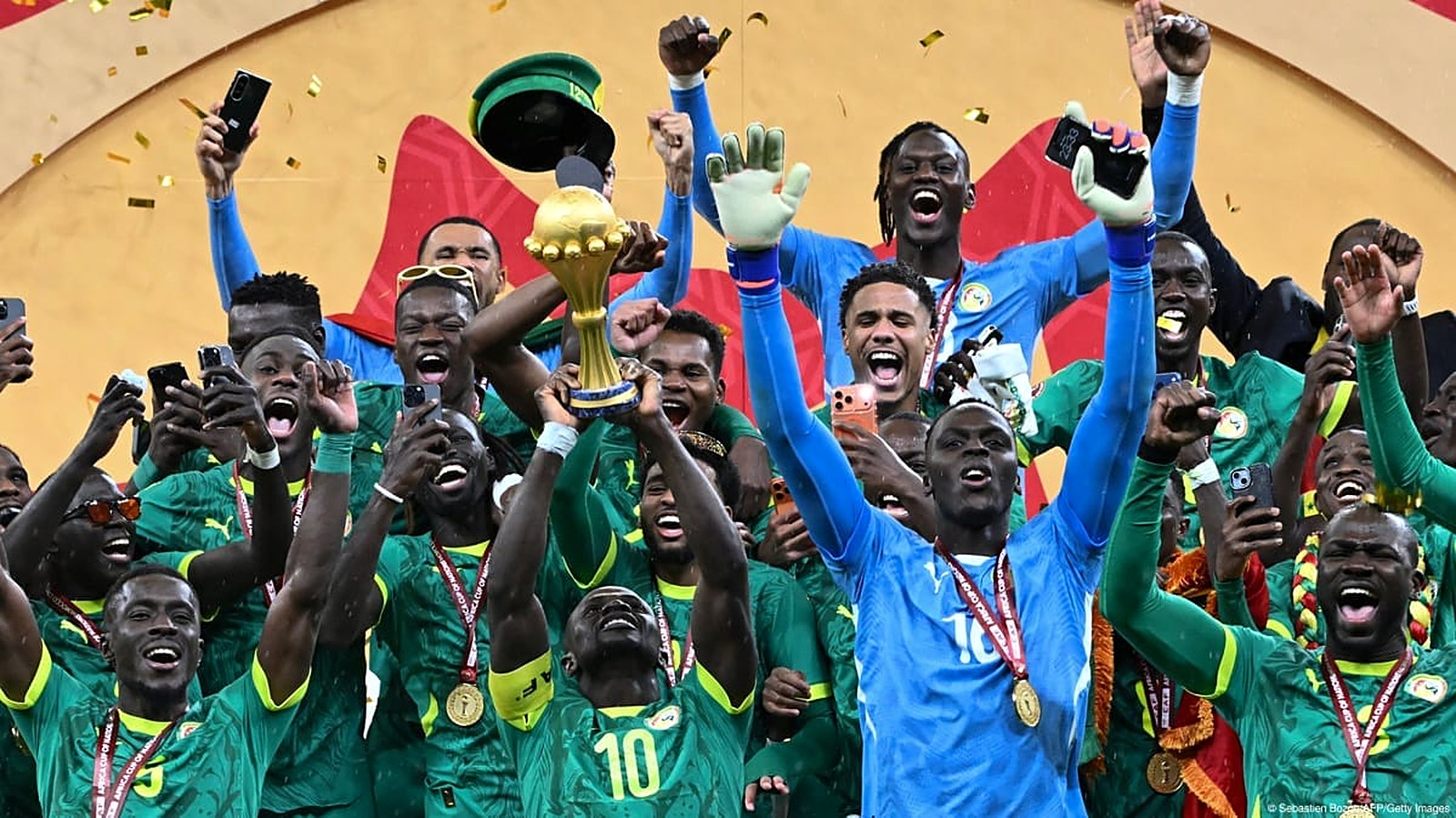
LAUSANNE: Senegal have been reinstated as Africa Cup of Nations champions after the Court of Arbitration for Sport (CAS) unanimously upheld the Senegalese Football Federation’s (FSF) appeal against a decision that had handed the 2025 title to Morocco.
In its ruling on Tuesday, CAS overturned the Confederation of African Football (CAF) Appeal Board’s decision to declare Senegal the losers of the final by forfeiture and award Morocco a 3-0 victory.
The arbitration panel confirmed that Senegal’s 1-0 win after extra time in Rabat on 18 January 2026 stands.
CAS said: “The result obtained at the end of the AFCON 2025 final is confirmed.”
The ruling brings an end to months of uncertainty surrounding a final that descended into controversy after Senegal’s players briefly walked off the pitch in protest over a late penalty awarded to Morocco.
Why CAS ruled in Senegal’s favour
At the centre of the dispute was whether Senegal’s decision to leave the field amounted to a forfeiture under the AFCON regulations.
CAS found that the referee had the authority to decide whether the match should resume. Both teams had returned to the pitch and were prepared to continue when he restarted play.
The panel held that the referee’s decision fell within the field of play doctrine, which generally protects decisions made by match officials during a game from being overturned through subsequent legal proceedings.
It also ruled that Articles 82 and 84 of the AFCON regulations, relied on by CAF’s Appeal Board, applied only where a match was permanently abandoned because of a team’s conduct.
That had not happened in Rabat. The referee had restarted the match, and CAS found no error of law in his decision to do so.
ALSO READ: Gueye’s Extra-Time Thunderbolt Hands Senegal Second AFCON Crown
The panel acknowledged that the referee had been operating under extreme pressure but concluded that this did not make his decision arbitrary.
CAS also noted that the FSF, head coach Pape Thiaw and several Senegalese players had already faced disciplinary sanctions from CAF over the walk-off. Those sanctions were dealt with separately and were not part of the appeal before the arbitration panel.
How the final descended into chaos
The dispute began during stoppage time in the final at the Prince Moulay Abdellah Stadium in Rabat.
Senegal had a goal ruled out in the 92nd minute. Six minutes later, Morocco were awarded a penalty in a decision that provoked furious protests from the Senegalese players.
The team left the pitch and remained off the field for several minutes before returning after play was eventually suspended and the situation addressed.
When the match resumed, Morocco’s Brahim Díaz attempted a Panenka-style penalty, but Senegal goalkeeper Edouard Mendy saved it.
The game went into extra time, where Pape Gueye scored the decisive goal to give Senegal a 1-0 victory.
Senegal lifted the trophy, and celebrations followed in Dakar. CAF’s Disciplinary Board subsequently imposed fines and sanctions on both federations but initially left the match result unchanged.
Morocco’s Royal Moroccan Football Federation (FRMF) appealed that outcome.
On 17 March, CAF’s Appeal Board ruled that Senegal had forfeited the final by leaving the field and recorded a 3-0 victory for Morocco.
The Senegalese federation strongly rejected the decision, describing it as “unfair, unprecedented and unacceptable” and arguing that it damaged the credibility of African football.
ALSO READ: Morocco’s Meltdown: Tantrums, Towel Wars and Taking The ‘L’
The FSF took the matter to CAS on 25 March, naming CAF and the FRMF as respondents.
Could Morocco take the case to the Swiss courts?
Although CAS has reinstated Senegal as champions, the dispute could still have a legal afterlife.
According to Reuters, the FRMF has raised a complaint with CAS, alleging that a judge spoke by telephone with the president of the Senegalese federation on the Sunday before the ruling. CAS has not publicly responded to the allegation.
Morocco could also seek to challenge the award before the Swiss Federal Tribunal, where CAS decisions can be reviewed on limited procedural grounds.
Such a challenge would not amount to a fresh hearing of the football dispute. The Swiss court does not ordinarily reconsider the merits of a CAS ruling, but examines whether there are grounds to set it aside under the applicable legal framework.
The FRMF has not confirmed whether it intends to pursue that route.
A controversy that went beyond the pitch
The dispute has also been accompanied by a wave of misinformation.
During the months in which the appeal was pending, several fabricated CAS documents claiming to declare Senegal the winners circulated on social media. Fact-checkers subsequently exposed the documents as fake.
The genuine ruling now restores the result recorded on the field in January and gives Senegal back the continental title they initially won in Rabat.
For CAF, however, the controversy has raised difficult questions about the interpretation and application of tournament regulations, the authority of match officials and the handling of disputes involving major competitions.