Nairobi and Washington are seeking to turn a longstanding diplomatic relationship into deeper commercial, health and security cooperation, with trade negotiations and the extension of AGOA to 2028 providing fresh momentum.
Kenya, US Deepen Trade And Security Ties As New Economic Framework Takes Shape
NAIROBI – Kenya and the United States are moving to broaden their strategic partnership beyond traditional diplomatic and security cooperation, with trade, investment, healthcare and critical minerals emerging as key areas of focus.
The latest push followed talks in Nairobi between Kenya’s Prime Cabinet Secretary and Cabinet Secretary for Foreign and Diaspora Affairs, Musalia Mudavadi, and US Assistant Secretary of State for African Affairs Frank Garcia, who is on an official visit to the country.
The discussions come at an important point for Kenya’s economic relationship with Washington. The United States has extended the African Growth and Opportunity Act (AGOA) to 31 December 2028, giving eligible Kenyan exporters continued preferential access to the US market.
For Nairobi, however, the extension is only part of the equation. Kenya and the US are also pursuing a reciprocal trade framework aimed at providing greater certainty for businesses and investors.
From diplomatic ties to economic returns
Mudavadi said the value of the relationship should ultimately be measured by what it delivers to citizens.
“The Kenya–United States partnership matters most when it translates into jobs, investment, better healthcare and greater security for our people.”
The message reflects Nairobi’s effort to extract more tangible economic value from its strategic relationship with Washington, particularly as Kenya seeks to expand exports, attract investment and strengthen domestic manufacturing.
AGOA remains important to that strategy. The US trade preference programme provides eligible sub-Saharan African countries with preferential access to the American market for thousands of products. Kenya’s export sectors, including apparel, horticulture and manufacturing, have benefited from the arrangement.
The latest extension is expected to provide exporters with greater certainty after years of uncertainty over the future of the programme. Kenyan officials have also argued that the additional time should be used to diversify exports and increase value addition rather than relying solely on existing preferential access.
Reciprocal trade talks gain importance
The two governments are simultaneously negotiating a broader reciprocal trade arrangement.
That process could prove more consequential over the longer term because it seeks to establish a more predictable framework for bilateral commerce beyond the temporary certainty offered by AGOA.
ALSO READ: News influencers are reshaping the media – insights from Kenya, Nigeria and South Africa
Kenya’s position is strengthened by its role as a regional commercial hub, with access to the East African, COMESA and wider African markets. Mudavadi has previously highlighted Kenya’s position as a gateway to a continental market of more than 1.4 billion people.
The challenge for Nairobi will be ensuring that deeper access to the US market translates into increased Kenyan production, investment and jobs, rather than simply greater imports.
Healthcare and critical minerals on the agenda
The discussions also moved beyond trade.
Kenya and the US examined cooperation in healthcare, including efforts to reduce the cost of cancer treatment. The two sides also discussed critical minerals, defence, peace and regional security.
Critical minerals are becoming an increasingly important component of global economic and geopolitical competition, making Kenya’s interest in mineral processing and value addition particularly significant.
Mudavadi has previously identified opportunities for cooperation in mineral processing while stressing the need for environmental safeguards, sound governance and community participation.
Security remains another pillar of the relationship, with Kenya and the US sharing interests in stability across parts of East Africa, including Somalia, Sudan, South Sudan and the Democratic Republic of Congo.
Mudavadi warned that instability threatens hard-won economic gains.
“The undesirable challenges to global peace and security have undermined the economic gains of the last decade.”
Diplomats’ families gain employment opportunities
The latest engagement also produced a practical agreement affecting diplomats and their families.
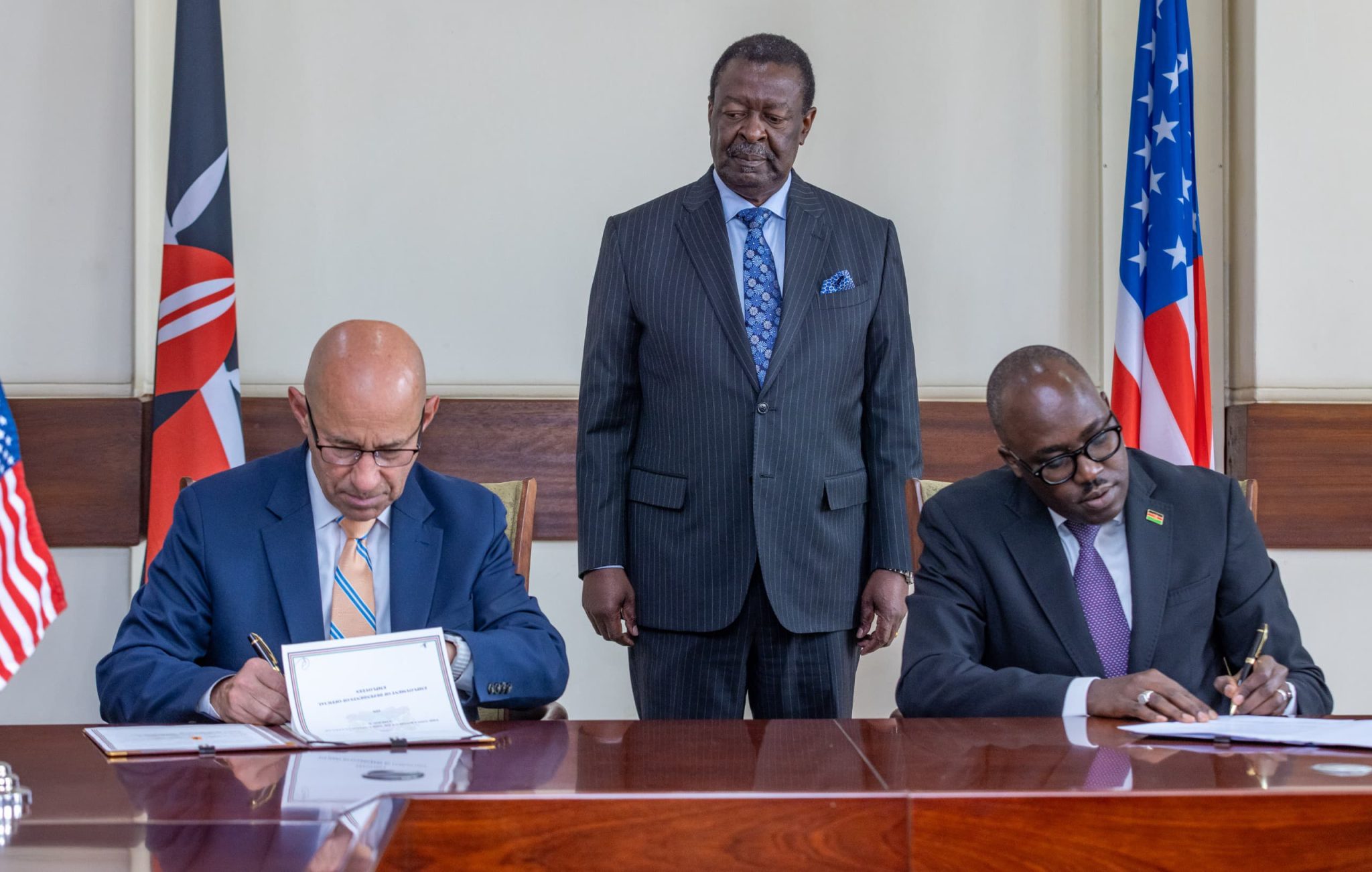
Kenya’s Principal Secretary for Foreign Affairs, Korir Sing’oei, and Garcia signed a Bilateral Work Agreement, witnessed by Mudavadi.
The agreement allows eligible dependants of Kenyan diplomats stationed in the US, and US diplomats serving in Kenya, to seek employment in their host country, subject to local laws and regulations.
ALSO READ: Kenya’s $1.6bn US Health Deal Faces Its First Big Test: Can Nairobi Take the Wheel?
It replaces a similar agreement signed in 2021 that has since lapsed.
While relatively technical, the agreement represents another layer of institutional cooperation between the two governments and removes a practical constraint that can affect the professional lives of diplomatic families.
December dialogue to test progress
The next major test of the relationship will come in December 2026, when Kenya hosts the fourth Kenya-US Bilateral Strategic Dialogue.
The dialogue will provide an opportunity for both governments to assess progress across their expanding areas of cooperation and identify new priorities.
For Kenya, the immediate task is to turn the diplomatic momentum into measurable economic outcomes.
As Mudavadi put it:
“Our focus is clear: turn strong diplomatic ties into greater opportunities, stronger businesses, healthier communities and a more secure future for Kenyans.”
The direction of the relationship is therefore becoming increasingly clear: Nairobi wants its partnership with Washington to deliver not only political and security cooperation, but also markets for Kenyan businesses, investment for local industries, more affordable healthcare and opportunities for ordinary citizens.
The success of that strategy will ultimately depend on what emerges from the reciprocal trade negotiations and whether Kenya can use the additional AGOA window through 2028 to build a more diversified and competitive export economy.
Subscribe to Our Newsletter
Keep in touch with our news & offers
Thank you for subscribing to the newsletter.
Oops. Something went wrong. Please try again later.