Rabat, Morocco — As Morocco prepares to co-host the 2030 FIFA World Cup alongside Spain and Portugal, the North African nation has unveiled a sweeping $4.2 billion (38 billion dirhams) investment plan to modernise and expand its main airports over the next five years.
This ambitious infrastructure push aims to more than double the country’s current airport capacity from 38 million to 80 million passengers annually by 2030, positioning Morocco as a premier aviation hub in Africa and the Mediterranean region.
The Moroccan government formalised the plan through a key agreement signed with the nation’s airports authority, ONDA (Office National Des Aéroports), detailing a phased investment of 38 billion dirhams.
Of this, approximately 25 billion dirhams (~$2.79 billion) will be channelled directly into airport expansion projects, including constructing new terminals and improving existing infrastructure. The remaining 13 billion dirhams (~$1.37 billion) is earmarked for airport maintenance and land acquisition to facilitate future development.
Casablanca: The Crown Jewel of Expansion
At the heart of the plan lies a major development at Casablanca’s Mohammed V International Airport, the country’s largest and most critical air facility.
Morocco initiated a call for bidders earlier this year to build a new terminal estimated to increase Casablanca’s capacity by an additional 20 million passengers annually, effectively boosting the airport’s handling capacity to around 58 million passengers.
ALSO READ: Morocco’s Colonialism by Proxy: The MKP’s two-faced foreign relations on Western Sahara
This terminal, planned to be operational by 2029 ahead of the World Cup, will also feature state-of-the-art facilities and integrate with Morocco’s expanding high-speed rail network, connecting Casablanca seamlessly with key cities including Rabat and Marrakech.
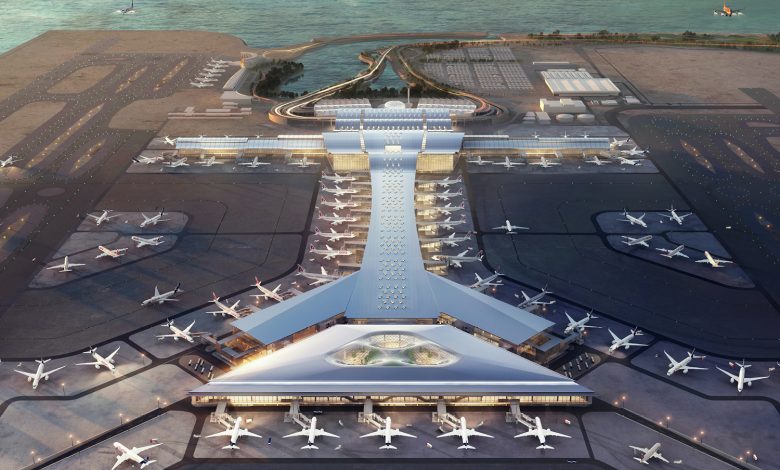
Beyond Casablanca, the expansion plan incorporates modernisation programs for other key airports across Morocco, including those in Rabat, Tangier, Marrakesh, Fez, Tetouan, and Agadir. For example, Rabat-Salé airport is slated for a new terminal capable of accommodating 4 million passengers annually.
Royal Air Maroc, Morocco’s leading airline, is simultaneously expanding its fleet to support the anticipated growth in passenger numbers and to enhance domestic and international connectivity. This holistic approach aims to not only increase capacity but also improve passenger experience, safety, and operational efficiency.
Tourism Surge and Economic Implications
Morocco’s travel and tourism sector is already experiencing a remarkable upswing. The country welcomed a record 17.4 million visitors in 2024, a 20% increase from the previous year and projects this number to swell to 26 million by 2030.
This tourism boom, combined with the expected influx of international visitors for the 2030 World Cup, underscores the urgent need for infrastructure capable of handling high volumes alongside modern amenities that meet global standards.
The airport expansions are thus not only part of World Cup preparations but also a strategic long-term investment aimed at positioning Morocco as a premier travel destination and regional transport hub, spurring job creation and economic growth.
ALSO READ: CAF and TECNO Unveil Exciting Sponsorship for Africa Cup of Nations
Morocco’s focus aligns with a nationwide airports development strategy targeting the doubling of passenger capacity and infrastructural modernisation by 2030. This vision taps into the global momentum of increasing international air travel and the continent’s rising profile.
Government officials emphasise that these upgrades will boost Morocco’s competitiveness and serve as a catalyst for further economic diversification, especially in the logistics, trade, and tourism sectors.
The project is complex and capital-intensive, requiring efficient coordination between government bodies, ONDA, private investors, and international contractors. A key challenge will be ensuring timely completion in alignment with the World Cup schedule and managing the integration of new infrastructure with existing transport networks.
However, Morocco has demonstrated steady progress with early tenders and expressions of interest from over two dozen international companies, including firms from China, Turkey, Spain, Egypt, India, Greece, and Switzerland, competing to undertake parts of the Casablanca airport expansion.