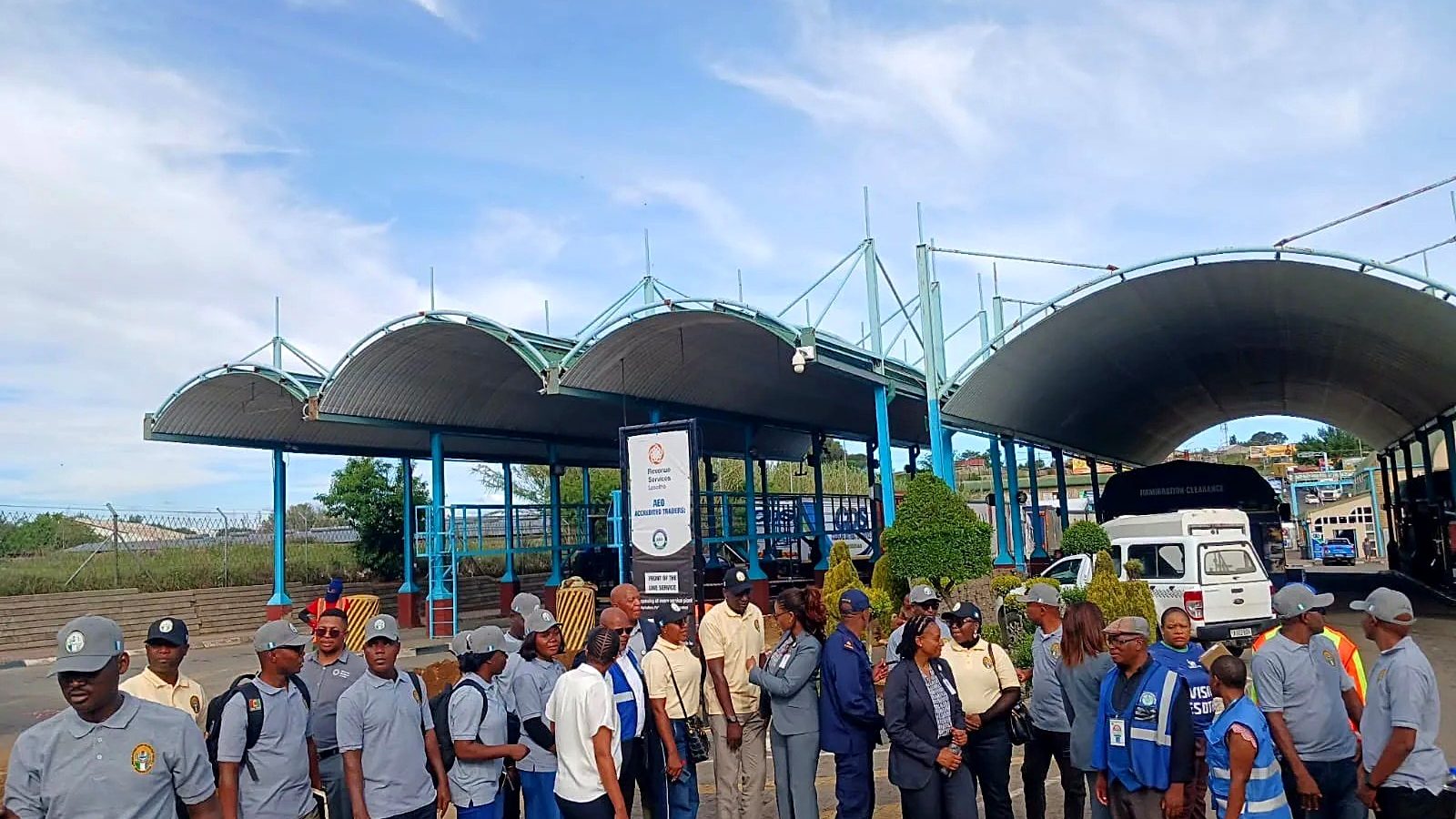
MASERU: Nigerian customs officers have spent five days studying operations at Lesotho’s busiest border post, examining how government agencies work together to regulate trade and the movement of people without creating unnecessary delays.
Revenue Services Lesotho (RSL) hosted the delegation from the Nigeria Customs Command and Staff College at Maseru Bridge, the country’s main gateway to South Africa.
The visit focused on coordinated border management, an approach that brings customs, immigration, security and other authorities together to improve service while maintaining controls.
Maseru Bridge handles the highest volume of trade and passenger traffic between Lesotho and South Africa, according to the World Customs Organization. Its efficiency is particularly important for a landlocked country entirely surrounded by its larger neighbour.
Different agencies working together
RSL Maseru Bridge manager ’Mats’epang Tsietsi told the visitors that the post operates under the Lesotho Border Management Service (LBMS), which coordinates the work of departments responsible for border controls.
Alongside revenue services, she identified Immigration, the Lesotho Mounted Police Service, the National Security Service, the Lesotho Tourism Development Corporation, Port Health, the Transport Department, the Agriculture Department and the Road Fund.
Tsietsi said cooperation between the agencies was essential to facilitating trade, protecting border users and ensuring that goods entering or leaving Lesotho were properly regulated.
The approach is intended to make different departments function as a coordinated service, rather than requiring travellers and traders to navigate disconnected processes.
Lesotho introduced the LBMS at Maseru Bridge on 1 November 2019, bringing government agencies together at a single service point for joint operations.
“We commit to provide better service to all our clients and border users,” Mosuoe Mapetla, then head of client services at the Lesotho Revenue Authority, said when the changes were announced, according to the Government of Lesotho.
ALSO READ: Eswatini and Lesotho seek to revive education ties and expand trade
The authority has since become Revenue Services Lesotho.
Reform beyond the border post
The Maseru Bridge model forms part of a broader effort to improve border management across Lesotho.
In its reporting to the World Trade Organization, Lesotho described the coordinated management arrangements introduced in November 2019 as a pilot, with a national programme still to follow, according to the WTO’s Trade Facilitation Agreement database.
In February 2024, the country validated a draft Coordinated Border Management National Strategy. The strategy sought to reduce duplication and delays while maintaining effective controls, safety and security, the Southern African Development Community reported.
Further work has focused on how agencies share and use information.
The World Customs Organization held a two-week workshop in Maseru from 23 February to 7 March 2025, covering coordinated border management and the standardisation of data across government departments.
That work matters because cooperation depends on more than agencies sharing premises. Their procedures and information systems must also allow them to make decisions together and avoid repeatedly requesting the same information from traders.
Lesotho and South Africa have also signed a joint action plan for smart one-stop border posts at Maseru and Ficksburg, according to theReporter.
In November 2025, SARS and RSL launched a joint Time Release Study to measure how long goods take to clear at the two crossings. Such studies help authorities identify where delays occur and where procedures need to change.
ALSO READ: UAE and Lesotho move to deepen bilateral cooperation
Lessons for Nigerian customs
Speaking on behalf of the visiting delegation, Chukwuka Mowete James described the tour as educational and informative.
He said participants had learnt through a range of activities and intended to apply the knowledge in their work. He also expressed hope that the delegation would be welcomed back should further exchanges be needed.
RSL’s Deputy Commissioner of Frontier Services Central, Dr Tseko Nyesemane, emphasised the importance of coordinated border management.
He acknowledged Nigeria’s extensive customs experience and encouraged the officers to identify areas for improvement and use lessons from the visit to strengthen their own practices.
The Nigeria Customs Command and Staff College, based in Gwagwalada near Abuja, was established in 2011. It is the Nigeria Customs Service’s highest training institution and serves as a World Customs Organization training centre for West and Central Africa, according to its institutional profile.
A wider African exchange
The Lesotho visit was one part of the college’s Africa Study Tour, with groups also visiting Tunisia, Niger and Cameroon.
In Cameroon, 13 trainees and four administrators studied customs operations from 26 to 30 October, according to Cameroon Tribune.
Their programme included cargo inspection, financial intelligence, revenue collection and coordinated border management.
Cameroonian customs official Ekolle Felix described the exchange as “a major academic and operational bridge”.
For Lesotho, hosting the Nigerian delegation offered an opportunity to demonstrate the border reforms it has pursued since 2019 while exchanging experience with a customs service operating in one of Africa’s largest economies. For the visiting officers, the practical test will be how those lessons can improve cooperation, controls and clearance processes at home.