CAPE TOWN – South Africa has taken a significant step towards bringing its fisheries and aquaculture data into a continental reporting system, moving beyond training to actually submitting national figures and assigning officials to keep the information current.
The shift came during a two-day workshop in Cape Town from 23 to 24 July 2026, where South African officials were trained to use the African Fisheries and Aquaculture Database (AFAData), a continental platform designed to help African Union member states collect, manage, analyse and share fisheries and aquaculture data.
But unlike many development-sector workshops that end with certificates and commitments, this one produced a more tangible outcome. South Africa’s 2024 fisheries and aquaculture data was reviewed and entered into the platform during the sessions, giving the country’s account an actual national dataset rather than a demonstration record.
The workshop was convened by the African Union Inter-African Bureau for Animal Resources (AU-IBAR) under the European Union-funded Fisheries Governance Project Phase Two, known as FishGov2.
Sixteen participants attended, including 13 technical officers from the Department of Forestry, Fisheries and the Environment, as well as representatives from the Southern African Development Community (SADC) Secretariat and AU-IBAR.
South Africa was one of five countries selected for accelerated, hands-on training on the platform, alongside Madagascar, Senegal, Tunisia and Uganda.
From training to accountability
The more important development may not have been the data entered into AFAData, but who was given responsibility for what happens next.
Belemane Semoli, Acting Deputy Director General of Fisheries Management, designated data validators within three existing chief directorates.
Marine Resources Management will oversee fish trade and vessel data, Fisheries Research and Development will handle capture fisheries and fishing effort, while Aquaculture and Economic Development will be responsible for aquaculture production and farms.
ALSO READ: Madagascar Invests $7 Million in Coastal Defence to Combat Climate Change
That arrangement gives AFAData a place within existing departmental structures instead of creating another reporting obligation dependent on individual officials remembering to update it.
It also addresses one of the biggest weaknesses of data systems across institutions: continuity.
A government department can be trained on a new platform and still stop using it once the workshop ends. Assigning responsibility within established directorates creates a reporting chain that can, at least in principle, survive staff changes and shifting priorities.

Whether that happens in practice will be the real test.
Hellen Guebama, representing AU-IBAR, said reliable data was becoming increasingly important to how governments make decisions about the sector.
“High-quality data is now essential for developing effective public policies, guiding investments, measuring sector performance, and ensuring rigorous monitoring of commitments made at the national, regional, and continental levels,” she said.
Guebama also linked the initiative to a wider continental mandate, noting that African ministers had adopted the platform through the Specialised Technical Committee on Agriculture, Rural Development, Water and the Environment, which recommended its gradual rollout across African Union member states.
She said the South African training should strengthen the country’s national information system and ultimately improve decisions affecting the sector.
“I am convinced that this training will be an important step in strengthening the national information system on fisheries and aquaculture in South Africa and that it will contribute to better decision-making, for the benefit of fishing communities, fish farmers and the sustainable development of the sector,” Guebama said.
The data problems beneath the milestone
There is, however, another story beneath the success of the workshop.
Working with real national data exposed technical and definitional problems that could affect the reliability of the continental database if they are not resolved.
Participants identified the need to use vessel registration numbers rather than vessel names as unique identifiers. They also flagged problems with import templates and species reference lists, while raising questions about how certain fish should be classified.
One example involved distinguishing between fish restocked from hatcheries and wild-caught fish that are subsequently fattened in cages.
These may sound like technical details, but they go to the heart of what makes a continental database useful.
If countries classify, identify or report the same types of fisheries activity differently, comparisons between them can quickly become unreliable. A database can contain millions of records and still produce poor policy if the underlying definitions and identifiers are inconsistent.
ALSO READ: SADC Ministers Confront Regional Food Security Crisis
AU-IBAR says the issues raised during the South African workshop will help inform improvements before the platform is rolled out further across the continent.
That makes the Cape Town exercise more than a training session. It also became a real-world test of whether the system can accommodate the complexity of national fisheries data.
Why South Africa’s data matters
The stakes are substantial.
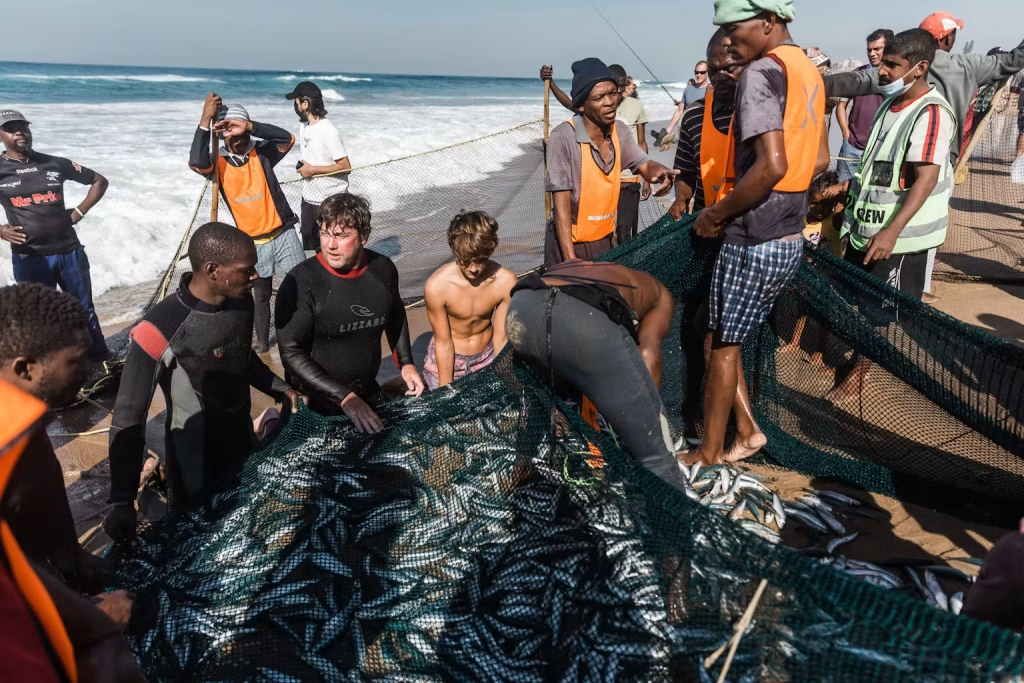
Industry figures put the direct contribution of South Africa’s fisheries sector to GDP at about R7.9 billion in 2022. The country was also a net fish exporter, generating close to R7 billion in foreign exchange, while the industry supported an estimated 58,000 jobs, many of them in rural coastal communities where alternative sources of income are limited.
Across Africa, the economic footprint is even larger. A 2014 NEPAD-FAO study estimated the value added by the continent’s fisheries sector at more than US$24 billion.
Reliable data therefore matters for more than statistical reporting.
It can influence where governments direct investment, how they manage fish stocks, how they measure the performance of the sector and how they assess the economic and social contribution of fishing and aquaculture communities.
Without consistent data, a sector can struggle to demonstrate its true economic importance.
Connecting South Africa to a continental system
AFAData is also being positioned as part of a broader African agricultural monitoring architecture.
The platform is intended to feed into the Kampala Comprehensive Africa Agriculture Development Programme Declaration and its Biennial Review process, which began in 2026. That gives national fisheries reporting a potential link to how countries’ progress on agricultural and related commitments is assessed at continental level.
SADC’s involvement in the Cape Town workshop is equally significant.
Motseki Hlatshwayo represented the SADC Secretariat, helping connect South Africa’s national reporting with the region’s broader efforts to harmonise fisheries information and reporting across member states.
FishGov2 has been working on these issues across Africa for several years, including the development of the database, training of officials and efforts to align national fisheries policies with the African Union’s Policy Framework and Reform Strategy for Fisheries and Aquaculture.
South Africa’s workshop was therefore not an isolated event. It forms part of a wider continental rollout that AU-IBAR says will continue as other member states nominate focal points and begin using the system.
The real test starts now
For now, South Africa has what many data initiatives struggle to achieve: a functioning account, a real national dataset and officials within three chief directorates tasked with keeping the information current.
That is a meaningful starting point.
But the value of AFAData will not ultimately be measured by what was achieved over two days in Cape Town. It will be measured by whether the information remains accurate, regularly updated and useful to policymakers months and years later.
The workshop may have put South Africa on Africa’s fisheries data map.
Keeping it there will require something much harder than training: institutional commitment, regular reporting and officials who continue doing the job long after the workshop is over.