JOHANNESBURG: South Africa faces the prospect of more coalition-run councils after the 4 November local government elections, with analysts warning that unstable political partnerships could further disrupt water, electricity and refuse collection.
With 23 days until the vote, legislation intended to bring greater stability to municipal coalitions remains before Parliament. It is not expected to become law before the elections, leaving incoming councils to negotiate governing arrangements under the existing rules.
The concern is whether parties can build partnerships that last long enough to approve budgets, oversee municipal administrations and deliver basic services.
Coalition government becomes more common
Coalition government has expanded substantially over the past decade. In 2011, 37 municipalities were governed by coalitions. That number fell to 27 in 2016 before rising to 70 after the 2021 elections.
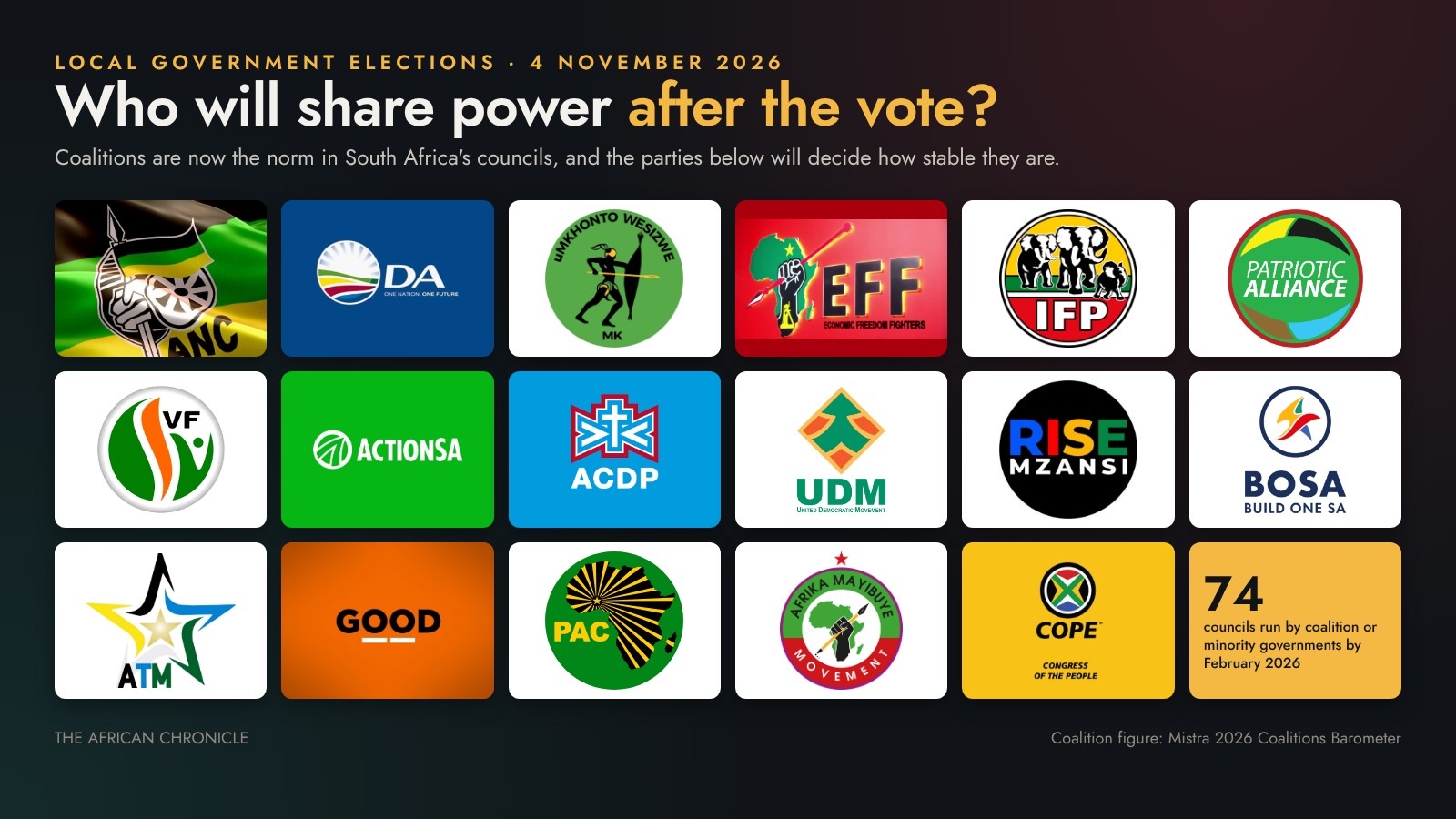
By February 2026, 74 municipalities were operating under coalition or minority arrangements, according to the Mapungubwe Institute for Strategic Reflection’s (Mistra) 2026 Coalitions Barometer.
The report found that 80 of South Africa’s 213 directly elected councils had been hung at some point between the 2021 elections and February 2026. Half of the governing administrations lasted less than 651 days, roughly 21 months.
Johannesburg and Karoo Hoogland in the Northern Cape each went through six administrations during that period, the highest number among the municipalities studied.
Political analyst and Wits University professor emeritus Susan Booysen expects coalition government to spread further. Speaking at The Gathering in September, she projected that the number of local coalitions could rise from about 88 to 110 after the elections, with coalition-run metros increasing from five to seven.
Stability determines whether coalitions deliver
Analysts say the central challenge is whether coalition partners can agree on a programme and sustain it.
Mielani Oleny, a local governance expert and chief adviser at Ndebele Consulting, said stable leadership was essential.
“Unity and agreement among coalition members are paramount,” he said.
Successful coalitions, Oleny said, approve budgets on time, follow the municipal calendar and maintain administrative oversight. Those foundations allow them to fulfil their commitments to residents.
Mistra’s findings underline the importance of coalition composition. Governing arrangements that excluded the largest party in a council collapsed at about four times the rate of those that included it.
Terry Tselane, executive chairman of the Institute of Election Management Services in Africa and a former Electoral Commission deputy chairperson, said a shared programme was indispensable.
“There’s got to be a programme. You can’t have a coalition without a programme,” he told Daily Maverick.
Smaller parties gain greater influence
Ofentse Davids, a research associate at the Centre for Risk Analysis, said declining support for the ANC was contributing to the growth of coalition government.
ALSO READ: The kingmakers’ elections: What the world should watch on 4 November
“The ANC’s decline and the lack of a strong alternative mean that more municipalities and provinces will operate under coalition arrangements,” he said.
Davids expects coalitions to become increasingly common at local and national level as voting patterns change.
According to Booysen, the ANC still holds outright majorities in about 105 of South Africa’s 205 local municipalities. However, she warned that smaller parties were exercising influence disproportionate to their electoral support.
She described micro parties as “strident in kingmaking, claiming inordinate power and distorting democracy.”
The formation of the national Government of National Unity (GNU) in June 2024 has not produced a corresponding shift in municipal cooperation.
Mistra found that none of the municipal administrations covered by its study since 2021 had included both the ANC and DA as governing partners, either before or after the GNU’s formation.
The report described national and local coalition politics as operating on “two separate tracks that only rarely interact with each other.”
Political differences complicate cooperation
Professor André Duvenage said some coalitions brought together parties with fundamentally different ideologies, making agreement difficult from the outset.
“Coalition politics arise in an unstable environment characterised by conflicting worldviews,” he said.
Existing weaknesses in local government compound those tensions, Duvenage added. He called for legislation that would make coalition agreements binding and strengthen political stability.
Dr Harlen Kluiter of the University of the Free State said parties needed greater political maturity, particularly in municipalities where cooperation between major parties had repeatedly broken down.
“The two biggest losers need to come together and prioritise what is best for South Africa,” he said.
Kluiter warned that continued failure to cooperate would deepen instability as increasingly fragmented voting patterns produced more coalition councils.
Coalition legislation will arrive too late
The Municipal Structures Amendment Bill, approved by Cabinet for tabling in July, would require parties in hung councils to enter into compulsory, legally binding coalition agreements.
Those agreements would have to be filed with the municipal manager, submitted to the provincial MEC responsible for local government and published in the Provincial Gazette.
The bill would also restrict motions of no confidence to one every 12 months, with exceptions for circumstances such as financial misconduct, criminal convictions or serious breaches of the code of conduct.
However, the legislation is not expected to be passed before polling day.
ALSO READ: Coalition Bill moves ahead in South Africa as November local elections loom
“It seems the bill will not be approved before the election. This process will proceed post November 4,” Cooperative Governance and Traditional Affairs communications director Legadima Leso told Business Day.
Incoming councils will therefore begin negotiating their governing arrangements without the proposed safeguards.
Residents bear the consequences of weak governance
The coalition debate comes against a broader record of poor municipal financial management.
In her 2024–25 local government audit report, tabled in June, Auditor-General Tsakani Maluleke found that only 39 municipalities, or 15%, achieved clean audits.
Municipalities recorded R36.05 billion in unauthorised expenditure and R40.14 billion in irregular expenditure during the financial year. They also spent a record R1.61 billion on consultants to help prepare financial statements.
“Over the past four years, mayors and councils of the 6th administration have made limited progress,” Maluleke said.
Her office warned that changes in political leadership after elections often contributed to further deterioration in audit outcomes.
“The calibre and capability of the elected leaders will determine the success of the 7th administration,” she said.
These findings concern municipal governance more broadly, but they illustrate the difficult financial and administrative conditions that incoming councils will inherit.
For residents, the consequences become apparent when municipalities cannot maintain infrastructure, manage spending or provide reliable basic services.
Voters want cooperation and reliable services
An Ipsos poll cited by Booysen suggests that voters are more receptive to cooperation than the political disputes might indicate: 54% of South Africans supported parties working together in local government, while 28% opposed it.
Residents’ expectations remain practical: running water, reliable electricity and regular refuse collection.
Booysen warned that those priorities could be overshadowed by negotiations over political control.
“Governance will be a secondary thought as parties wheel and deal to construct a majority.”
With coalition legislation delayed, the next councils’ stability will depend heavily on the agreements parties reach after 4 November and whether they sustain those commitments once positions have been allocated.
For residents, the test will be whether those agreements produce functioning municipalities and dependable services.