JOHANNESBURG – South Africa is being urged to intervene urgently in the proposed $60-billion merger between Anglo American and Canada’s Teck Resources, a deal that could accelerate Anglo’s withdrawal from the country and shift the centre of gravity of one of the world’s biggest mining groups to Vancouver.
A new 25-page analysis by economist and mining policy specialist Duma Gqubule warns that the transaction is being sold as a “merger of equals,” but is in reality a political bargain that hands out oversized benefits to Canada while weakening the position of countries that actually host Anglo’s mines.
“This is not a merger of equals,” he writes, noting that Anglo’s revenues, market value and earnings far exceed Teck’s. “Talk of ‘a merger of equals’ is political – to justify giving most of the benefits to Canada after intense pressure from its government, including prime minister Mark Carney and industry minister Mélanie Joly.”
A merger that shrinks South Africa’s historic mining champion
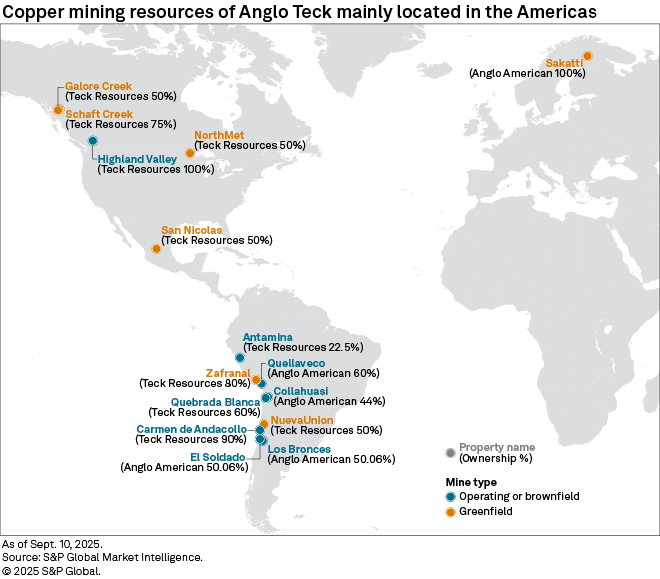
If the deal goes ahead, the new company, Anglo Teck, will control copper, iron ore and zinc assets across South America and Africa. But in South Africa, Anglo will be left with only one remaining asset: Kumba Iron Ore. Even that, Gqubule warns, is likely to be sold.
“After the merger, Anglo Teck will remain with one asset – Kumba Iron Ore – in the country. According to some analysts, Kumba will eventually be sold,” he notes, citing a JP Morgan view that the new group could divest iron ore to become a pure copper player.
This would mark a dramatic fall from Anglo’s once-towering presence. In the 1990s, the group controlled companies worth 43% of the JSE’s market capitalisation. In 2015, it still employed more than 88,000 workers in South Africa. But after years of restructuring, divestment and offshore shifts, a complete exit is now in sight.
ALSO READ: South Africa’s coal mines are leaking methane – and no one knows how much
“A complete exit would be a sad ending for Anglo, which Ernest Oppenheimer established in 1917 and grew to become by far the largest company in South Africa,” Gqubule writes.
Why Canada stands to gain — despite contributing very little
One of the most contentious elements of the deal is the suite of concessions made to Canada in order to secure regulatory approval. These include:
- Relocating the new company’s global headquarters to Vancouver
- Appointing Teck’s chair, Sheilla Murray, as chair of the Anglo Teck board
- placing a “substantial proportion” of the board and top executives in Canada
- committing CAD 4.5 billion (about R55 billion) in investment over five years
Yet Teck’s Canadian operations contributed only 3.4% of combined revenue in 2024.
Gqubule frames this imbalance bluntly:
“Why does Canada, a country that is not even a shareholder in Anglo Teck and contributes so little to its revenues, have such a large say over the fortunes of a company that will derive more than 90% of its revenues from four countries that are in the Global South?”
Canadian regulators have already pressured the companies to make even deeper commitments. Industry Minister Mélanie Joly has publicly said Anglo’s pledges are “not enough” and that Canadians “should get more of this merger.”
Benefits to South Africa fall far behind
Anglo has since highlighted two commitments:
- R600 million for a junior mining exploration fund with the IDC
- R11.2 billion for new processing technology at Sishen
But these offer limited comfort. The Sishen project dates back to 2021 and is already underway. Only R7.6 billion in new investment will be spent over the next four years.
“The investment in Canada is seven times larger,” Gqubule writes.
He argues that these local commitments “would have happened without the planned takeover of Teck.”
Global South resources, Global North control
The report questions how a company overwhelmingly dependent on mines in South Africa, Chile, Peru, Brazil, Botswana and Namibia could be governed primarily by Canadian and British interests.
“What right does Anglo Teck have to play monopoly with the natural resources of South Africa, Chile, Peru and Brazil?” Gqubule asks.
ALSO READ: Congo-Rwanda draft deal outlines role of US, others in revamp of minerals sector
He adds that Botswana and Namibia will also be affected because Anglo is in talks to sell De Beers, which depends heavily on diamond production from these two countries.
A proposal: South Africa should seize the moment
Gqubule calls on the South African government to block the merger in its current form and instead push for a demerger of Anglo’s South African assets into a new, state-led mining company.
He argues that the Public Investment Corporation (PIC), the Industrial Development Corporation (IDC) and community trusts already hold valuations that could give them a combined 50% ownership of such an entity.
“There should be a demerger of Anglo’s South African assets into a new listed state-led mining holding company,” he writes. “Before Anglo discards Kumba, South Africa must stop its takeover of Teck and bring back our minerals.”
The proposed structure would create a national mining champion, consolidate iron ore, manganese and diamond assets, and prevent South Africa from losing strategic control over its mineral endowment.
A pivotal decision ahead
With Canada demanding more concessions and Anglo fighting to push the merger through, the next few months will shape the future of one of the most influential mining companies on earth and determine whether South Africa remains part of that story.
What is clear from Gqubule’s report is that, in his view, the deal is not simply a business transaction. It is a shift in power over resources, capital and influence. And unless South Africa asserts itself now, he warns, it may find itself on the outside looking in as its century-old mining champion leaves for good.