PRETORIA – The Public Protector has provisionally found systemic deficiencies in the administration, governance, funding and oversight of South Africa’s student financial aid system, warning that recurring failures are prejudicing students’ ability to access and complete higher education.
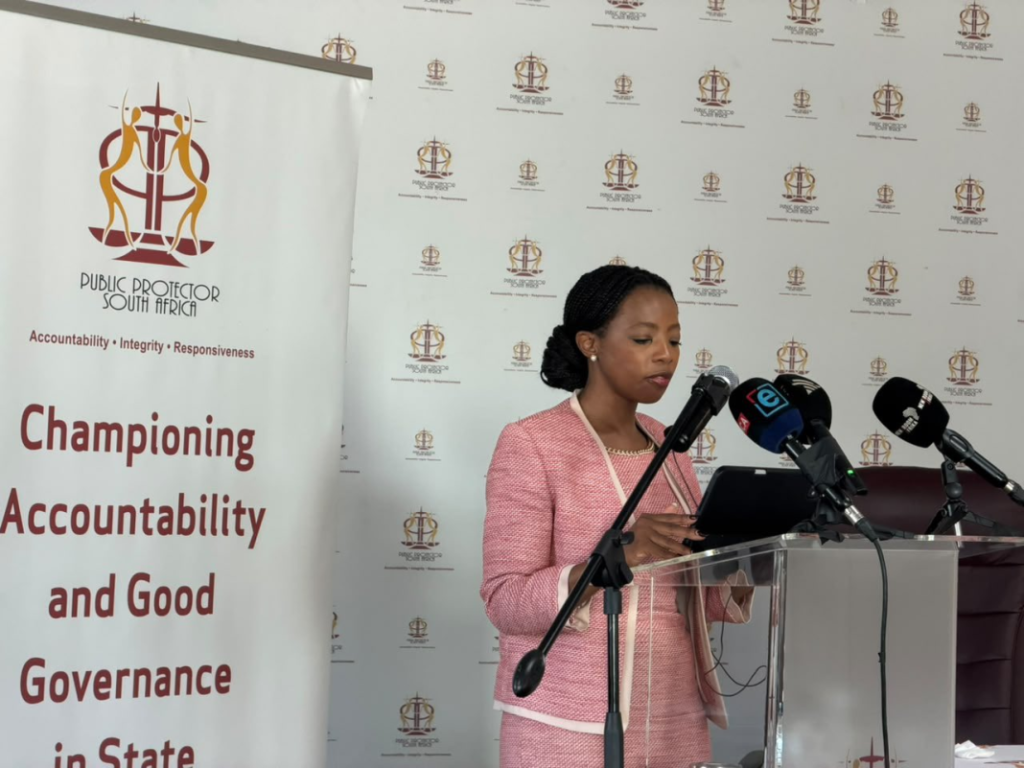
Public Protector Adv. Kholeka Gcaleka made the finding on Tuesday in Pretoria, when she released a Section 7(9) notice for a systemic investigation into the National Student Financial Aid Scheme (NSFAS), the Department of Higher Education and Training (DHET), universities, and other sector role players.
“This is an own-initiative systemic investigation,” Gcaleka said, explaining that complaints initially raised about NSFAS had revealed “broader and systemic challenges confronting the higher education sector”.
The investigation found recurring problems, including delays in funding decisions and allowances, appeal backlogs, inconsistent funding criteria, poor communication with students, unresolved tuition accounts, and weaknesses in coordination among NSFAS, DHET, and institutions.
Gcaleka said the investigation had established that the allegation of systemic deficiencies in the administration, governance, funding, coordination, and oversight of student financial aid within the higher education sector is substantiated.
However, the findings remain provisional. The Section 7(9) notice gives affected and implicated parties 60 days to respond.
Gcaleka stressed that the notice does not prevent respondents from changing the outcome.
“It is important to note that issuing a notice in terms of Section 7(9) does not mean that affected and implicated persons may not, upon submission of substantive representations, persuade the Public Protector to reach different conclusions,” she said.
A major concern is NSFAS’s organisational instability. The investigation found repeated governance and administrative problems, with NSFAS subjected to Section 17A interventions three times in eight years, in 2018, 2024 and 2026.
READ MORE: 70-years Later, the Freedom Charter Still Holds the Map—But Will We Follow It?
The Public Protector linked this instability to delays experienced by students in funding confirmations, allowance payments, appeals and the settlement of tuition accounts.
“The evidence gathered depicts NSFAS as an institution affected by persistent governance instability, administrative weakness and inadequate systems,” Gcaleka said.
The investigation also criticised the incomplete NSFAS Close-Out Project, which began in 2021 to reconcile financial information between NSFAS and higher education institutions.
Twelve complaints involving unresolved tuition payments, collectively worth R601,000, resulted in students being unable to obtain their certificates after completing their studies.
The accounts were eventually settled following Public Protector intervention.
Gcaleka said that withholding qualifications due to unresolved student debt could have serious consequences.
This includes limiting graduates’ ability to access employment, pursue further studies and participate meaningfully in the labour market.
The investigation further found weaknesses in NSFAS’s accessibility. NSFAS reportedly indicated that 80% of queries received through its contact centre could not be resolved there and required escalation to other units.
Concerns were also raised about the slow implementation of the 2022 Ministerial Task Team recommendations on student funding. Of particular concern was support for the “missing middle” and postgraduate students.
NSFAS received 43,261 applications from students eligible for missing-middle funding but could not roll out the scheme because a new loan system still needed to be procured.
The Public Protector intends to recommend stronger oversight, improved NSFAS systems, clearance of appeal backlogs, better inter-agency data sharing and binding service standards for funding decisions.
Gcaleka said the investigation’s purpose was ultimately “not merely to identify instances of maladministration”, but to determine the root causes of recurring failures and propose “practical, sustainable and systemic remedial measures”.
Student accommodation was excluded from the current investigation and will be dealt with separately.
However, the Public Protector urged government to act urgently on unsafe and inadequate student housing.
FACT-BOX
Investigation: Systemic investigation into student financial aid
Public Protector: Adv. Kholeka Gcaleka
Notice: Section 7(9), Public Protector Act
Response period: 60 days
NSFAS interventions: 2018, 2024 and 2026
Improperly funded students: More than 40,000 across 76 institutions, according to SIU findings cited in the notice
Estimated value: R5.1 billion
Recoveries: More than R2 billion
Close-Out complaints: 12 cases worth R601,000
Missing-middle applications: 43,261
NSFAS queries: 80% reportedly required escalation
Accommodation: Subject to a separate systemic investigation