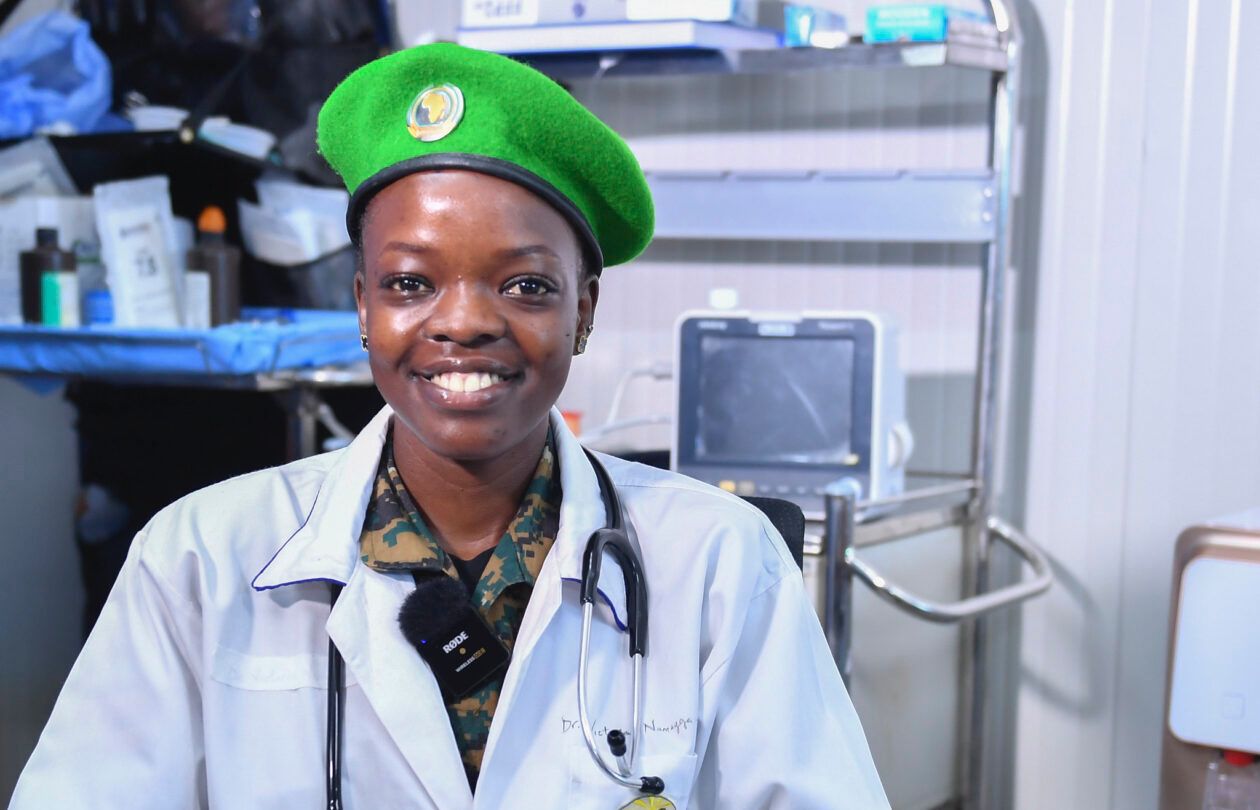
MOGADISHU, Somalia — The sound of artillery is not what most doctors expect to hear when they begin their working day.
For Lt. Dr Victoria Namagga, however, it has become part of the environment in which she practises medicine.
Thousands of kilometres from the place where her medical journey began, the Ugandan doctor is working in one of the world’s most challenging medical environments, providing care to soldiers and civilians in Somalia while serving with the Uganda Battle Group 44 under the African Union Support and Stabilisation Mission in Somalia (AUSSOM).
Her journey to the frontline did not begin with the military.
It began in a refugee settlement.
A lesson in Nakivale
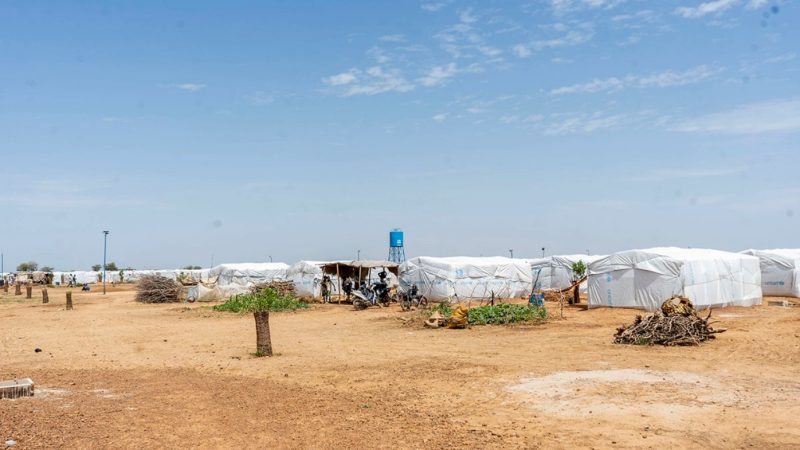
In 2019, Namagga arrived at Nakivale Refugee Settlement in western Uganda as a medical intern.
She had gone there to practise medicine and gain experience. Instead, she encountered a side of human suffering that would fundamentally shape her understanding of what it means to be a doctor.
Nakivale is one of Africa’s largest and oldest refugee settlements, home to people who have fled conflict, persecution and instability in countries across the region.
Behind the statistics were individual lives.
Namagga encountered people who had lost homes, livelihoods, relatives and, in some cases, their sense of security. Some carried physical injuries. Others carried trauma that could not be detected through a scan or treated with a prescription.
She learned that a patient could need far more than medicine.
Sometimes, the first step towards recovery was simply knowing that someone cared enough to listen.
The experience left a lasting impression.
Namagga began to see medicine not merely as the diagnosis and treatment of disease, but as an opportunity to restore dignity, confidence and hope to people at their most vulnerable.
That conviction would eventually influence one of the biggest decisions of her life.
Choosing a different path
In 2021, Namagga joined the Ugandan military.
For her, the decision was not simply about becoming a soldier. It was about finding another way to serve.
“I purposed to be part of something bigger than myself where I can make a difference in someone’s life,” Namagga says.
That sense of purpose has since taken her into environments where medical care is delivered under extraordinary circumstances.
ALSO READ: ‘We Just Needed a Hospital’ – The Struggle for Mothers and Children in Somalia’s Southwest
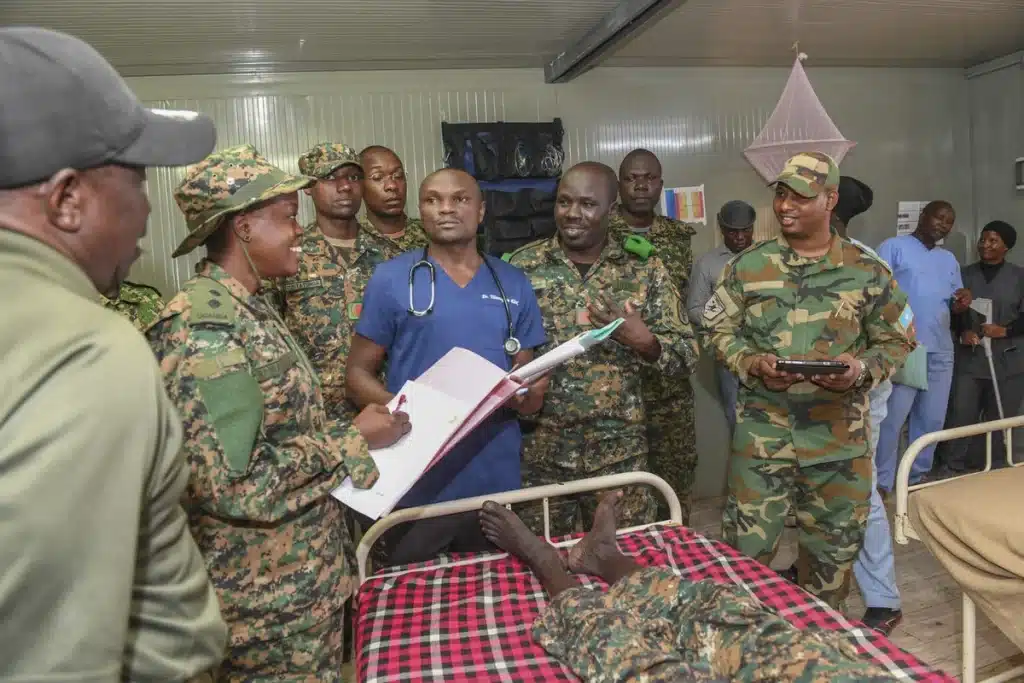
Today, she serves in Somalia as Lt. Dr Victoria Namagga, leading the medical component of Uganda Battle Group 44.
Her workplace is a field hospital, but the patients who arrive there are not defined by one category of illness or injury.
Some are soldiers wounded in combat.
Others are civilians seeking treatment for conditions that have nothing to do with the battlefield.
Together, they reflect the complicated reality of providing healthcare in a country that has endured decades of insecurity and conflict.
Medicine under fire
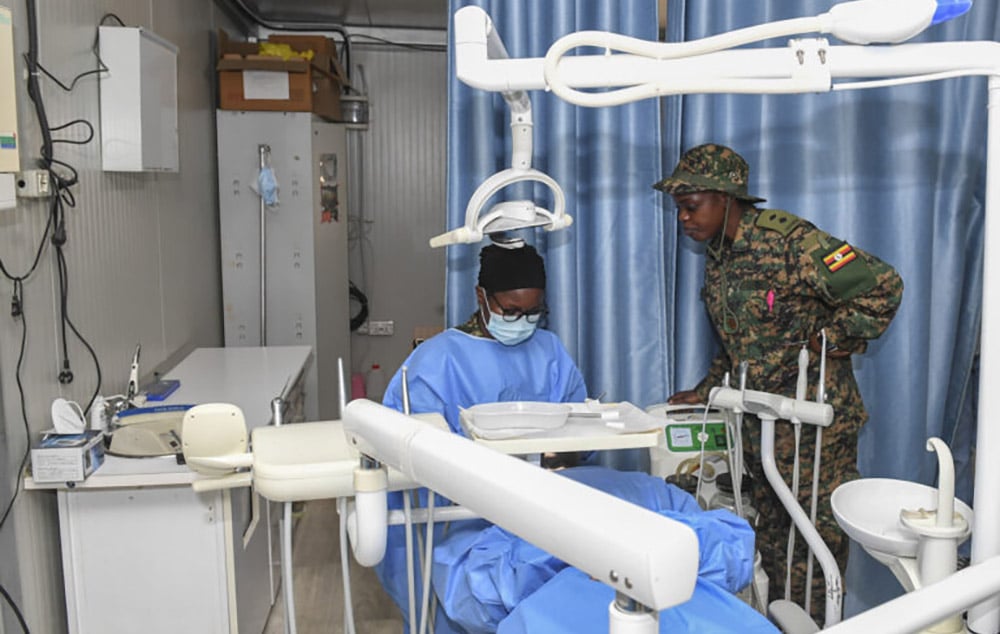
Inside the field hospital, the work follows the familiar routines of medicine, but the circumstances are anything but ordinary.
The day begins with clinical rounds before moving into outpatient consultations, emergency treatment, trauma care and surgery.
Medical personnel treat a wide range of conditions, including battle injuries, burns, malaria, dengue fever, hernias and congenital conditions.
The team must be prepared to respond when casualties arrive unexpectedly.
For doctors and nurses working in a conflict-affected environment, clinical decisions can have to be made quickly, sometimes with limited resources and under the pressure of an unpredictable security situation.
Namagga does not hide the reality of the deployment.
At forward operating bases, particularly those closer to the frontline, the sound of heavy artillery is a reminder that the medical team is operating in a theatre where danger can arrive without warning.
Every soldier deployed in such an environment understands that they could become a casualty.
For a military doctor, that reality carries an additional responsibility: caring for others while knowing that you, too, are exposed to the same risks.
Yet fear has not diminished Namagga’s commitment.
A hospital for soldiers and civilians
One of the most significant aspects of her work is the treatment of civilians.
People travel from different parts of Somalia in search of medical assistance. Some travel considerable distances because they have few alternatives for accessing healthcare.
For many of those who arrive at the AUSSOM field hospital, treatment is provided without charge.
That makes the hospital more than a facility for treating military personnel. It becomes an important point of access to healthcare for civilians living in communities where medical services can be difficult to reach.
Namagga says the gratitude of those patients remains one of her greatest sources of motivation.
“When they come here, they have this hope, this confidence that they’re going to get the solution that they’re looking for.”
ALSO READ: U.S. Aid Cuts Disrupt Life-Saving Treatment For Starving Children In Kenya
For her, the significance of the work cannot be measured only by the number of patients treated or procedures performed.
There is also the human connection.
A patient arrives frightened or in pain. A medical team intervenes. Eventually, that patient walks out of the hospital able to return home.
That moment, however small, is what keeps Namagga going.
“I’m very passionate about being a doctor and being able just to serve people and put colour in their lives,” she says.
Then there are the patients who provide an even more direct reminder of why she chose this profession.
“When the civilians come, and then they go back smiling, they go back thankful. It’s easy. I wake up feeling motivated.”
Building trust beyond the operating theatre
Namagga’s work in Somalia is not limited to treating patients.
She and her medical team also work alongside Somali doctors serving with the Danab special forces, creating opportunities to exchange medical knowledge, experience and skills.
The collaboration is important in an environment where relationships and trust can be as valuable as medical expertise.
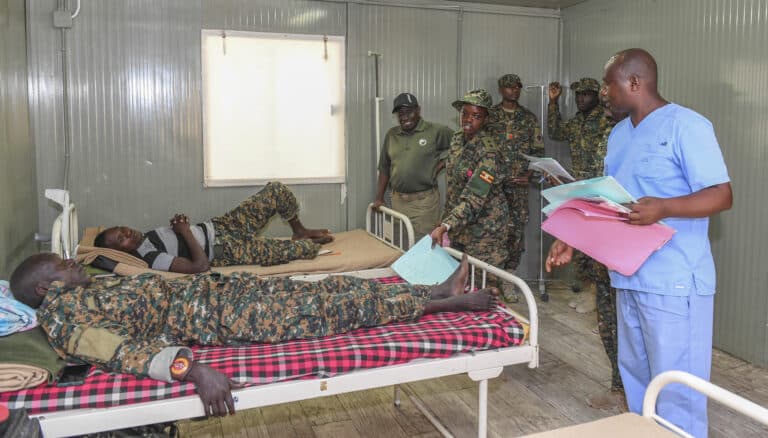
Through their interactions, the doctors learn from one another while strengthening professional ties between Ugandan and Somali medical personnel.
For Namagga, it reinforces a lesson she first learned in Nakivale.
Healthcare is not simply about treating the physical condition in front of you.
It is also about understanding the person behind the illness or injury.
It is about building enough trust for someone who has experienced loss, conflict or displacement to believe that help is possible.
From a refugee settlement to the frontline
The distance between Nakivale and Mogadishu is measured in thousands of kilometres.
But for Namagga, the two places are connected by a single thread.
In Nakivale, she encountered people whose lives had been shattered by conflict and displacement.
In Somalia, she is working directly in an environment shaped by conflict, providing medical care to those caught in its consequences.
The circumstances are different, but the fundamental mission remains the same.
Serve people when they are most vulnerable.
Restore what can be restored.
And give people a reason to believe that their circumstances can change.
For a doctor, that can mean performing an operation that saves a life.
It can mean treating a soldier wounded in battle.
It can mean providing a civilian with access to medical care they might otherwise never receive.
And sometimes, it can simply mean being there.
Namagga knows the risks of the place where she works. She hears the artillery. She sees the injuries. She understands that the line between being a caregiver and becoming a patient can be frighteningly thin.
Still, each morning she returns to the hospital.
Her journey from Nakivale to Somalia has transformed medicine from a profession into a vocation of service.
She first entered a refugee settlement as an intern hoping to treat patients.
Years later, she finds herself treating patients in a conflict zone, carrying the same conviction that took root in her years ago: that healing is about more than keeping people alive.
It is about helping them recover their belief in life.
And perhaps that is where Namagga’s courage is most clearly found.
Not in the absence of fear, but in the decision to keep walking towards those who need help, even when the world around them is telling them to run.