Liberia’s president met White House Faith Office adviser Paula White-Cain during his US visit, highlighting the longstanding relationship between the two countries as migration, visas, aid and trade remain key issues in the wider bilateral relationship.
Boakai Takes Faith and Friendship to the White House as Deportees, Visas and Aid Test US-Liberia Ties
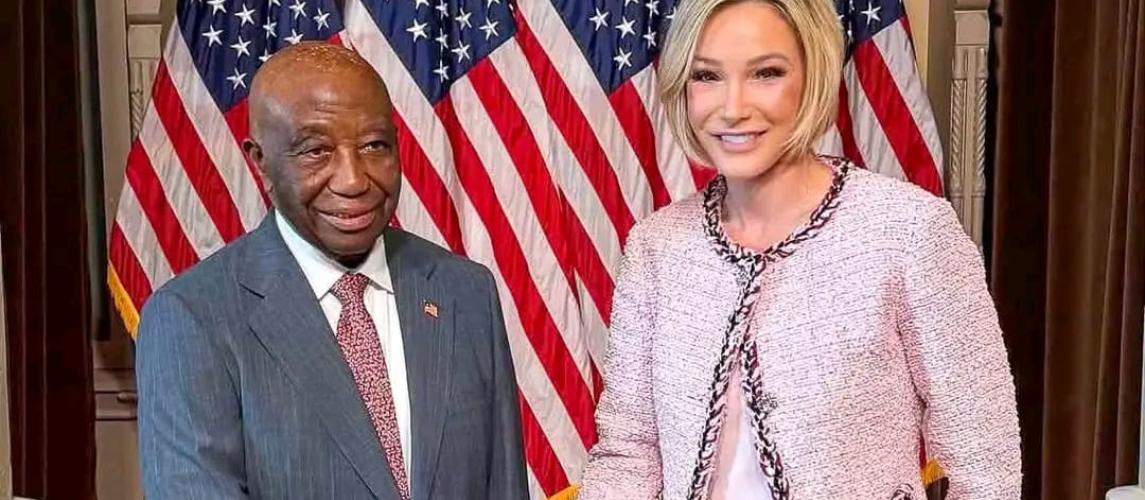
WASHINGTON, DC, – Liberian President Joseph Boakai has used a White House meeting with Paula White-Cain, senior adviser to the White House Faith Office, to underline what he described as Liberia’s “historic friendship” with the United States.
The meeting, held during Boakai’s current US visit, focused on faith, leadership and the longstanding relationship between the two countries, according to Liberia’s Executive Mansion.
“Liberia deeply values its historic relationship with the United States,” Boakai said. “We remain committed to strengthening this partnership for the benefit of our people.”
White-Cain described the meeting as a “tremendous honour” and said it had particular significance following her recent visit to Liberia, where she said she had “come to love deeply” the country and its people.
She described Boakai as a respected leader and a cherished friend.
The Executive Mansion said the engagement was intended to deepen cooperation in faith-based development, humanitarian assistance, education and people-to-people relations. It also said the meeting provided Boakai with an opportunity to promote Liberia’s interests among senior US government figures.
A relationship with a history
The relationship between Boakai and White-Cain predates the latest White House meeting.
Before Boakai became president, White-Cain publicly supported his candidacy and said the two had prayed together in Washington.
In July, she travelled to Liberia as a special guest for the country’s 179th Independence Anniversary celebrations. She delivered the sermon at the national Thanksgiving and Intercessory Service in Buchanan, Grand Bassa County, where she urged national leaders to embrace humility, integrity, accountability and service.
On 27 July, Boakai conferred on White-Cain the Grand Band of the Order of the Star of Africa, one of Liberia’s highest national honours, recognising what the Liberian government described as her religious and humanitarian engagement with Liberia and Africa.
ALSO READ: Boakai Tells Cabinet: ‘Procure With Accountability’ as Liberia’s Contracting System Faces Scrutiny
The White House Faith Office, where White-Cain serves as senior adviser, was established in February 2025. Its stated focus includes religious freedom, faith-based organisations and strengthening families.
For Boakai, the latest engagement was one part of a broader diplomatic mission aimed at strengthening Liberia-US relations.
The Executive Mansion’s statement on the White House meeting did not identify any new agreement arising from the engagement. It also did not say whether the two discussed trade, visas or migration specifically. Boakai was accompanied by Foreign Minister Sara Beysolow Nyanti, Cabinet Director General Nathaniel T. Kwabo and Liberia’s ambassador to the United States, Al-Hassan Conteh, among other officials.
Part of a wider US mission
Boakai arrived in the United States in September for the 81st United Nations General Assembly and a series of meetings with US political and business figures.
The Liberian Embassy said he arrived in Washington on 14 September before travelling to New York for the General Assembly. He is scheduled to address world leaders on 24 September and will later return to the Washington area for the Liberia Annual Diaspora Conference.
His meetings on Capitol Hill have focused more directly on economic and diplomatic issues.
Boakai met Congressman Gregory Meeks, ranking member of the House Foreign Affairs Committee, for discussions on strengthening bilateral relations, trade and investment, energy, infrastructure, security and Liberia’s role on the UN Security Council.
He also met Senator Angela Alsobrooks of Maryland to discuss implementation of the Liberia-Maryland partnership signed in June. The agreement covers areas including trade and investment, education, workforce development, agriculture, technology, infrastructure, tourism and cultural exchange.
Boakai said the priority was to move the agreement “from paper to practical action”.
Migration puts the relationship under scrutiny
One of the most consequential issues in the broader US-Liberia relationship is migration.
Liberia has agreed to accept up to 1,200 third-country nationals removed from the United States over a 12-month period. The first group of 20 arrived in Liberia in August.
The arrangement is based on an exchange of notes between the two governments dated September 4 and September 10, 2025, according to the Liberian government.
The first group included people from countries other than Liberia. The United States has provided $5 million for migration-management activities, while Liberian officials have said the arrangement does not involve direct payment for accepting deportees.
The arrangement has attracted legal and human-rights scrutiny in the United States.
A US federal appeals court ruled on 18 September that migrants facing removal to third countries must have a meaningful opportunity to raise safety concerns before being deported. The ruling could have implications for the wider US policy of sending migrants to countries other than their countries of origin.
The Liberia arrangement therefore remains an important test of how the two governments manage migration while addressing legal and humanitarian concerns.
Visa restrictions remain another pressure point
Visa policy is another unresolved issue for Liberians travelling or seeking to settle in the United States.
The United States has paused immigrant visa issuance for nationals of 75 countries, including Liberia, since January. The Liberian government has said the measure should not be interpreted as a deterioration in Liberia-US relations.
At the same time, Washington previously extended the validity of multiple-entry visas for Liberians from 12 to 36 months and signed a US$124 million health memorandum with Liberia.
The broader question for Liberians affected by the immigrant visa pause is when normal processing will resume.
From aid to investment
The economic relationship is also shifting towards a greater emphasis on trade and investment.
US Chargé d’Affaires Joe Zadrozny recently told an event in Monrovia linked to the Millennium Challenge Corporation that Liberia could not build the economy it wants through assistance alone.
The event marked the opening of an office preparing Liberia’s second Millennium Challenge Corporation compact, which is intended to expand electricity access from about 33% to 75% over four years.
The emphasis reflects a broader discussion about how Liberia can use US support to attract investment and expand its productive economy rather than remain dependent on external assistance.
Liberia’s domestic economic test
Boakai is also conducting the US engagement against a backdrop of economic gains and continuing domestic pressures.
Liberia’s economy grew an estimated 5.1% in 2025, driven largely by mining, with iron ore production increasing by about 42%.
ALSO READ: Liberia Moves To Unlock Climate Finance With National Carbon Policy
Domestic revenue collections surpassed US$1 billion in September, a first for the country, although questions remain about how much of that growth is translating into improvements in household living standards.
Public debt stood at about US$2.83 billion at the end of March.
What the White House meeting means
The meeting with White-Cain reinforces the personal and faith-based dimension of Boakai’s relationship with influential figures around the White House.
But the wider Liberia-US relationship extends well beyond that connection.
Migration arrangements, immigrant visa processing, development assistance, infrastructure investment and trade are issues with direct consequences for Liberians at home and abroad.
Boakai has previously met US President Donald Trump and other senior US figures, including during a 2025 White House visit. His latest trip comes as Liberia seeks to deepen economic and diplomatic ties with Washington while navigating a changing US approach to migration and foreign assistance.
The immediate measure of the visit will therefore be the progress made on the practical issues facing both countries, including the treatment and status of third-country deportees, visa access and the implementation of development and investment programmes.
The White House meeting provided an opportunity to reaffirm friendship. The broader diplomatic agenda will determine what that relationship delivers.
Subscribe to Our Newsletter
Keep in touch with our news & offers
Thank you for subscribing to the newsletter.
Oops. Something went wrong. Please try again later.