WASHINGTON D.C., United States – The World Bank has raised its growth forecast for sub-Saharan Africa to 4.3% this year, but warned that the region’s economic recovery is still too weak to create enough jobs for its rapidly expanding workforce.
In its latest Africa Economic Update, released on Tuesday, the bank said the region was weathering the effects of war in the Middle East, climate shocks and declining development assistance better than expected.
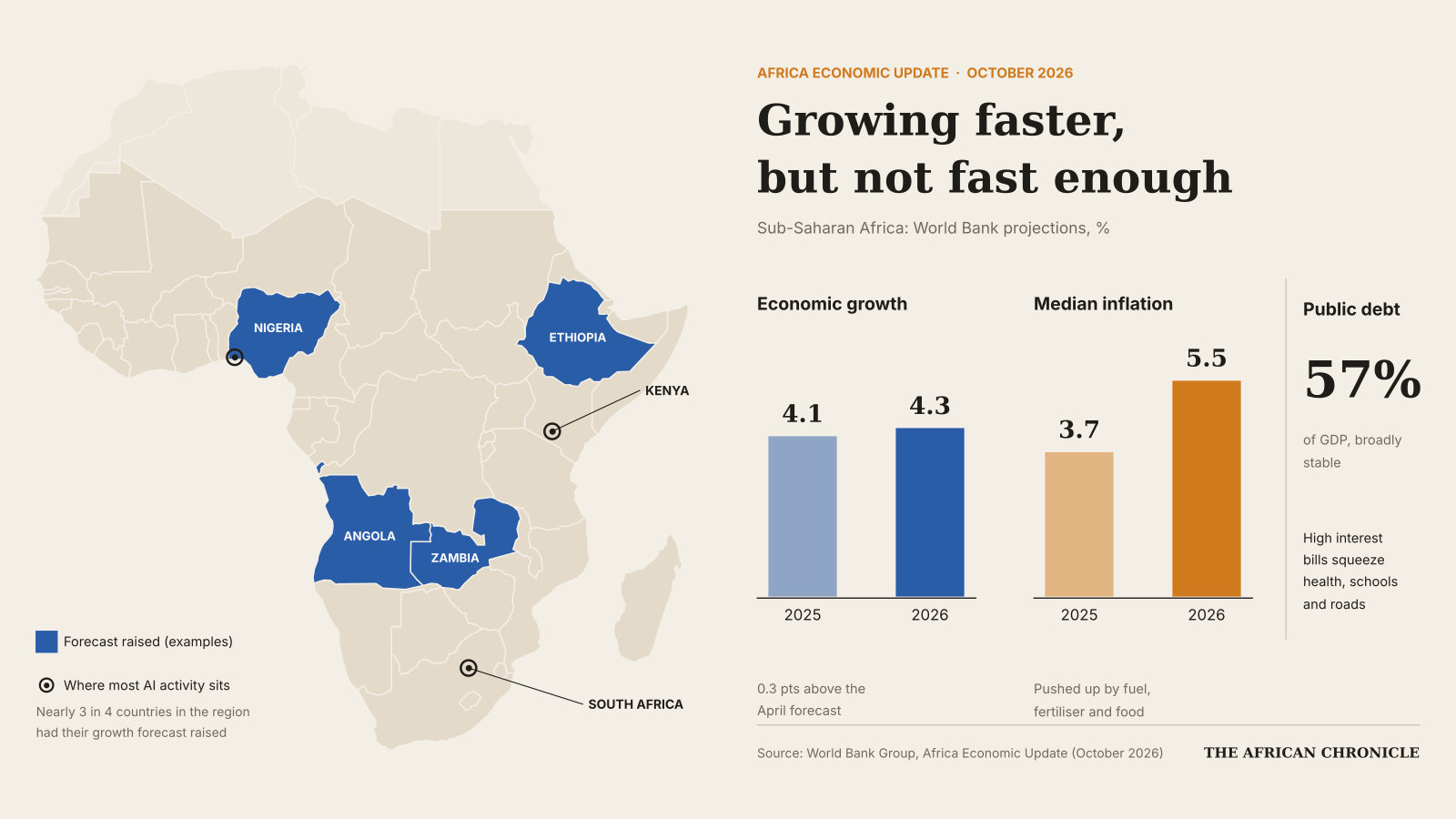
Growth is projected to rise from 4.1% in 2025 to 4.3% in 2026, an increase of 0.3 percentage points on the bank’s April forecast. It has upgraded its projections for nearly three-quarters of countries in the region, including Angola, Ethiopia, Nigeria and Zambia.
“Despite a challenging global environment, economic activity in Sub-Saharan Africa continues to demonstrate remarkable resilience,” said Andrew Dabalen, the World Bank’s chief economist for the Africa region.
“These gains reflect years of reforms and improved economic management. The next challenge is turning growth into more jobs and better opportunities.”
What Is Driving Africa’s Stronger Growth?
The bank attributes the improved outlook to stronger economic buffers, firmer domestic demand and investment linked to the global energy transition and digital technologies.
The upgrade follows a more cautious assessment in June, when its Global Economic Prospects report forecast regional growth of 4.0% for 2026. That report warned that higher energy prices linked to the Middle East conflict were pushing up inflation and tightening financial conditions.
The effects have been uneven. Higher oil prices can boost earnings for exporters such as Angola and Nigeria, while countries that depend on imported fuel and fertiliser face rising costs.
Even with the stronger outlook, the bank warns that growth remains insufficient to substantially reduce extreme poverty. Its June assessment projected growth in real income per person of just 1.6% this year, highlighting how population growth limits the gains available to individual households.
ALSO READ: ECOWAS, World Bank Advance West Africa Digital Identity Integration
Rising Prices And Debt Costs Squeeze Budgets
Higher living costs are also threatening some of the region’s recent progress in bringing inflation under control.
Median inflation in sub-Saharan Africa is projected to rise from 3.7% in 2025 to 5.5% in 2026, driven by increases in global fuel, fertiliser and food prices.
Public debt has broadly stabilised at about 57% of gross domestic product. However, servicing that debt remains expensive, leaving governments with less money for health, education and infrastructure.
Declining development assistance adds to the pressure. The bank says countries need to raise more revenue domestically, deepen local capital markets and develop more sustainable sources of financing.
These constraints leave governments facing competing demands: containing debt costs while investing in the services and infrastructure needed to support growth and employment.
Conflict And Climate Shocks Threaten The Outlook
The bank cautions that risks to its forecast remain tilted towards weaker growth.
Further geopolitical tensions could drive commodity prices higher, intensify inflation and worsen trade balances and public finances in vulnerable economies.
Climate shocks pose another threat. A possible El Niño could damage harvests and deepen food insecurity, adding to the strain on households already struggling with rising prices.
Tighter global financing conditions would further restrict governments’ ability to borrow and spend, complicating efforts to sustain the recovery.
Why The World Bank Is Backing “Small AI”
Alongside its economic assessment, this edition of the report examines how artificial intelligence could help African countries improve productivity, strengthen public services and create jobs.
AI adoption remains at an early stage across much of the continent, with activity concentrated in a handful of economies, notably Kenya, Nigeria and South Africa.
The bank argues that the region’s greatest opportunity lies in affordable, locally adapted “small AI”: tools that can operate with limited bandwidth and address practical needs in education, agriculture, healthcare, finance, logistics and public administration.
“By investing in the foundations of an AI-ready economy, African countries can unlock productivity gains, spur innovation, and accelerate the structural transformation needed to raise living standards and reduce poverty,” Dabalen said.
Realising those benefits will require reliable electricity, affordable internet access, digital skills, quality data, computing infrastructure and sound governance.
The report also calls for stronger institutions, technical capacity and regional cooperation, including through the African Union’s Continental AI Strategy and the African Continental Free Trade Area.
For the region, the challenge is to turn a stronger growth outlook and emerging technologies into higher productivity, better incomes and enough jobs for the people entering its labour market.