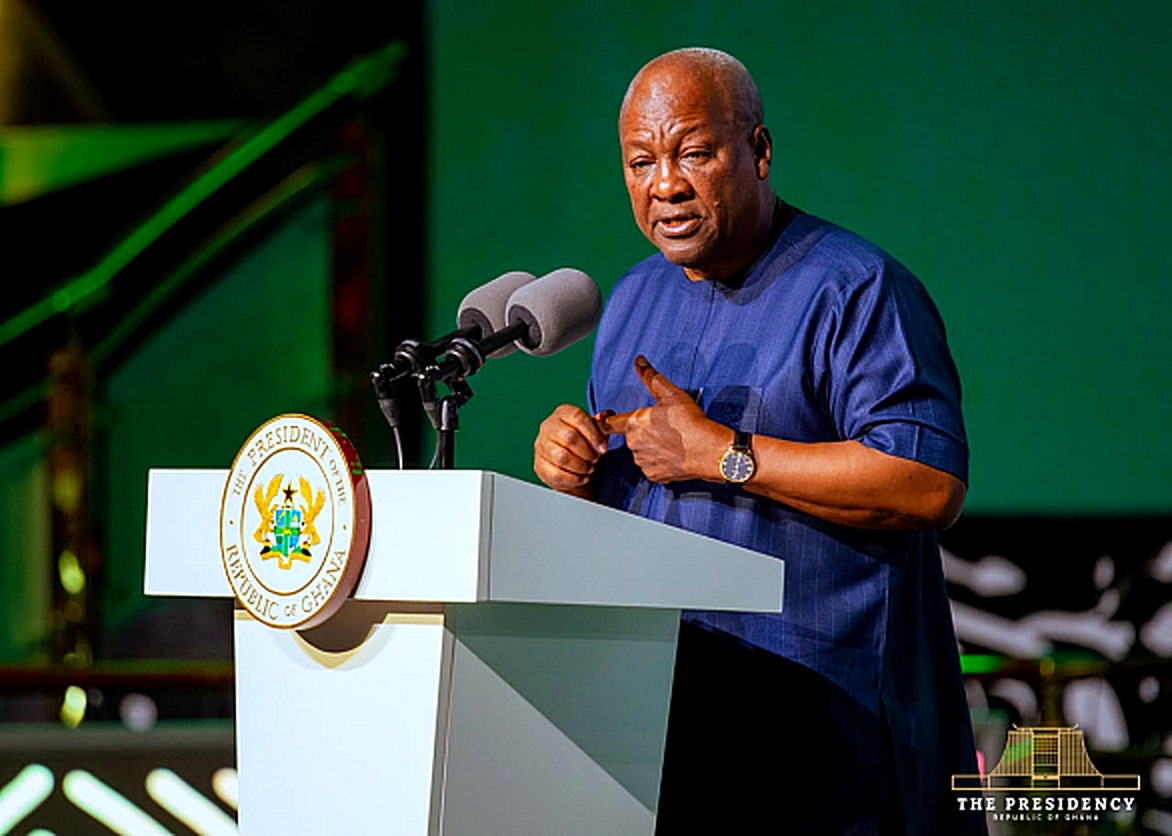
ACCRA, Ghana: President John Dramani Mahama has put mining companies on notice that Ghana intends to end exports of unprocessed mineral ores by 2030, but delivering that promise will require legislation and a rapid expansion of the country’s processing capacity.
Addressing the Mining in Motion Summit in Accra on Monday, 19 October, Mahama outlined a phased transition intended to turn Ghana’s mineral resources into domestic manufacturing, skilled employment and industrial growth.
The policy would affect resources including bauxite, manganese, iron and lithium. Its implementation will depend on requirements tailored to individual minerals, legal measures and clear timetables, according to the government’s account of his address.
For mining companies, the message is that access to Ghana’s deposits will increasingly carry obligations to process minerals locally. For the government, the challenge is to ensure that factories, electricity, transport infrastructure and financing are available before export restrictions take effect.
The deadline still needs legal backing
Mahama first announced the 2030 target in February and repeated it in New York in September. His latest address reinforces that direction, but a presidential pledge does not itself establish an enforceable export prohibition.
A September review by JoyNews Research found that Section 110 of the proposed Minerals and Mining Bill would allow the minister to restrict exports of unprocessed mineral concentrates and require domestic processing through subsequent regulations. The draft contained no 2030 deadline and did not make those measures automatic.
The timetable also extends beyond Mahama’s current term, which ends in January 2029. Carrying the policy through to its stated deadline would therefore require continuity under his successor.
The distinction matters to companies deciding whether to invest in processing plants. They need to know which products will be covered, how much processing will be required and when each restriction will begin.
Mahama’s proposed phased approach recognises that different minerals require different investments. The next test is whether those commitments become detailed, enforceable rules.
Manganese and bauxite face the biggest adjustment
Manganese and bauxite are likely to be more directly affected than gold because Ghana exports much of their production as ore.
The scale of the manganese trade illustrates the commercial stakes. According to Shanghai Metals Market, China imported 5.32 million tonnes of manganese ore from Ghana in 2025, an increase of 14.5% from the previous year. Ghana accounted for 16.2% of Chinese manganese ore imports, making it the country’s third-largest supplier.
Processing a greater share of that material domestically could retain more industrial activity in Ghana. It would also require companies to develop facilities capable of competing on cost, reliability and product quality.
ALSO READ: Ghana secures US$10m to advance its 24-hour economy projects
The question is therefore wider than whether Ghana can stop ore leaving its ports. It is whether domestic processors can turn that ore into products that manufacturers are ready to buy.
Gold follows a different path
Gold presents a different policy challenge. Large-scale miners already process ore into doré, a semi-pure alloy, before export. A prohibition focused on raw ore would therefore have a different effect on gold than on manganese or bauxite.
The government has separately moved to increase domestic gold refining. Under an agreement announced in June, large-scale mining companies are to sell 30% of their output to the Ghana Gold Board, known as GoldBod, in doré form for local refining.
GoldBod also directed self-financing aggregators to refine gold doré in Ghana before exporting it, effective from 1 September 2026.
These measures show why the detail of the proposed restrictions matters. Mining, concentrating, smelting and refining represent different stages of production. The government will need to specify which stage each mineral must reach before it can be exported.
VALCO will test the industrial promise
Ghana’s aluminium industry offers perhaps the clearest test of whether the 2030 ambition can become an operating industrial system.
The government wants to connect domestic bauxite production to alumina refining, aluminium smelting and the manufacture of finished products. That requires both a refinery and the modernisation of the Volta Aluminium Company, or VALCO.
In January, Lands and Natural Resources Minister Emmanuel Armah-Kofi Buah urged the selected investor to begin modernisation work in 2026 and increase VALCO’s annual production from about 40,000 tonnes to at least 200,000 tonnes by the end of 2028.
“The refinery will feed the smelter, the smelter will anchor downstream aluminium manufacturing,” Buah said when an investor-selection committee presented its report.
The ministry described the projects as interdependent, requiring investment in power, logistics, rail and port infrastructure. Buah projected that a fully operational VALCO would provide at least 6,000 direct jobs. That remains a government employment forecast, dependent on the investment being delivered.
The aluminium programme will therefore be judged by construction, reliable production and sales, as well as investment announcements.
Lithium raises the processing question
Ghana’s emerging lithium industry adds another layer to the debate.
Parliament ratified the mining lease for Atlantic Lithium’s Ewoyaa project in March 2026, making it Ghana’s first ratified lithium mining lease. The project is designed to produce spodumene concentrate suitable for further conversion into materials used in electric vehicle batteries.
ALSO READ: Hichilema warns mining licence holders to develop projects or lose their rights
Producing concentrate involves processing, but it does not amount to manufacturing battery chemicals, components or finished batteries.
That distinction will be important when Ghana defines its export rules. A requirement to concentrate ore locally would set a different industrial obligation from a requirement to convert lithium into battery-grade chemicals.
Huayou’s proposed acquisition of Atlantic Lithium also puts the ownership and investment structure of the project under scrutiny. A regional competition notification published in August described the transaction as a proposed acquisition of sole control of Atlantic Lithium.
For Ghana, the policy question is what processing capacity, technology and local participation such investment will deliver.
Investors need rules they can build around
Mahama has acknowledged that processing obligations must be matched by government action on infrastructure, skills and financing.
That balance will determine whether the policy attracts investment into factories or creates uncertainty around existing mining operations.
Processing plants require substantial capital and long development periods. Investors need clarity on power costs, approvals, access to feedstock and the treatment of existing agreements. Communities, meanwhile, need enforceable environmental obligations and a clearer account of the benefits they should receive.
The government’s proposed mining reforms go beyond exports. A draft reviewed by Reuters in September would allow the state to require a special share carrying consent rights over certain major transactions, alongside shorter terms for new mining leases. Those proposals underline the wider shift towards stronger state influence over the sector.
An African ambition with a domestic delivery test
Mahama has also called for African countries to cooperate on mineral processing rather than compete for investment on terms that leave most industrial value elsewhere.
The government’s account of his summit address envisaged regional value chains in which minerals extracted in one country could be processed in another and supplied to manufacturers across the continent.
Liberia’s Vice President Jeremiah Kpan Koung similarly stressed the importance of reliable energy and transport infrastructure, stronger geological institutions, community participation and benefits that continue after mining ends.
For Ghana, however, the immediate delivery test is domestic: Parliament must establish the legal framework, investors must commit capital, and processing facilities must become commercially viable.