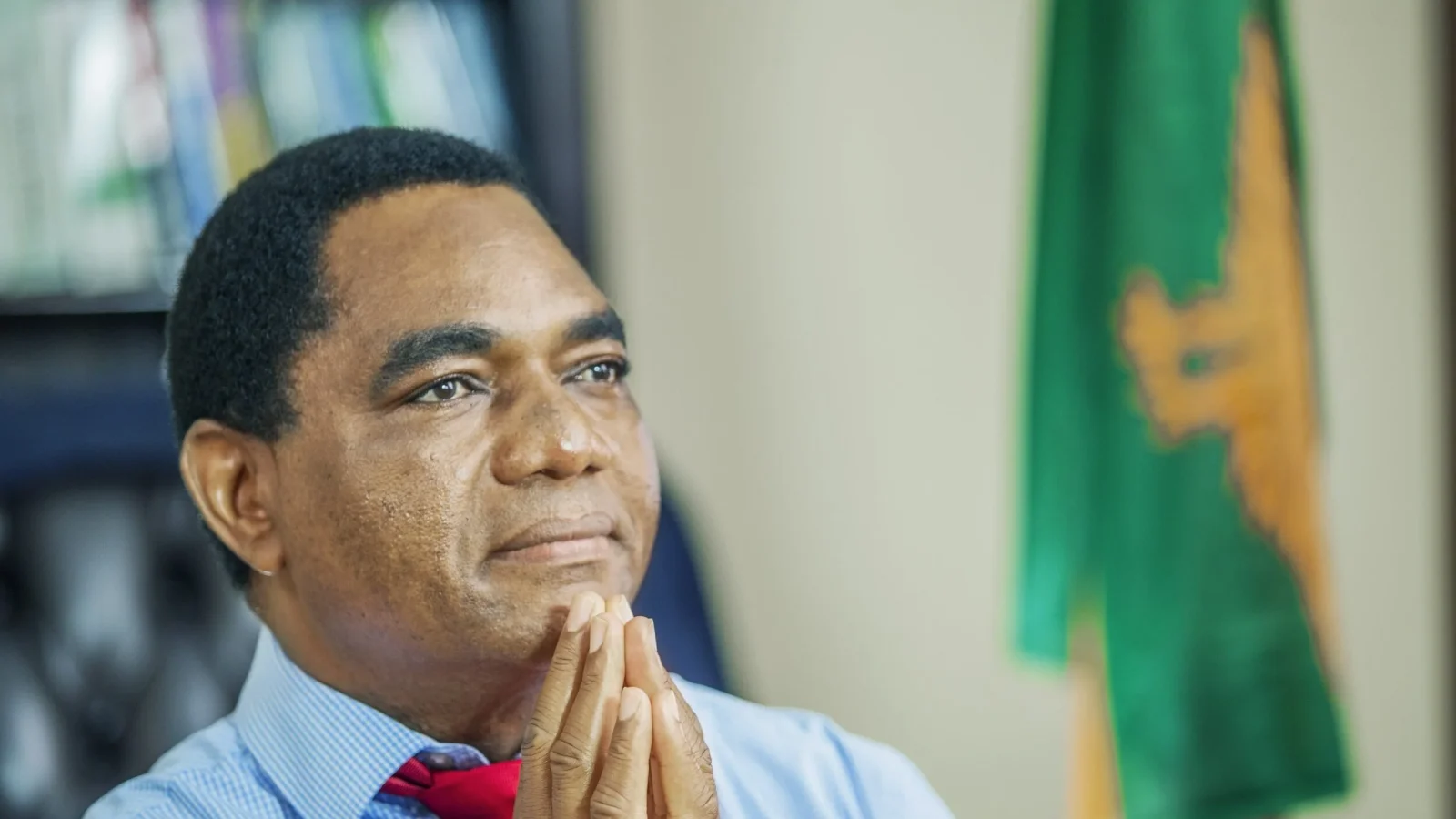
LUSAKA: President Hakainde Hichilema has warned that Zambia will reclaim mining licences held for speculation rather than development, saying dormant mineral rights are denying the country investment, jobs and revenue.
Speaking at the 2026 Zambia Mining and Investment Insaka in Lusaka, Hichilema said the government would apply a “use it or lose it” approach as it pursues its target of producing three million tonnes of copper annually by 2031.
“How can you sit on a licence for 25, 26 years?” he asked, according to the Lusaka Times, referring to a licence holder he said had received a final warning.
Hichilema said previous administrations had revoked the licence, only for the holder to regain it through negotiations or court proceedings.
“We don’t encourage mining in court here,” he said. “We want investments in the mining areas and in the boardrooms, not in courtrooms.”
His warning formed part of a broader call for Zambia and its neighbours to turn mineral resources into productive mines, local business opportunities and regional industries.
Dormant licences and unpaid charges
Licence hoarding has long frustrated efforts to expand Zambia’s mining sector.
In 2022, then mines minister Paul Kabuswe limited companies to five mining licences each after an audit found that some held as many as 50.
“We have had a lot of licences being used for speculative purposes and we want to curtail that,” Kabuswe said at the time.
The government also faces difficulties collecting money owed by licence holders.
A report released this week by the Office of the Auditor-General found that the Ministry of Mines and Minerals Development had failed to collect K626.64 million in penalties during the year ended 31 December 2025. Another K30.48 million in annual area charges remained outstanding.
Closing the copper production gap
Hichilema said Zambia could meet its copper ambitions by reviving stalled projects, expanding operating mines and increasing exploration across all provinces.
The scale of the challenge remains substantial. Zambia produced 890,346 tonnes of copper in 2025, up from 825,513 tonnes in 2024, but below the government’s hoped-for one million tonnes.
ALSO READ: Hichilema targets economy twice its size under Grow Zambia agenda
Reaching three million tonnes by 2031 would require production to more than triple from the 2025 level.
Hichilema identified the revival of Konkola Copper Mines (KCM) and the Konkola Deep Mining Project as important steps. He said stakeholders had agreed that KCM should contribute 300,000 tonnes annually towards the national target.
He also cited the Kitumba greenfield project in Mumbwa District, which proceeded after years of litigation, as an example of how resolving investment disputes could unlock economic activity outside established mining centres.
To reduce exploration risk, Hichilema said the government had spent nearly US$100 million on a high-resolution geophysical survey covering Zambia’s entire territory of approximately 752,000 square kilometres.
Jobs and local contracts over one-off donations
Hichilema urged mining companies to look beyond conventional corporate social responsibility programmes and focus on lasting economic opportunities for surrounding communities.
Jobs, skills development and contracts for local businesses, he argued, could deliver greater long-term benefits than isolated donations.
He pointed to Lumwana Mine and the US$1.3 billion S3 expansion at Kansanshi Mine as examples of projects creating opportunities for local contractors and young people across mining, manufacturing and supply chains.
According to the Lusaka Times, Hichilema said local content commitments had generated close to US$1 billion for local suppliers in about a year.
He also warned that increased production must not come at the expense of the environment.
“If you are polluting, please stop it. But mine as much,” he said.
Zambia seeks a regional minerals industry
Hichilema called for Zambia, the Democratic Republic of Congo (DRC) and Botswana to develop cross-border joint ventures and common standards for critical minerals and energy.
He said deep-level mining and beneficiation, which adds value to minerals through processing before export, required reliable electricity generation, interconnected transmission infrastructure and an open-access energy market.
ALSO READ: Madagascar Ends 16-Year Mining Freeze to Attract Investment
Cooperation, he argued, would help the three countries achieve the scale needed to compete internationally.
Botswana’s Minister of Minerals and Energy, Bogolo Joy Kenewendo, echoed the call while representing President Duma Gideon Boko at the gathering.
She said Africa had spent too long exporting raw materials while other economies captured the benefits of processing, manufacturing and technological development.
That pattern, she argued, could no longer define the continent’s economic future.
Kenewendo said Botswana, whose development had been built on the careful management of diamond resources, was diversifying into copper, base metals and critical minerals.
The objective was to strengthen Botswana and the wider Southern African Development Community (SADC) as mining destinations while supporting industrialisation, employment and regional cooperation.
DRC calls for complementary industries
DRC Mines Minister Louis Watum Kabamba said his country and Zambia shared the mineral-rich Copperbelt stretching between Kolwezi and Ndola, with deposits of copper, cobalt and other resources essential to the energy transition.
He argued that mining success should be measured by more than production volumes and export earnings. Its contribution to employment, infrastructure and skills development was equally important.
Kabamba urged Zambia and the DRC to build complementary industries rather than compete unnecessarily. He cited the proposed battery and electric vehicle value chain linking Musompo and Ndola as an opportunity for cooperation.
He also called for investment in reliable rail transport to reduce truck congestion at border crossings, particularly Kasumbalesa.
Closer collaboration on geological research, mineral traceability and efforts to curb illicit mineral trading would further strengthen the regional industry, he said.
For Kabamba, those economic ambitions rested on a broader foundation: peace, stability and respect for national sovereignty.
The discussions placed a common challenge before the three countries: how to translate mineral wealth into industries that process more locally, create sustainable employment and retain a greater share of the value within the region.