PRETORIA: The global race for artificial intelligence (AI) dominance has become a contest of scale. Bigger datasets, more powerful processors, larger data centres and increasingly expensive computing infrastructure are widely regarded as essential ingredients for technological leadership.
But what if we are asking the wrong questions? What if the future of intelligence depends not on how much data we can process, but on how deeply we understand the mathematical principles that make intelligence possible?
More importantly, what would such a shift mean for Africa?
These questions occupied my thoughts as I left the 2026 IEEE 7th International Conference on Computing and Big Data (ICCBD) in Guiyang, China.
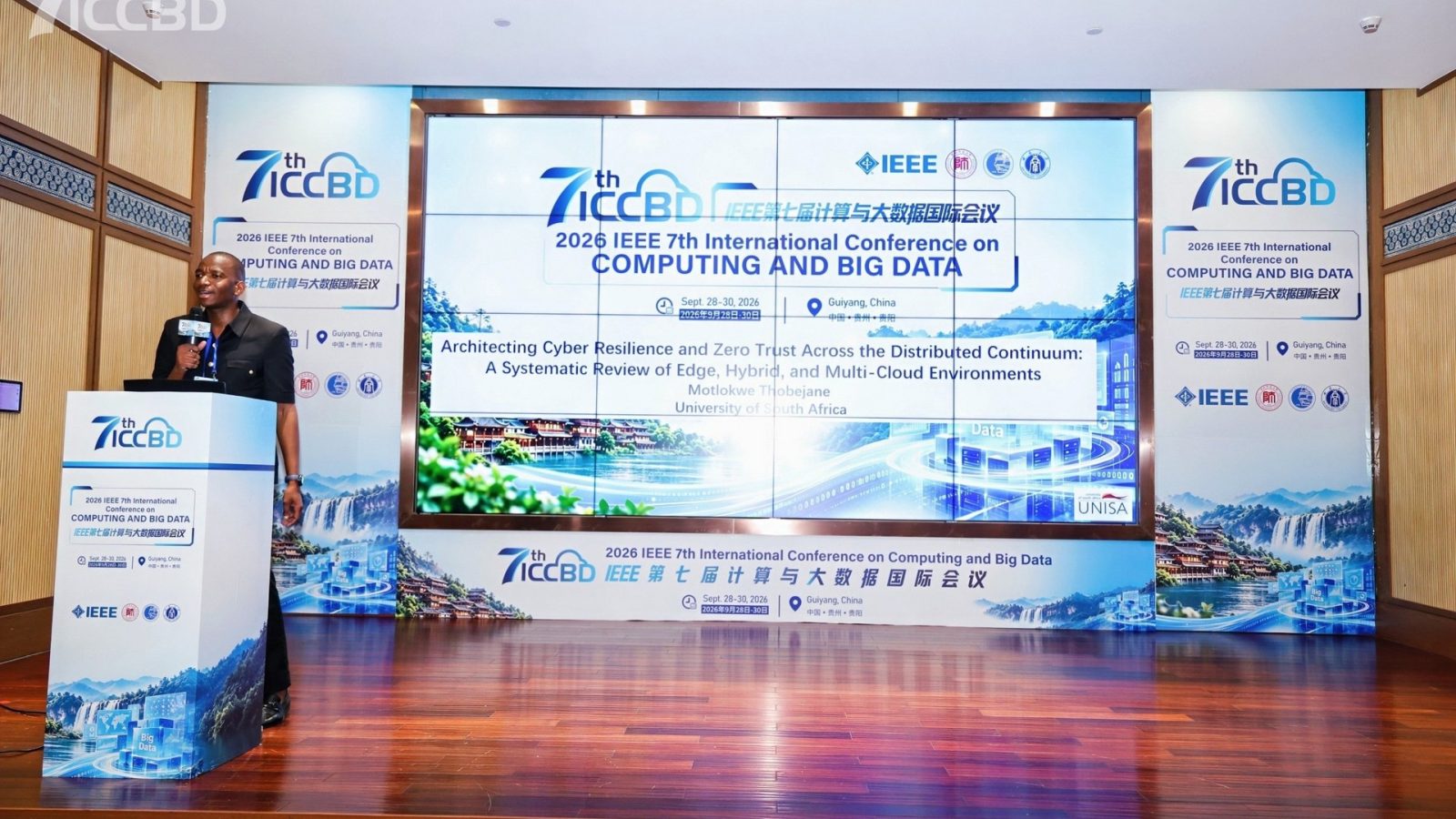
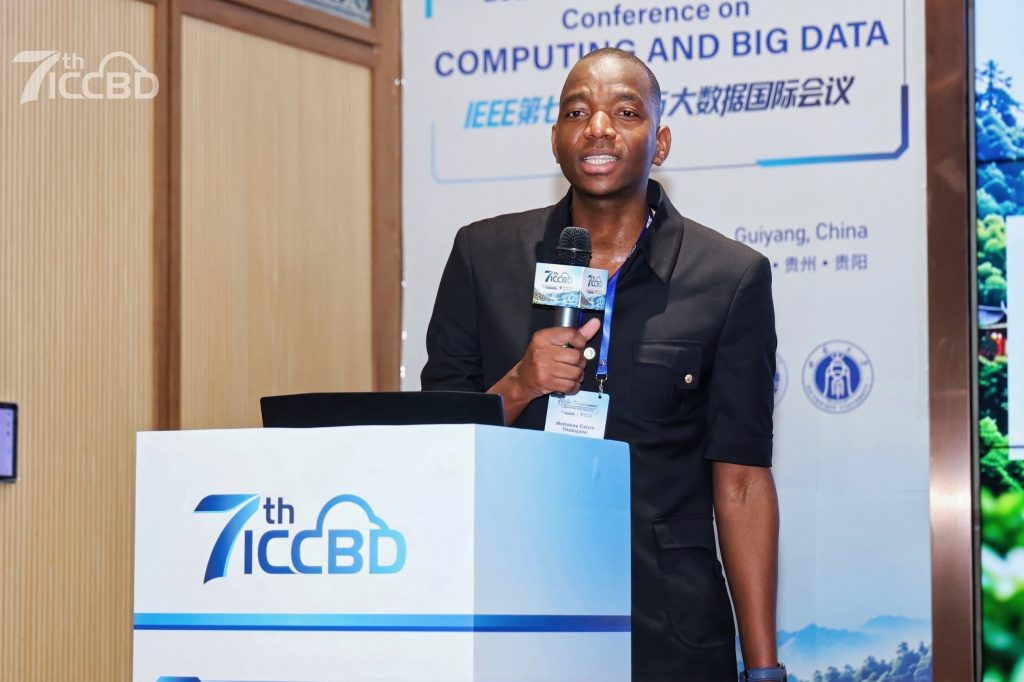
I had the privilege of presenting my research paper, Architecting Cyber Resilience and Zero Trust Across the Distributed Continuum: A Systematic Review of Edge, Hybrid, and Multi-Cloud Environments, which received the Best Presentation Award.
While the recognition was personally meaningful, what stayed with me most was a keynote address that challenged some of the assumptions underpinning today’s AI revolution.
Delivered by Prof Wang, the address, titled On the Theoretical Foundations of Intelligent Science: From Exhaustive Data Training to Rigorous Intelligent Generation by Intelligent Mathematics, offered a different perspective on the future of intelligence.
Rather than asking how we can build larger AI models, Wang challenged us to consider whether intelligence could be generated through rigorous mathematical principles instead of increasingly resource-intensive data training.
For Africa, this is a question worth taking seriously.
The problem with an endless appetite for data
Much of contemporary AI development depends on training computational models using enormous quantities of data.
These approaches have produced remarkable advances in language processing, image recognition, scientific discovery and automation. Yet their success has reinforced the assumption that progress requires ever-greater quantities of data and computing power.
This trajectory presents a fundamental challenge.
The potential supply of data is effectively unbounded. New information is generated continuously, creating an almost inexhaustible range of circumstances from which machines might learn.
The resources required to process that information, however, are finite.
Electricity, computing infrastructure, capital, specialised hardware and environmental capacity all impose constraints. As demand for AI grows, so do concerns about the economic and environmental consequences of increasingly powerful systems.
This raises an important question: Can we continue pursuing intelligence primarily through computational scale, or must we develop approaches that achieve more with fewer resources?
The answer matters particularly for developing economies that cannot assume unlimited access to energy, advanced computing infrastructure or substantial research funding.
From training intelligence to understanding it
Wang’s keynote introduced Intelligent Mathematics as a proposed theoretical foundation for a different approach to AI.
He argued for a shift from exhaustive data training towards what he described as rigorous intelligent generation.
His framework is expressed through the principle:
AI_IS_IM: The theoretical foundation of Artificial Intelligence is Intelligent Science, while the foundation of Intelligent Science is Intelligent Mathematics.
Although this remains a theoretical proposition rather than an established scientific consensus, it raises important questions about the direction of AI research.
Wang challenges the assumption that examining increasingly large collections of empirical examples is sufficient to explain intelligence.
The natural and mental worlds are complex, dynamic and effectively unbounded. No finite collection of observations can capture every possible situation or fully explain how intelligence operates.
If we want machines to reason, adapt and generate knowledge more effectively, perhaps we must first understand the principles underlying those capabilities.
How does the human brain reason? How does knowledge emerge from information? What enables intelligent systems to adapt to unfamiliar circumstances? Can these processes be represented mathematically without endless cycles of training?
These questions extend beyond engineering into the scientific foundations of intelligence.
Wang described a future centred on Autonomous AI, or AI*, where greater emphasis is placed on principled forms of intelligent generation.
Whether this framework will produce practical breakthroughs remains uncertain. Its significance lies in challenging researchers to investigate alternatives to the prevailing emphasis on computational scale.
Why this debate matters for Africa
As I reflected on the keynote, my thoughts turned to scientific research across Africa.
Many African universities and research institutions operate under significant resource constraints. Access to high-performance computing, advanced infrastructure, reliable energy and sustained research funding remains uneven.
If AI leadership depends almost entirely on investing billions in infrastructure and model development, African institutions risk remaining dependent on technologies created elsewhere.
But that outcome is not inevitable.
More efficient, mathematically grounded approaches to intelligence could create opportunities for countries and institutions that lack the world’s largest computing facilities.
If progress can emerge from new theories, architectures, algorithms and scientific principles, participation in frontier research need not be determined solely by financial resources.
This does not mean Africa can develop competitive AI without infrastructure or investment. Mathematical breakthroughs still require experimentation, validation and implementation.
It means we should not define our scientific ambitions exclusively by the resources we lack.
Africa has mathematicians, computer scientists, engineers and researchers capable of contributing original ideas to the global knowledge economy.
The challenge is to create environments where their work advances beyond applying existing technologies to developing the foundations of new ones.
Africa needs invention, not only innovation
One of my strongest reflections from ICCBD 2026 concerned the research questions receiving attention.
Across Africa, much technology research understandably focuses on practical applications. We investigate how AI can improve healthcare, strengthen cybersecurity, enhance agriculture, support education and improve public administration.
This work is essential because our societies face urgent development challenges.
However, practical application should not define the limits of our scientific ambition.
During the conference in China, I encountered discussions placing considerable emphasis on theoretical foundations, mathematical models and the scientific principles underpinning technological development.
This prompted an uncomfortable question: Are African researchers investing enough intellectual effort in creating tomorrow’s technologies, or are we concentrating primarily on finding new uses for technologies developed elsewhere?
This is not to suggest that Africa lacks foundational research or that China focuses exclusively on theory. Both regions undertake theoretical and applied research.
Rather, we must strengthen the relationship between these dimensions of scientific inquiry.
We need researchers who can solve immediate problems using existing technologies, but also those who ask fundamental questions.
What new algorithms could make intelligent systems more efficient? What mathematical models could improve reasoning? How might new computing architectures reduce energy consumption?
Africa needs more than innovation through adoption. It needs invention through original scientific discovery.
Universities must change the research agenda
If Africa is to contribute meaningfully to the next generation of intelligent technologies, universities must play a central role.
Higher education institutions should produce more than graduates who know how to operate AI tools developed elsewhere. They must also cultivate researchers capable of questioning assumptions, developing theories and testing alternative approaches.
This requires stronger investment in mathematics, theoretical computer science, computational science and interdisciplinary research.
It also demands closer collaboration between universities, industry, governments and research institutions.
Foundational research often produces results over longer periods than applied projects. Its value may not immediately translate into commercial products or economic returns.
ALSO READ: Kenya pushes for human oversight of military AI ahead of Nairobi summit
Yet this research can establish the intellectual foundations for future industries.
African research funding models must therefore accommodate scientific inquiry whose immediate applications are not yet known.
We must strengthen postgraduate research, support emerging scholars and build continental research networks that allow institutions to share expertise and resources.
Importantly, foundational research and practical innovation should reinforce one another.
Africa’s challenges in energy, agriculture, healthcare, education and cybersecurity can inspire original scientific questions whose solutions may have applications far beyond the continent.
This is how we begin moving from technological dependence towards greater scientific capability.
Sustainability must shape AI development
The search for alternative approaches to intelligence also raises an important sustainability question.
AI development cannot be separated from the resources required to sustain it.
As computing demand grows, researchers and policymakers must consider energy consumption, infrastructure costs and environmental impacts alongside technological performance.
For Africa, where expanding electricity access, strengthening digital infrastructure and addressing climate change remain development priorities, these considerations are particularly important.
We should ask not only whether an AI system performs well, but how efficiently it uses resources and whether its benefits justify its costs.
More efficient algorithms, alternative computing architectures and advances in mathematical reasoning could make intelligent technologies more accessible and sustainable.
Intelligent Mathematics is one proposed direction within this broader search. It deserves critical investigation alongside other approaches to improving AI efficiency.
The objective should not be to replace one technological orthodoxy with another, but to encourage scientific exploration that produces greater value with fewer resources.
Africa must help shape what comes next
My experience at ICCBD 2026 reinforced a conviction: Africa cannot define its role in the global technology landscape solely through consumption, implementation and regulation.
These activities matter, but they are insufficient.
We must also contribute to the theories, mathematical principles, scientific models and computing architectures that shape technological development.
The continent’s digital transformation should be measured not only by how many AI systems we deploy, but also by how much original knowledge we generate.
That ambition requires investment, scientific discipline, institutional commitment and a willingness to pursue questions whose answers may take years to emerge.
Wang’s keynote did not establish a definitive alternative to resource-intensive AI training. It challenged us to reconsider the assumptions guiding our research priorities.
Perhaps the next major advance will emerge from larger models and more powerful computers. Perhaps it will come from mathematical breakthroughs that enable intelligent systems to achieve more with less.
Most likely, progress will involve multiple approaches.
But Africa should not wait for that debate to be settled before participating.
The question I carried home from China is not simply whether we can build AI systems that compete with those developed elsewhere.
It is whether we are prepared to invest in the intellectual foundations that could make entirely new forms of intelligence possible.
Africa should not be satisfied with participating in the AI revolution. It must aspire to help define the science behind whatever comes next.
About the author

Dr Motlokwe Calvin Thobejane is Executive Director: ICT Infrastructure and Systems at the University of South Africa (Unisa). He holds a PhD in IT Management and an MPhil in Informatics, specialising in cloud project and risk management. His research focuses on cloud computing, cyber resilience, digital sovereignty and responsible AI adoption in higher education. A certified Cloud Solutions Architect Expert, he received the Best Presentation Award at the 2026 IEEE International Conference on Computing and Big Data in China for research on cyber resilience and Zero Trust security.