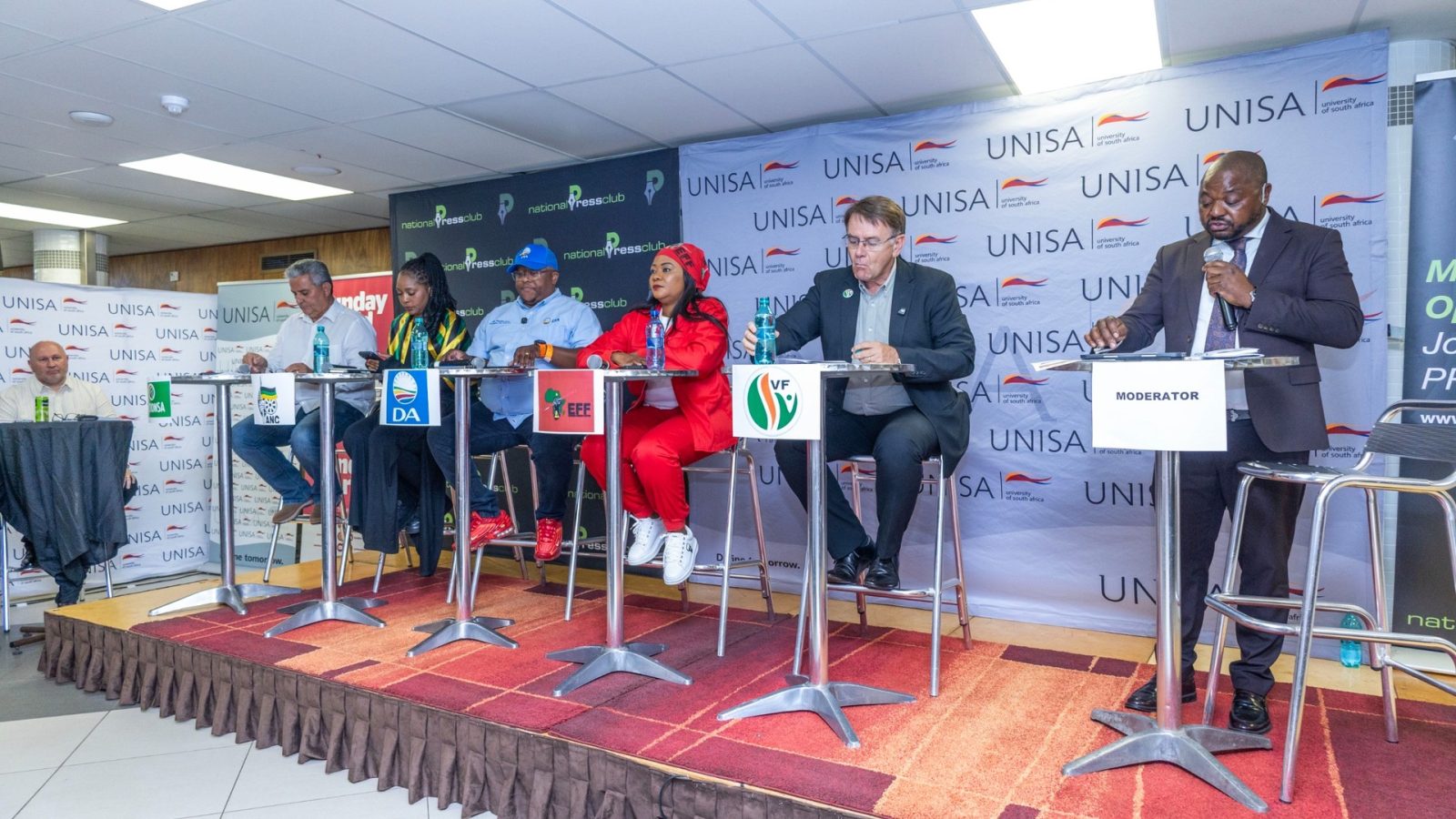
PRETORIA: Tshwane’s leaking pipes, potholes and strained finances took centre stage at a debate hosted by the University of South Africa, where political contenders faced a question familiar to residents: how will they repair the capital’s failing services while keeping its finances afloat?
With South Africans due to vote in local government elections on Wednesday, 4 November, representatives offered competing plans to collect unpaid bills, protect service revenue and direct more money towards infrastructure.
The city’s 2026/27 budget illustrates the challenge. Of its R58.5 billion total, R55.7 billion is allocated to operating expenditure and R2.8 billion to capital spending, putting capital investment at approximately 4.8% of the budget.
EFF mayoral candidate Omphile Maotwe argued that the balance between operating costs and infrastructure investment was at the heart of Tshwane’s service delivery problems.
“You cannot expect adequate service delivery when such a disproportionate amount of the budget is allocated to maintaining a bloated workforce,” she said.
Maotwe characterised roughly R55 billion as spending on salaries and debt. However, the operating budget covers considerably more: it also pays for bulk electricity and water, repairs, maintenance and other municipal services.
The R2.8 billion capital allocation therefore does not represent all spending on infrastructure. The budget speech lists, for example, R378 million for electricity infrastructure maintenance under operating programmes.
Losing water and revenue
Much of the debate focused on money the city either loses or fails to collect.
ActionSA representative and Tshwane alderman Hannes Coetzee said about 42% of the city’s water was lost through leaks and illegal connections, at an estimated annual cost of R1.8 billion.
“We must fix the water pipes and engage communities willing to pay for services,” he said.
Other published estimates point to losses of a similar scale. EWN this week put annual water losses at R1.7 billion and electricity losses at R3.2 billion, while the DA reported a water loss rate of 39% last year.
The 2026/27 budget allocates R110 million specifically to reducing water losses. That forms part of a wider water and sanitation programme, rather than the entirety of the city’s spending on its water network.
Coetzee also promised to end estimated billing, a persistent source of disputes between residents and the municipality. He said the city had to balance its obligations to creditors, including Eskom, with equitable service delivery across its seven regions.
Tshwane entered a court-approved arrangement to repay approximately R6.66 billion in Eskom arrears, beginning in December 2024 and running until March 2029. That was the debt covered by the agreement, rather than necessarily the current outstanding balance.
In a recent statement, the city said it had reduced its Eskom debt to R4.73 billion by March 2026.
ALSO READ: The kingmakers’ elections: What the world should watch on 4 November
At the same time, the municipality faces the challenge of recovering money owed by its customers.
In late 2024, Gauteng’s then finance MEC Lebogang Maile said households, businesses and other customers owed Tshwane R24 billion. Most of that debt was attributed to households. He described the city’s credit control policy as “not effective”.
Protecting service revenue
The DA’s Themba Fosi called for revenue from electricity and water to be ring-fenced for those services.
“The money that comes from electricity should go straight back to electricity needs, and the same for water,” he said.
His proposal addresses a recurring concern in financially distressed municipalities: revenue from trading services can be used to cover wider spending pressures while the networks generating that income deteriorate.
The DA’s mayoral candidate for Tshwane is former mayor Cilliers Brink.
Potholes and political will
The ANC’s Tlangi Mogale, Tshwane’s MMC for Roads and Transport and one of the names on the party’s mayoral shortlist, focused on maintenance and accountability.
She cited a backlog of 18,000 potholes and called for communities to participate in efforts to improve revenue collection.
“We must reflect on the political will required to implement recommendations from the Auditor-General,” she said.
FF Plus mayoral candidate Willie Spies, a Pretoria attorney returning to politics after 16 years, questioned past water management decisions and the relationship between the city’s budget and the services residents receive.
“The disconnect between the budget and actual service delivery is alarming,” he said.
Spies also questioned the practical value of a budget being classified as “funded” when residents continued to experience service failures.
National Treasury classified Tshwane’s 2026/27 budget as fully funded, meaning anticipated revenue is sufficient to cover its planned commitments. That assessment does not, by itself, establish whether infrastructure investment is adequate or whether services will improve.
Maotwe similarly called for the municipality to implement the Auditor-General’s recommendations and give communities a greater role in budgeting.
What the auditors found
The Auditor-General’s 2024/25 local government report, released in June, highlighted financial and governance weaknesses across the country’s metros.
None of the eight metropolitan municipalities received a clean audit.
ALSO READ: Participation In Elections Without Understanding Reflects ‘Democracy On Autopilot’
Tshwane received a qualified audit opinion and recorded R12.1 billion in irregular expenditure accumulated since 2021/22, the highest figure among the metros.
Irregular expenditure indicates that spending did not comply with applicable requirements. It does not automatically mean that the entire amount was stolen or that no goods or services were received.
The pressures extend beyond Tshwane.
Johannesburg retained an unqualified opinion with findings but was described as technically insolvent. The report put its Eskom debt at R5.3 billion, while City Power recorded R11.8 billion in irregular expenditure since 2021/22. Johannesburg’s infrastructure backlog exceeds R200 billion.
In July, Gauteng’s finance MEC said only two of the province’s 11 municipalities had received clean audits.
Auditor-General Tsakani Maluleke said the central weakness was not an absence of rules or responsibilities.
“What remains insufficient is the consistent, diligent and effective execution of these responsibilities,” she said.
Political instability adds to the challenge
Tshwane’s financial difficulties have unfolded alongside repeated changes in political leadership.
The city has had six mayors and four coalition arrangements in eight years. Current mayor Nasiphi Moya of ActionSA took office in October 2024 and is seeking another term.
No party holds an outright majority in the existing council. The ANC has 75 seats, the DA 69, the EFF 23 and ActionSA 19.
Unless a party secures a majority in the election, the next mayor will again depend on a coalition. Political cooperation will be essential to passing budgets, maintaining oversight and carrying projects through to completion.
Promises face a practical test
The parties at Unisa largely agreed on the problems: leaking pipes, disputed bills, unpaid creditors, potholes and weak financial controls.
Their proposals included tighter revenue collection, ring-fenced service income, greater community participation and stronger action on audit findings.
The test will be whether the next administration can turn those proposals into sustained improvements while managing debt and keeping a fragmented council together.
For residents accustomed to outages, water tankers and repeated changes of mayor, the measure of the next administration will be whether taps run, bills are accurate and repairs last.