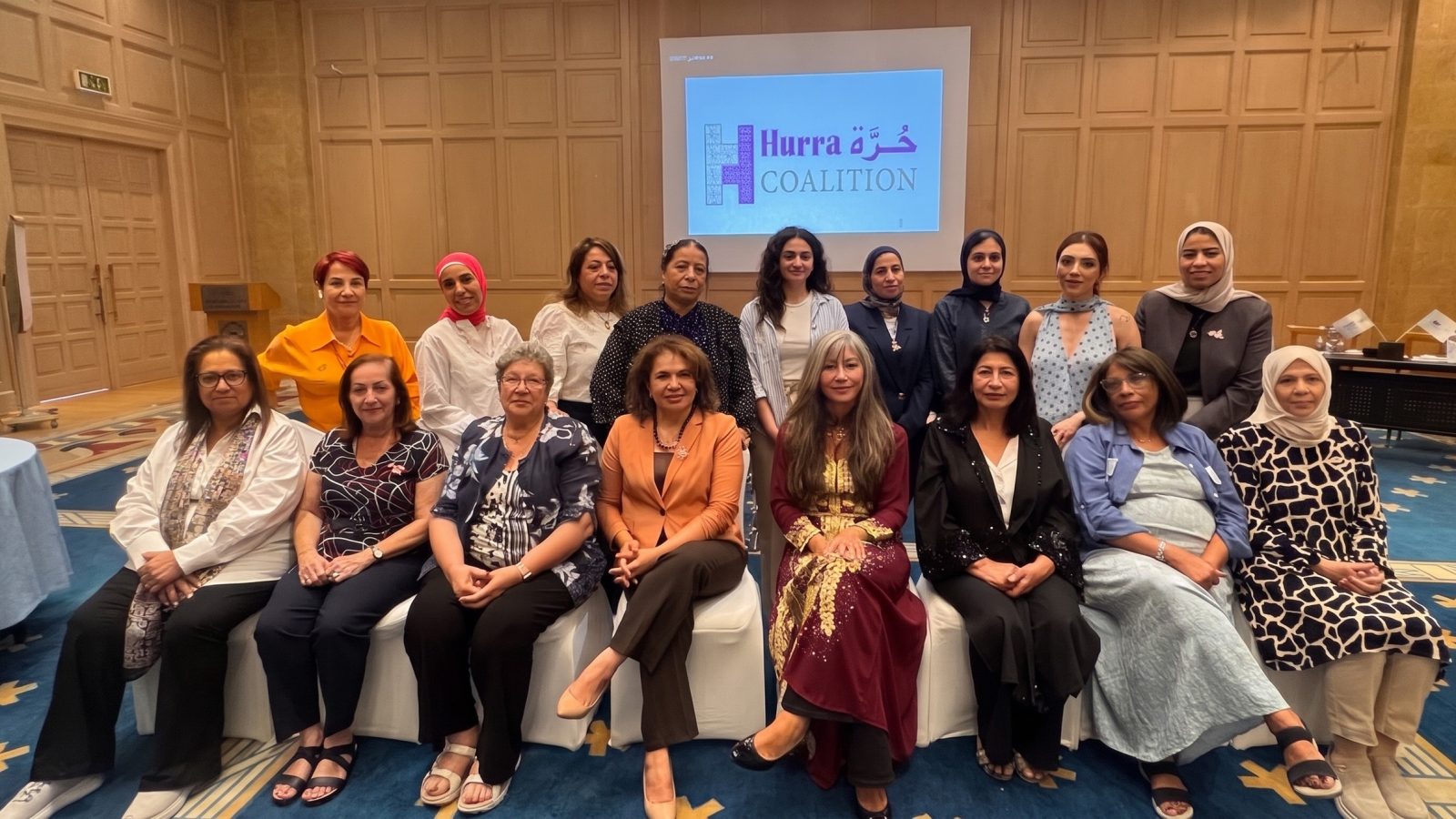
HURGHADA, Egypt: Women’s rights advocates from across the Middle East and North Africa (MENA) have renewed calls for urgent reform of family laws that they say continue to expose women and girls to discrimination in marriage, divorce, inheritance and child custody.
Members of the Hurra Coalition met in Hurghada, Egypt, in October to assess progress in family law reform, examine setbacks and agree on priorities for strengthening women’s legal rights and protections across the region.
The meeting comes amid growing concern that discriminatory legislation, inconsistent court rulings and weak enforcement are limiting women’s access to justice. Advocates also warn that organised anti-rights movements are using religious and cultural arguments, often framed around protecting traditional family values, to resist legal reforms and challenge existing protections.
Family and personal status laws govern some of the most consequential aspects of women’s lives, including the right to marry, seek divorce, retain custody of children and claim financial support or a share of marital assets.
However, in several countries, these rights are shaped by overlapping civil, religious and customary legal systems, creating different levels of protection for women depending on their circumstances and the laws applied to their cases.
Reform gaining ground, but challenges remain
There have been signs of legislative progress across the region.
The United Nations’ Gender Justice and the Law initiative, which monitors legal frameworks in 17 Arab countries through 73 indicators across six areas of law, recorded the adoption or amendment of 32 legal texts in 12 countries during 2025. The changes contributed to strengthening women’s legal status and protections.
In Egypt, the government approved draft personal status legislation in April 2026 and referred two bills to Parliament the following month. The proposed reforms seek to modernise and consolidate laws governing Muslim and Christian family matters, including marriage, divorce, child custody and financial maintenance. The bills remain under parliamentary consideration.
Morocco has also proposed more than 100 amendments to its Family Code, known as the Moudawana. Announced in December 2024, the proposals include changes relating to child marriage exceptions, parental guardianship, custody, polygamy, inheritance and the division of marital assets. They have yet to be enacted.
In Lebanon, civil society organisations and women’s rights advocates have proposed a unified civil personal status law to replace the country’s 15 separate religious systems governing family matters.
The current arrangements allow different religious courts to apply their own laws and procedures, resulting in unequal legal protections, particularly in matters involving divorce, inheritance and child custody.
Tunisia’s experience offers lessons
During the Hurra Coalition meeting, Imen Zahouani Houimel, a gender expert and former Tunisian Minister of Women, Family and Seniors, highlighted the importance of sustained political commitment and building on previous legal gains.
ALSO READ: Stop shielding the corrupt and killing women, church tells Southern Africa’s leaders
“Legal reform is a cumulative process where each phase builds upon previous gains,” she said.
Houimel reflected on Tunisia’s Code of Personal Status, adopted in 1956, which introduced significant changes to family law. The legislation prohibited polygamy, required the consent of both spouses to marry, set 18 as the minimum marriage age and replaced unilateral divorce by husbands with court-supervised divorce, which either spouse can seek.
She also pointed to Tunisia’s 2017 law on eliminating violence against women, which recognises physical, sexual, psychological and economic violence. The law also removed provisions that had allowed perpetrators of certain sexual offences against minors to escape prosecution by marrying their victims.
Houimel said political will had been decisive in advancing reform, but warned that legal gains could be reversed without strong institutions, effective implementation, public awareness and continued human rights advocacy.
“Political will has been decisive, but it must be sustained by strong institutions, effective implementation, and feminist and human rights advocacy,” she said.
Family laws also affect women’s economic security
The coalition’s concerns extend beyond the formal recognition of women’s rights to the practical ability to exercise them.
In some countries, exceptions to the minimum marriage age allow child marriages to take place. Women seeking financial maintenance from former spouses can face complex and costly legal procedures, while inadequate provisions for dividing marital assets can leave them economically vulnerable after divorce or the death of a husband.
Inconsistent court decisions on child custody and guardianship also remain a major concern.
The issue has wider economic implications. When women cannot claim property, inheritance or income earned through their contributions to a marriage, their financial independence is weakened. Advocates argue that discriminatory family laws can therefore reinforce poverty and limit women’s participation in economic life.
Growing backlash against gender equality
The coalition also raised concern about organised opposition to gender equality, which it says is increasingly using religious and cultural arguments to block reform and undermine women’s rights organisations.
Equality Now, which serves as the coalition’s secretariat, says these movements use claims about protecting traditional family values to reinforce discriminatory laws and challenge institutions working to advance women’s rights.
ALSO READ: Cameroon’s femicide crisis deepens as government promises fail to protect women
Dr Dima Dabbous, Equality Now’s MENA Representative, said regional cooperation was essential in responding to attacks on women’s rights defenders and organisations.
“In light of mounting backlash, movement building and coalitions like the Hurra Coalition are essential,” she said.
“When we stand together, risk is distributed. When one activist in a MENA country is attacked, 20 organisations from across the region respond and raise the issue in global human rights spaces to ensure accountability. Solidarity is our security strategy.”
Naglaa Sarhan, Hurra Coalition Coordinator and Equality Now Legal Adviser, said arguments framed around protecting family values were being used to silence women’s rights defenders and obstruct reform.
“This rhetoric does not protect families. Rather, it is weaponised as a tool to dismantle women’s movements, silence and intimidate human and women’s rights defenders, and obstruct vital reforms of family laws that continue to allow child marriage, deny women their financial rights, and deprive mothers of custody of their children,” she said.
Sarhan argued that equality and justice were essential to protecting families and building safer societies.
“Strong families are built on equality and justice, not on discrimination and subjugation,” she said.
Regional solidarity central to reform
The Hurra Coalition, established as a regional initiative by Equality Now and women’s rights organisations, brings together advocates working to reform discriminatory family laws across the MENA region.
Its work focuses on issues including child marriage, women’s financial rights, marital property, and the custody and guardianship rights of mothers after divorce. It also supports cooperation between organisations, legal advocacy and engagement with policymakers.
The coalition’s latest meeting highlighted both the progress made in some countries and the resistance that continues to slow reform.
For advocates, the challenge is no longer simply getting laws amended. Governments must also ensure that protections are implemented consistently, courts apply the law fairly and women can access justice without prohibitive financial or procedural barriers.
The coalition maintains that reform must be grounded in equality and international human rights standards, with sustained regional cooperation to protect existing gains and prevent further erosion of women’s rights.