TSHWANE – South Africa has opened a pharmaceutical research facility aimed at helping local scientists and companies develop medicines and their essential ingredients, tackling a dependence on imports that leaves the country exposed to global supply disruptions.
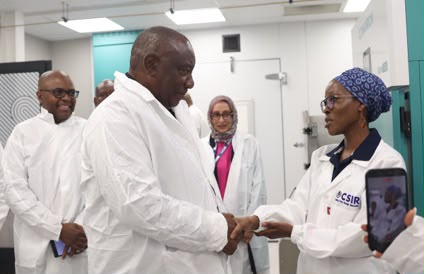
President Cyril Ramaphosa launched the Council for Scientific and Industrial Research’s (CSIR) FuturePHARMA facility at its Waterkloof campus in Tshwane on Wednesday, 7 October. He described it as a step towards greater control over the country’s medicine supply.
“This is truly a milestone in South Africa’s journey towards health sovereignty,” Ramaphosa said.
The challenge extends across the continent. According to an analysis published by The Conversation and Gavi in October 2025, Africa imports more than 70% of its medicines and more than 95% of its active pharmaceutical ingredients, mostly from India and China. These ingredients give medicines their therapeutic effect.
Africa produces about 3% of the world’s medicines. Its dependence is even greater for vaccines, with roughly 99% of those used on the continent imported.
FuturePHARMA is intended to help close part of that gap. Its success, however, will depend on whether research conducted at the facility leads to products that manufacturers can produce and patients can access.
From laboratory research to medicine production
FuturePHARMA operates as an open-access facility, giving researchers, universities and emerging companies access to specialised equipment and expertise that would otherwise be costly to secure.
Its work includes developing pharmaceutical production processes, testing whether they can operate at a larger scale and transferring those technologies to industry. Active pharmaceutical ingredients are among its areas of focus.
The facility is designed to support the journey towards commercial production, rather than operate as a commercial medicine factory itself.
Ramaphosa described it as a shared national resource connecting research with process development, clinical development, regulation, manufacturing, investment and procurement.
ALSO READ: Ramaphosa calls for BRICS to break Africa’s Raw-Materials trap
“Too many promising innovations struggle to move from the laboratory into further development,” he said. “That is the challenge FuturePHARMA has been established to help address.”
He said its performance should be measured by the technologies it develops, the companies it supports, the partnerships it builds, the skills it strengthens and the innovations that reach society.
Covid-19 exposed Africa’s vulnerability
Ramaphosa linked the facility’s purpose to the experience of the Covid-19 pandemic, when wealthy countries secured vaccines and medical supplies while African countries struggled to obtain them.
“The pandemic was a reminder that health security, economic resilience and national development are interconnected,” he said.
That experience reinforced the push to expand African pharmaceutical manufacturing. The African Union and the Africa Centres for Disease Control and Prevention have backed a target for the continent to manufacture 60% of its vaccine requirements by 2040.
The starting point remains low: only about 1% of the vaccines used in Africa are manufactured on the continent.
“South Africa stands ready to use its strong research institutions, universities, regulatory capabilities and pharmaceutical manufacturing capacity to contribute to regional value chains and partnerships across Africa,” Ramaphosa said.
Research needs a route to market
Turning scientific discoveries into medicines requires coordination across several institutions.
These include the departments of Science, Technology and Innovation; Health; and Trade, Industry and Competition, alongside National Treasury and the South African Health Products Regulatory Authority (SAHPRA).
Ramaphosa called for their policies and investments to work towards a common goal.
“Our strategies, investments and programmes must reinforce each other,” he said. “We are building a connected system in which each institution and investment contributes to a common national objective.”
ALSO READ: Mnangagwa hands SADC baton to Ramaphosa, warns region against Over-Reliance on foreign funding
He also called for the emerging Pharmaceutical Roadmap and the Vaccine Innovation and Manufacturing Strategy to reflect national health priorities, industrial opportunities and market demand.
Regulatory approval is a critical part of that process. In July 2025, SAHPRA committed to accelerating the registration of locally manufactured medicines and vaccines. This included an aim to reduce local vaccine registration times from 360 working days to 180, alongside lower fees for local applicants.
“Registration, if not done timeously and efficiently, can be a barrier (to access),” SAHPRA chief executive Dr Boitumelo Semete-Makokotlela said at the time.
The questions that will define success
The launch establishes a platform for pharmaceutical development. Assessing its impact will require clear information about its cost, operating budget, first projects and delivery targets.
Which medicines and ingredients will receive priority? Will the facility support work addressing major disease burdens such as HIV, tuberculosis and diabetes? How many South African companies will use it, and how soon could their products reach the market?
Procurement will be equally important. Government purchasing decisions could help determine whether locally developed medicines find a dependable market and whether manufacturers have enough certainty to invest in production.
Local producers must also compete with established suppliers in India and China, whose large-scale operations can offer significant price advantages. Research infrastructure can help develop products and production methods, but commercial success also depends on financing, regulatory approval and sustained demand.
FuturePHARMA’s contribution will therefore have to be measured beyond the laboratory: in viable manufacturing processes, businesses able to expand and medicines available to patients.
“This facility stands as a symbol of what can be achieved when government, academia and industry come together,” Ramaphosa said.
The task now is to turn that cooperation into a more reliable medicine supply before the next health emergency exposes the same vulnerabilities.