NAIROBI, Kenya: Competition among global powers for influence and resources in Africa is deepening political and economic tensions and could ignite new conflicts, Kenya’s Prime Cabinet Secretary Musalia Mudavadi has warned.
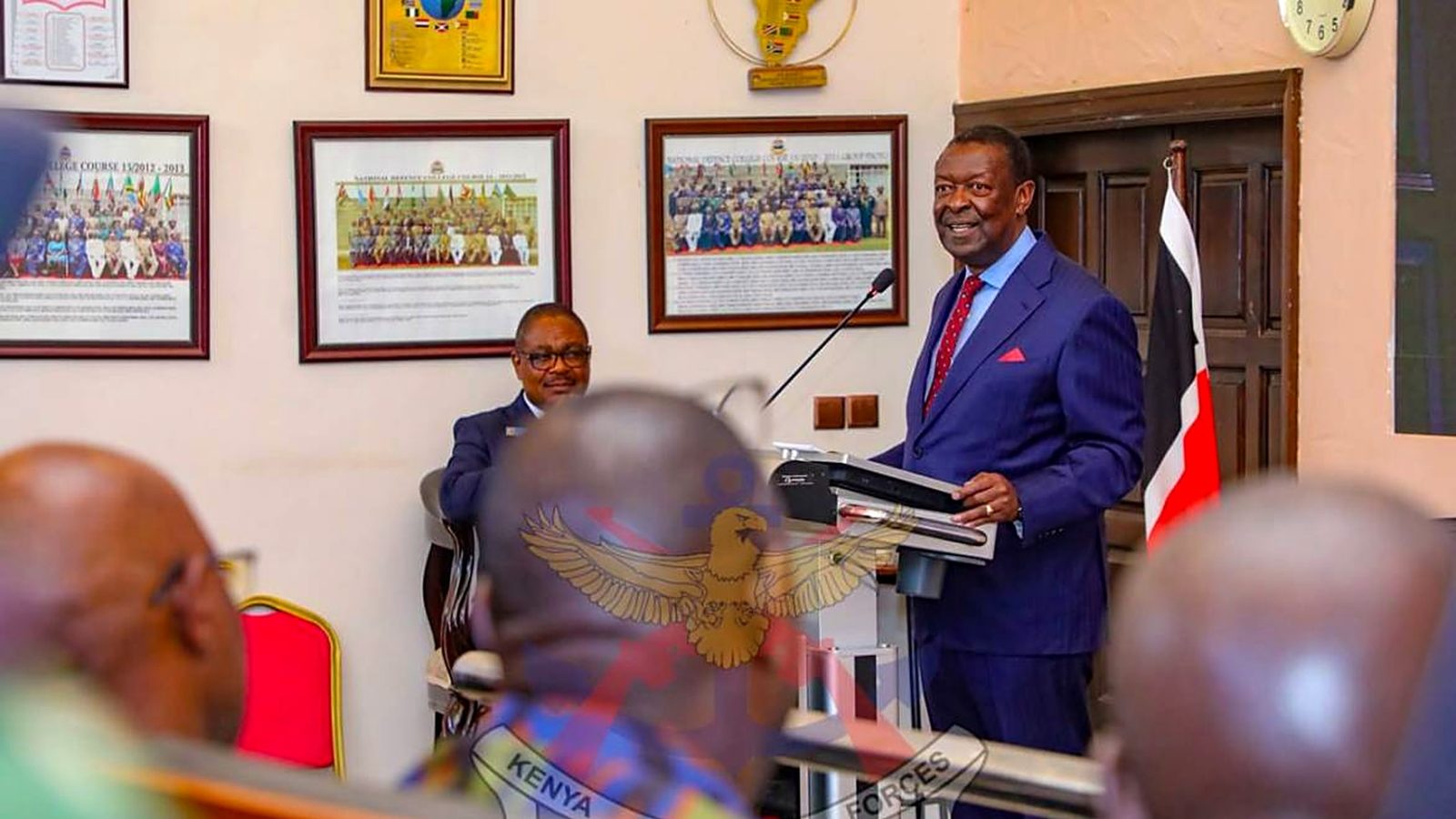
Addressing senior military officers and government officials at the National Defence College in Karen, Nairobi, on Wednesday, Mudavadi said established and emerging powers were pursuing influence through infrastructure financing, security cooperation and other partnerships.
“The resulting competition among external actors can, and already has, exacerbated existing political and economic tensions,” said Mudavadi, who also serves as Cabinet Secretary for Foreign and Diaspora Affairs, according to The Star.
“If not managed through transparent, inclusive, and locally driven approaches, these tensions can spark both intra and inter-state conflicts.”
His lecture to the 81 participants of the college’s Course No. 29 coincided with Kenya Defence Forces (KDF) Day and examined how geopolitical competition is reshaping Africa’s security environment.
Africa’s Wealth Brings Opportunity And Risk
Mudavadi said the continent’s appeal to outside powers stemmed from its “vast natural and mineral wealth, coupled with a dynamic and rapidly growing youthful population”, The Standard reported.
Those strengths offer opportunities for investment and development. However, he warned that they could also become sources of instability if external partnerships failed to reflect African priorities.
“Peace is not simply the absence of conflict,” he said. “It is the foundation upon which jobs, investment and national prosperity are built.”
His message linked security directly to economic wellbeing: conflict undermines the conditions needed to attract investment, create employment and sustain development.
Regional Conflicts Heighten Security Concerns
Mudavadi identified Eastern Africa as particularly vulnerable, citing the war in Sudan, political tensions in South Sudan, insecurity in Somalia and instability in eastern Democratic Republic of Congo.
He also highlighted the continuing threat posed by Al-Shabaab and other non-state armed groups.
ALSO READ: Kenya on Ebola alert after first imported case ends in death
“Protracted conflicts, intensified activities of non-state armed groups and transnational organized crime continue to undermine state authority and hinder development in several regions,” he said.
Sudan illustrates the scale of the regional crisis. More than three years into the war between the Sudanese army and the paramilitary Rapid Support Forces (RSF), about nine million people remain displaced within the country and at least 4.5 million have fled abroad, according to the UN refugee agency. It describes Sudan as the world’s largest displacement crisis.
Kenya’s involvement in efforts surrounding the conflict has itself drawn controversy.
In February 2025, the RSF and its allies signed a charter for a rival government at Nairobi’s Kenyatta International Convention Centre. Sudan’s army-backed government accused Kenya of supporting the RSF, recalled its ambassador and banned imports from Kenya in March that year.
Nairobi rejected the accusations, according to The EastAfrican.
Regional Institutions Face Funding And Political Constraints
Mudavadi said Kenya would continue pursuing dialogue and collective security through the East African Community (EAC), the Intergovernmental Authority on Development (IGAD), the International Conference on the Great Lakes Region (ICGLR) and the African Union.
“Through the EAC, IGAD, ICGLR and African Union, Kenya continues to advance dialogue, stability and collective security,” he said.
However, he acknowledged that funding shortages and political differences among member states constrained these institutions.
Prolonged wars, he added, had exposed weaknesses in international diplomacy and eroded confidence in global institutions. Kenya would therefore continue advocating a fairer and more representative system of global governance.
“Strengthening regional cooperation, enhancing international cooperation, and fostering inclusive political settlements are crucial for navigating the complexities of the evolving strategic landscape,” Mudavadi said.
Foreign Policy Must Improve Kenyans’ Lives
Mudavadi connected these security concerns to Kenya’s revised Foreign Policy 2024, launched in December 2024 and anchored in Sessional Paper No. 1 of 2025.
ALSO READ: Kenya defence Ministry sets new readiness targets as 23rd performance cycle begins
The framework sets out eight priority areas covering peace and security, economic diplomacy, diaspora engagement, digital diplomacy, climate, health and multilateral cooperation.
“For Kenya, foreign policy is not simply an instrument for managing relations between states,” he said. “It is a means of protecting our sovereignty, creating opportunities for our people, safeguarding our development ambitions and contributing to a more peaceful and secure world.”
The policy seeks to connect diplomatic activity more closely to citizens’ everyday needs.
Addressing the Senate in April 2025, Mudavadi said: “We want our international and diplomatic engagements to help improve the livelihoods and welfare of every Kenyan.”
KDF Day Underscores Continuing Security Challenges
The lecture took place on KDF Day, which commemorates the launch of Operation Linda Nchi on 14 October 2011.
Kenyan troops crossed into Somalia to pursue Al-Shabaab following a series of cross-border attacks and kidnappings. They subsequently joined the African Union mission in Somalia.
Al-Shabaab has continued to launch attacks in Somalia and Kenya’s border counties, underscoring the enduring security challenges facing the region.
National Defence College Commandant Lieutenant General Juma Mwinyikai thanked Mudavadi for the lecture, saying it provided valuable insight into geopolitical developments and their implications for defence and security policy, according to the Ministry of Defence.
The course brings together senior officers from the KDF, other disciplined services and government ministries, as well as officers from allied countries in Africa and Asia.
Mudavadi urged participants to focus on preventing crises rather than responding only after violence had erupted.
“We must therefore continue to invest in the partnerships, institutions and capabilities that enable us to anticipate threats, prevent conflict and support peaceful political settlements,” he said.