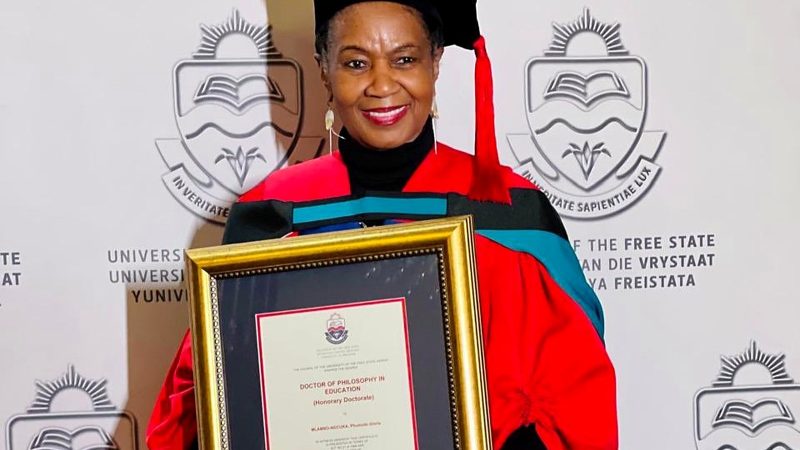
POLOKWANE: On 26 November 2026, I reached a milestone that fills me with immense joy, gratitude and a profound sense of personal achievement. I graduated with an Executive Doctor of Business Administration (EDBA) from the University of Business Innovation and Sustainability (UBIS), bringing to an end four years of demanding, rigorous and intellectually stimulating research.
The journey required discipline, sacrifice and unwavering commitment. Attending classes, spending countless hours reading academic literature, responding to supervisors’ feedback and navigating the demands of doctoral research became part of my daily life.
Beyond the academic workload, I balanced family and business responsibilities while leading a professional football club, Sekhukhune United FC. Managing these competing demands was not always easy, but it taught me valuable lessons about time management, resilience, prioritisation and perseverance.
Some of the most intellectually demanding, yet rewarding, moments came when I had to defend my final thesis before a panel of subject experts. Those examinations challenged me to defend my ideas, engage critically with different perspectives and demonstrate the depth and relevance of my research to addressing contemporary socio-economic challenges in Africa, particularly in South Africa.
Ultimately, the EDBA journey transformed me. It sharpened my critical thinking, strengthened my practical problem-solving abilities and reinforced the importance of resilience, commitment and lifelong learning. Although the demands felt overwhelming at times, the rewards have been immeasurable.
I am deeply grateful to UBIS, my supervisors, family, friends, employees and business associates for their encouragement, understanding and unwavering support throughout this journey.
The motivation behind my research
My decision to pursue a doctorate after completing my MBA was driven by a desire to contribute to youth empowerment through entrepreneurship and inclusive, sustainable development.
I wanted to understand the factors that influence young people’s intention to become entrepreneurs in South Africa, particularly against the backdrop of high unemployment and low levels of business participation among the youth.
My choice of research topic was rooted in a conviction that education is fundamental to individual and societal development. It provides the foundation for intellectual growth and serves as an important catalyst for social and economic progress.
Knowledge enables people to think critically, make informed decisions, develop their capabilities and contribute meaningfully to the transformation of society. Without access to adequate knowledge and relevant skills, young people risk being excluded from opportunities to participate fully in the economy.
ALSO READ: Kenya turns to sport to market country as three major hosting tests approach
I believe that equipping young people with entrepreneurial knowledge, skills and resources can help developing countries, particularly those in Africa with large youthful populations, turn their demographic potential into economic opportunity. Young people bring technological awareness, creativity and innovation that can be harnessed to address some of the continent’s most pressing challenges.
This informed my investigation into the influence of normative, regulative and cognitive-cultural factors on youth entrepreneurial intention in South Africa. These factors shape how entrepreneurship is viewed and accepted within society and influence whether individuals consider it a legitimate and desirable career path.
My research also examined whether entrepreneurship education moderates these relationships and can help address some of the barriers that discourage young people from pursuing business opportunities.
What the research revealed
The findings showed that favourable policies, positive societal norms and the skills and knowledge young people possess can strengthen their intention to pursue entrepreneurship.
The study also highlighted the important role of entrepreneurship education in bridging cultural gaps and encouraging young people to consider business ownership as a viable career option.

Education can help challenge negative perceptions and cultural predispositions towards entrepreneurship by giving young people the confidence, knowledge and practical skills to explore opportunities and establish businesses.
These findings have implications beyond academic debate. They point to the need for an integrated entrepreneurial ecosystem that brings together government policy, educational institutions, communities and the private sector.
My research therefore developed context-specific theoretical, practical and policy implications that could inform efforts to strengthen youth entrepreneurship in South Africa. The broader objective is to create an environment in which young people can participate meaningfully in economic activity and contribute to the country’s sustainable development ambitions towards 2030.
Our responsibility as a nation
The findings also raise a broader question about our collective responsibility to create opportunities for young people.
ALSO READ: Opinion | More than a trophy: Africa’s moment to champion women’s football
Responsibility, in its broadest sense, is both a moral and practical obligation. It requires individuals and institutions to fulfil their duties with diligence, accountability and commitment.
As a nation, we cannot speak about youth empowerment without confronting the barriers that prevent young people from accessing education, developing relevant skills and participating in the economy.
Entrepreneurship cannot be promoted as a solution to unemployment without ensuring that young people have access to the knowledge, resources, supportive policies and opportunities needed to turn ideas into viable businesses.
Government, educational institutions, the private sector and communities all have a role to play in building an environment that supports innovation and enterprise. Education must go beyond theory and equip young people with practical capabilities that respond to the realities of the economy.
If we are serious about inclusive and sustainable development, youth entrepreneurship must become more than a policy aspiration. It must be supported through meaningful interventions that allow young people to create opportunities for themselves and others.
Growth beyond the qualification
Looking back, this achievement has reinforced my belief that meaningful accomplishments rarely come without sacrifice. They demand perseverance, discipline and the courage to continue, even when the road becomes difficult.
There were moments of pressure and uncertainty, but each challenge became an opportunity to learn, grow and remain focused on the bigger purpose.
Today, I celebrate more than earning a doctoral qualification. I celebrate the personal growth that came with the journey, the people who supported me and the knowledge I have gained along the way.
For me, this is not the end of an academic journey. It is another beginning, with a renewed responsibility to use what I have learnt to contribute to society, support young people and help advance entrepreneurship and sustainable development in South Africa.
Dr Hlabishi Simon Malatji leads Sekhukhune United FC. He holds an MBA and an Executive Doctor of Business Administration from the University of Business Innovation and Sustainability.