Veteran and young artists revived songs associated with the school established by the EPLF in 1976, as a two-hour concert in Asmara brought the institution’s history and legacy back into the spotlight.
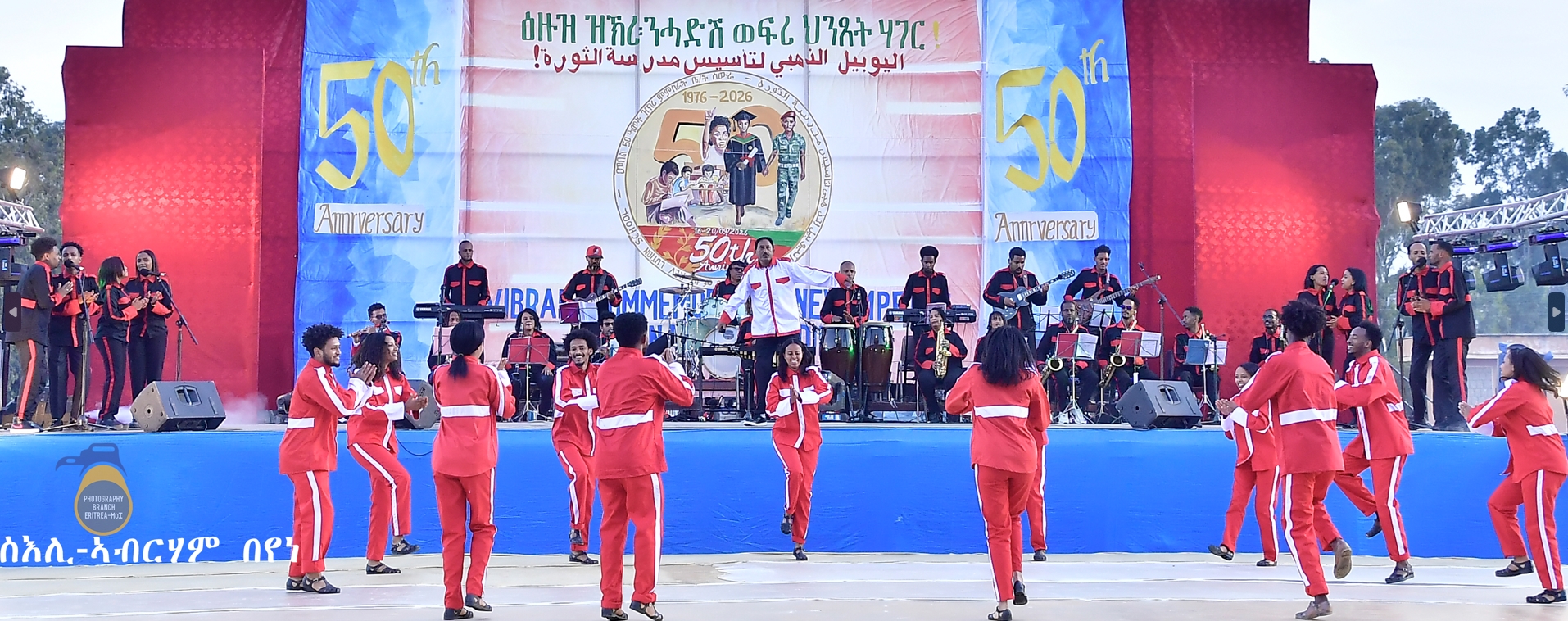
ASMARA – Veteran and young Eritrean artists gathered at Bahti Meskerem Square in Asmara on Friday night to perform songs associated with the Revolution School and the Red Flowers troupe, marking 50 years since the school was established during Eritrea’s armed struggle.
The Commission of Culture and Sports and the National Holidays Coordinating Committee organised the two-hour concert, which was broadcast live on Eritrean Television.
Zerit Tewoldebrhan, Managing Director of the Central Region, described the Revolution School as “one of the EPLF’s significant initiatives during the struggle for independence”.
Participants at the concert said the event was not only about reviving old songs, but also about preserving the history and experiences of the liberation struggle for younger generations.
They called for similar programmes to “continue in an organised manner”, saying they could help pass on Eritrean history and the hardships endured during the struggle.
A school built in the mountains
The Revolution School, commonly known as Zero, was established by the Eritrean People’s Liberation Front (EPLF) in 1976 as a boarding school.
It brought together children of fighters, orphans, nomadic children and teenagers who wanted to join the armed struggle but were considered too young to fight.
The first students arrived in the summer of 1976, including children from refugee camps in Sudan and communities across areas controlled by the liberation movement.
The name “Zero” originated as a radio code for a remote base in the Zagre Mountains of the Sahel, according to Eritrean government accounts.
Accounts differ on the size of the school’s first intake. Eritrea’s Ministry of Information says it began with 90 children, while other historical accounts put the number at about 150 students and several teachers.
There is less disagreement over its subsequent growth.
By 1983, the school had more than 3,000 students and was being used as a laboratory for a new national curriculum based on integrating theory and practical education.
Four additional Revolution Schools were opened in 1981, according to Eritrean government accounts, initially serving 273 students.
Eritrean state media has credited former students with becoming part of the first generation of locally trained doctors, engineers, diplomats, teachers and pilots following independence in 1991.
Those accounts, however, come from the same government that is organising the 50th anniversary commemorations.
The Red Flowers
The music performed at Friday’s concert is also linked to the Red Flowers, or Keyahti Embaba, a youth troupe formed in 1978.
The group was established for underage young people in towns liberated by Eritrean forces during the armed struggle.
ALSO READ: Muslim ritual meets Swahili culture at Kenya’s unique annual maulidi festival
According to an account by a former member published in Eritrean state media, the troupe was disbanded in 1985.
The former member recalled that the EPLF maintained a policy of keeping underage children out of combat and directing them towards education instead.
The songs associated with the group have survived long after the troupe itself disappeared.
A national commemoration
The concert formed part of a wider national programme marking the Revolution School’s 50th anniversary.
The Commission of Culture and Sports scheduled celebrations from 17 to 20 September under the theme “Vibrant Commemoration: New Impetus for Nation-Building”.
The programme includes exhibitions, concerts, seminars, sporting activities and a symposium.
According to the organisers, the celebrations are also intended to create an environment in which Eritreans in the diaspora can strengthen their contribution to national development.
Foreign Minister Osman Saleh opened an exhibition at Asmara Municipality Hall on 17 September featuring 260 photographs, as well as paintings and cartoons.
A symposium and concluding ceremony are scheduled to take place at the Asmara Palace Hotel on Sunday.
The commemorations have also extended beyond Eritrea. State media has reported events in Toronto, the Netherlands, Riyadh and the United States.
The anniversary programme follows a similar televised cultural event held on 31 August to mark the 65th anniversary of the beginning of Eritrea’s armed struggle.
Part of a wider liberation-school tradition
The Revolution School was part of a broader tradition in which African liberation movements established educational institutions for children and young people affected by conflict and displacement.
The PAIGC, which fought for Guinea-Bissau’s independence, established a Pilot School in Conakry in 1969 under the leadership of Lilica Boal to educate young people, including war orphans.
In 1978, the ANC established the Solomon Mahlangu Freedom College at Mazimbu in Tanzania for South African students who had fled the country, including young people who left following the 1976 Soweto uprising.
Oliver Tambo formally opened the college in 1985.
The Revolution School, established in the same year as the Soweto uprising, belongs to this wider history of liberation movements using education to prepare young people for a post-colonial future.
What the official account leaves unanswered
The account of Friday’s concert is based on information released by Eritrea’s Ministry of Information.
The release does not identify the performers or provide an attendance figure. The comments attributed to participants are also not linked to named individuals.
That matters in assessing how widely the views expressed at the event are shared.
ALSO READ: Eritrean Community In Juba Marks 65 Years Of Independence Struggle Through Culture And Remembrance
Reporters Without Borders says Eritrea does not permit independent national or foreign media to operate in the country and that the country’s media are controlled by the state.
Eritrea ranked 180th out of 180 countries in the 2026 World Press Freedom Index, according to RSF.
The anniversary celebrations are therefore taking place within a broader political and media environment that remains contested.
The history and the present
The Revolution School’s legacy is also being remembered against ongoing debate over education, national service and migration.
Human Rights Watch says Eritrea’s national service, which is legally supposed to last 18 months, has in practice been extended indefinitely since 1998.
It also reports that students continue to be directed towards military service before completing secondary education. Since 2003, final-year secondary students have been sent to the Sawa military training camp.
President Isaias Afwerki presided over the 38th graduation ceremony at Sawa on 11 July, according to Human Rights Watch. The organisation noted that some of those students were still under 18.
Human Rights Watch also estimated that more than 660,000 Eritreans were living in exile by late 2024, equivalent to about 18% of an estimated population of 3.8 million.
The government has historically presented national service as part of the continuing responsibilities created by Eritrea’s 30-year independence struggle.
Songs carrying a generation’s memory
For former students and performers, the songs revived in Asmara carry memories of an education system created during wartime and of a generation shaped by the liberation struggle.
For the organisers, the anniversary is an opportunity to connect that history to their vision of nation-building today.
The exhibition marking the 50th anniversary will remain open until 25 September.
The continuing question is how the legacy being celebrated through the Revolution School’s songs and history is reflected in Eritrea’s education system and the experiences of young Eritreans today.