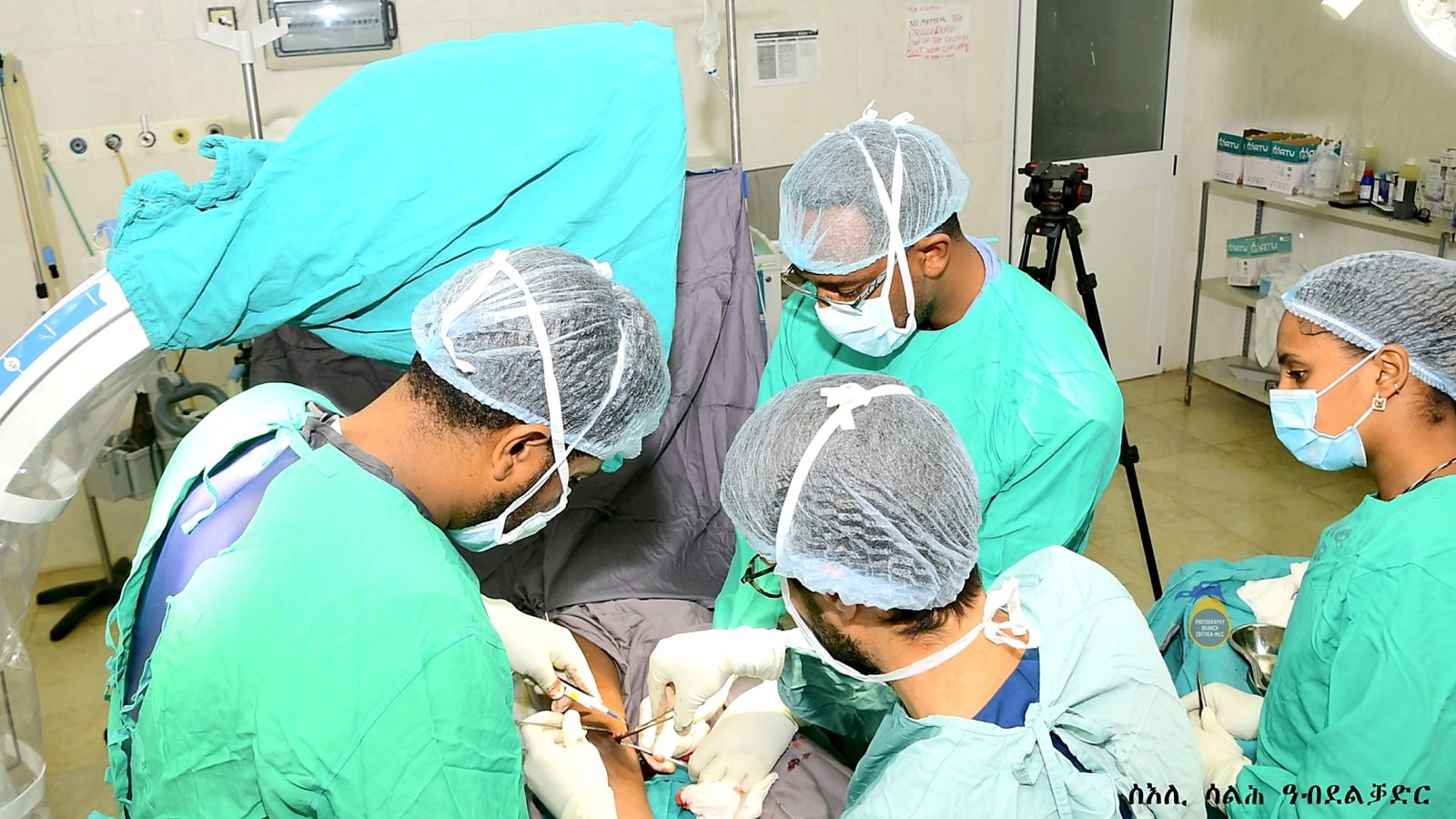
ASMARA: Eritrean surgeons and a visiting Italian orthopaedic team have performed corrective operations on 18 children with joint deformities at Halibet National Referral Hospital since 26 September.
The programme treats children under 15 with congenital deformities, which are present at birth, or conditions acquired later, the Eritrean Ministry of Information said on Thursday.
Prof Elzein Hashim, head of orthopaedic surgery at Halibet, confirmed that 18 children had received surgery so far.
The procedures form part of a long-running partnership with the Italian volunteer organisation Annuliamo La Distanza, which provides specialist care while helping Eritrean doctors develop their surgical skills.
A decade of surgical visits
Dr Simone Lazzeri, who leads the Italian team, said the group’s surgeons had travelled to Eritrea two to three times a year over the past decade to operate on children.
Five specialists joined this year’s visit, bringing the equipment needed for the procedures. Lazzeri praised the contribution of Eritrean medical staff and the hospital’s administration to the programme.
Dr Yoel Abraham, an Eritrean specialist involved in the work, said operating theatres for bone and tendon surgery were established at Halibet in 2015 with support from the Italian team.
He said the partnership was steadily expanding Eritrean doctors’ experience and technical knowledge.
ALSO READ: Uganda MPs demand staff, medicines and power as UgIFT health centres struggle to open
Annuliamo La Distanza’s early work in Eritrea focused on congenital foot deformities, particularly clubfoot.
By early 2016, a joint project involving the association, Bologna’s Rizzoli Orthopaedic Institute and UNICEF had examined about 800 Eritrean children and operated on approximately 400, Italian news agency DIRE reported.
The Rizzoli institute also donated equipment for two operating theatres at Halibet.
Building local expertise
Training has been central to the partnership from the outset.
DIRE reported that Eritrean doctors initially had greater experience in treating injuries than congenital orthopaedic conditions, leaving gaps in the specialist care available to children.
Franco Riboldi, then head of health projects at the association, described the goal as helping the Italian team “to become useless as soon as possible”, with Eritrean staff eventually able to carry out the work independently.
The cooperation has since expanded beyond corrective surgery.
ALSO READ: Kenya’s $1.6bn US health deal faces its first big test: Can Nairobi take the wheel?
Between March 2025 and February 2026, a project called ROAD trained Halibet doctors in emergency trauma care for children and adults. It was implemented by Annuliamo La Distanza with funding from the Italian Agency for Development Cooperation.
According to the Autonomous Province of Trento, the project involved Lazzeri and specialists from hospitals in Trento, Florence and Bologna. It delivered more than 450 outpatient consultations and 80 operations.
The programme also introduced simulation-based teaching, giving participating doctors a new way to practise clinical skills.
The importance of early care
Clubfoot, one of the conditions addressed through the partnership, affects the position of a baby’s foot or feet.
A 2023 study led by the London School of Hygiene & Tropical Medicine estimated that 1.18 in every 1,000 babies worldwide are born with the condition. The estimated rate for Africa was higher, at 1.31 per 1,000 births, according to the university.
Without treatment, clubfoot can cause pain, restrict mobility and result in lifelong disability. Early treatment offers the best opportunity to correct it.
“These insights aren’t just numbers; they are the roadmap to breaking down care barriers,” said Dr Tracey Smythe, who led the study.
For the children treated at Halibet, the corrective procedures are intended to improve movement and function. The partnership’s longer-term contribution lies in strengthening the local expertise needed to make specialist care more widely available.