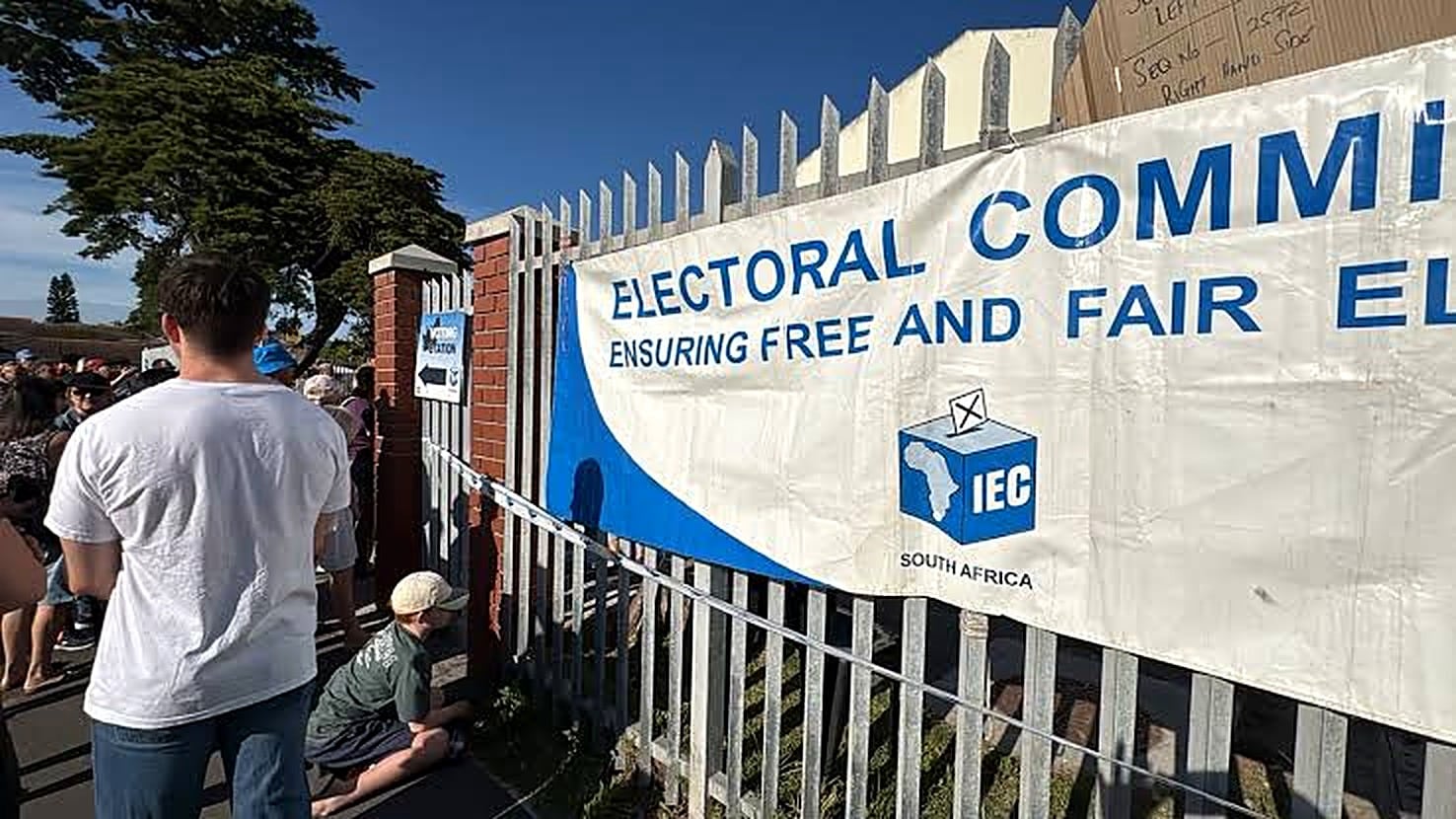
JOHANNESBURG: South Africa’s local government elections have entered the counting phase, with the ANC and Democratic Alliance running close in the early national tally and several major metros facing the prospect of another round of coalition negotiations.
About 14.5 million people cast their ballots, including special votes recorded on Monday and Tuesday, according to preliminary IEC figures reported by eNCA.
Against a voters’ roll of approximately 29.2 million, that would put turnout at around 50%, compared with about 46% in the 2021 municipal elections. The final turnout figure will depend on the commission’s verified results.
The IEC hopes to declare the results by the weekend. Chief Electoral Officer Sy Mamabolo said an early declaration “will provide certainty” and allow parties to begin negotiations where no outright winner emerges.
Voting largely orderly despite delays
Voting began briskly on Wednesday, with approximately 3.5 million people having cast ballots by 10am, IEC Deputy Chief Executive Masego Sheburi told a briefing at the national results centre at Gallagher Estate in Midrand.
Sheburi credited handheld barcode scanners with helping officials process voters and manage queues.
“Despite minor delays reported from localised protests and adverse weather conditions in the Eastern Cape, KwaZulu-Natal, and Mpumalanga, I am pleased to confirm that all voting stations were operational by 9:00 am,” he said.
“Voting has progressed well across the country, notwithstanding some isolated incidents,” Mamabolo said.
The commission arranged generators and alternative lighting for stations affected by electricity outages so counting could proceed.
The contest involved 546 parties and nearly 137,000 candidates seeking seats in eight metropolitan, 44 district and 205 local municipalities.
Voters received up to three ballots: one for a ward councillor, another for a municipal proportional representation list and, outside metropolitan areas, a district council ballot.
The IEC also provided universal ballot templates to assist visually impaired voters.
Court ruling forced ballot reprints
Preparations were complicated by a last-minute court ruling affecting candidate lists.
ALSO READ: Ramaphosa urges voters to help rebuild failing municipalities in Wednesday’s elections
After the Constitutional Court ordered the IEC to include 181 ANC candidates, the commission also admitted candidates from 32 other parties. This required at least 33 million ballot papers to be reprinted, according to eNCA.
The resulting delays affected the start of special voting on Monday, when 217 Cape Town voting stations opened late.
Ballot theft and police incidents
One of the most serious incidents occurred at a Ward 2 voting station in eThekwini, where unmarked ballot papers and stamps were reported stolen.
The IEC said it had opened cases with police, relieved the affected staff of their duties and introduced additional safeguards.
Elsewhere in KwaZulu-Natal, a police officer was removed from duty at a voting station after arriving in a vehicle displaying political party posters.
Police spokesperson Colonel Robert Netshiunda said she could face internal disciplinary action. Voting at the station continued without disruption.
In Umlazi, a man who appeared to be intoxicated assaulted police officers. He was arrested for assault and could face additional charges under electoral legislation.
Separately, three officers sustained minor injuries when their vehicle struck cattle while they were on election duty in KwaZulu-Natal.
Police had identified 331 voting stations as high-risk before polling began. Of those, 165 were in KwaZulu-Natal, including 124 in eThekwini.
A close count, not a final outcome
Early Thursday results showed little separating the ANC and DA nationally.
At 8.01am, a snapshot of the IEC dashboard reported by The South African put the ANC at 31.36% and the DA at 31.04%, a difference of 10,627 votes in the tally at that point. The MK Party stood at 5.43%.
Those figures remain provisional. Areas report at different speeds, so the national balance can shift substantially as counting and verification progress.
National percentages also do not determine who governs individual municipalities. Control depends on the allocation of seats within each council.
ALSO READ: Unstable coalitions threaten service delivery as local elections near
Metros remain unsettled
The early metropolitan results were even less complete.
The DA led with 39.6%, while the ANC, on 16.8%, and ActionSA, on 16.6%, were separated by fewer than 200 votes.
In Tshwane, ActionSA held an early lead of 29.7% with approximately 11% counted. The DA was ahead in Ekurhuleni with 40.9%.
The DA also held a substantial early lead in Cape Town and was ahead in Nelson Mandela Bay, while the ANC led in Buffalo City.
These partial counts do not establish final winners or confirm which councils will be hung.
Nevertheless, parties have already begun setting conditions for potential partnerships.
ActionSA leader Herman Mashaba said any agreement with the DA in Johannesburg would depend on a change in its leadership offer.
“If DA wants to really work with ActionSA, they must remove Helen Zille,” he said.
Coalition talks come next
Once the IEC declares the results, attention will turn to councils where no party has secured a majority and agreements are needed to elect municipal leaders.
The first council meetings must take place within 14 days of the declaration. Parties are therefore under pressure to negotiate governing arrangements quickly, although coalition discussions can continue beyond those initial meetings.
The new administrations will also take office as government pursues its Revised White Paper on Local Government, which proposes changes to municipal management, service provision and infrastructure funding.
Those reforms include protecting water and electricity revenue for the services that generate it and strengthening professional standards in municipalities.
For residents, the immediate question is who will govern. The longer test will be whether the resulting councils can remain stable long enough to improve water supplies, electricity networks, roads and other basic services.