MITCHELLS PLAIN, CAPE TOWN – On one side of the Cape Flats, soldiers have been deployed to help police confront gang violence. On another, children are being handed rugby fields, cricket pitches and a place to go when the school bell rings.
The interventions are vastly different, but they speak to the same underlying challenge: what can be done to protect young people growing up in communities where gangs, drugs and violence compete for their attention?
In Mitchells Plain, the Western Cape Government is putting R31.5 million behind one answer.
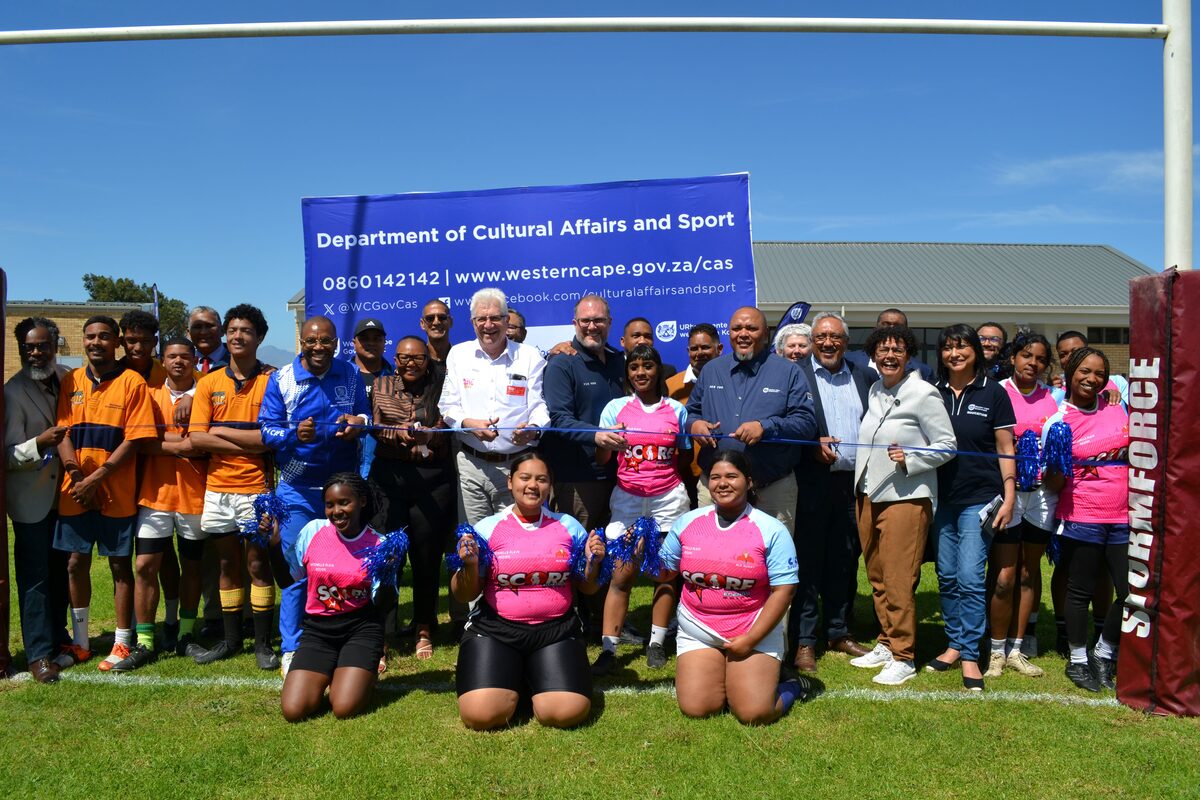
A new shared sports facility at Lentegeur Senior Secondary School and Cornflower Primary School has been developed to serve not only learners at the two schools, but thousands of children from across the surrounding community.
The facility was officially opened on Monday, 28 September, by Western Cape Premier Alan Winde, Basic Education Minister Siviwe Gwarube, provincial Cultural Affairs and Sport Minister Ricardo Mackenzie and Education Minister Jaco Londt.
It includes two rugby fields, a cricket oval with three pitches, three practice nets, a clubhouse and an artificial playing surface catering for rugby, football and hockey.
But in Mitchells Plain, the significance of the investment extends beyond sport.
It is about what happens to children after school.
Growing up where violence is never far away
Mitchells Plain has lived with gang violence for generations.
Crime statistics have repeatedly placed police stations serving the broader area among the country’s hotspots for serious and violent crime, drug-related offences and illegal firearms.
For children growing up here, the consequences are not abstract.
They are visible in neighbourhoods, schools and families.
Between 30 March and 5 April this year, gang violence across parts of Cape Town left 36 people dead and resulted in 47 attempted murder cases, according to Parliament’s Portfolio Committee on Police chairperson Ian Cameron.
Children were among those caught in the violence.
“These children should have been enjoying a carefree school holiday,” Cameron said at the time.
Only months earlier, in December 2025, nine-year-old Zechariah Matthee was among three people killed in a shooting in Rocklands.
His death became another reminder of how easily children can become casualties of violence they had nothing to do with.
The national government’s response to escalating violence has included deploying soldiers to assist police.
President Cyril Ramaphosa authorised the deployment from 1 April 2026, at a projected cost of R823 million over 12 months.
Yet the killings did not simply stop.
Within days of the deployment, Mitchells Plain experienced another series of daylight shootings that left four people dead.
The experience illustrates the complexity of the problem.
Security forces can patrol streets, seize firearms and arrest suspects. But the forces feeding gang violence, including organised drug markets, poverty, unemployment, school disengagement and the recruitment of young people, extend beyond policing.
That is where investments such as the Lentegeur facility take on a different significance.
R31.5 million for somewhere to belong
The facility was developed through the province’s Shared Facilities Initiative, a partnership between the Western Cape Department of Cultural Affairs and Sport and the Western Cape Education Department.
Lentegeur Senior Secondary and Cornflower Primary will be the main users.
But the gates are intended to open much wider.
Learners from 68 additional schools in the area are expected to have access, potentially turning the facility into a sporting hub serving children across Mitchells Plain.
For Gwarube, that reach is central to the project.
“This facility is serving 68 schools in the area. That is an incredible level of access for the children in this community,” she said.
“I want to emphasise to the community here today that this facility belongs to you.”
That sense of ownership could prove crucial.
Building a sports field is one thing. Keeping it functioning, safe and accessible years after the ribbon-cutting ceremony is another.
What happens after the school bell
The provincial government wants the facility to become particularly active once formal classes end.
Through its Mass Participation, Opportunity and Access; Development and growth programme, commonly known as the MOD Programme, organised activities are intended to give learners structured recreation after school.
The idea is not simply to produce elite athletes.
It is to create a pathway that begins with participation and can progress through school leagues into clubs, federations and, for talented athletes, higher levels of competition.
The province also wants more girls, learners with disabilities and children who have traditionally participated less in organised sport to become involved.
The Lentegeur development forms part of a wider provincial school-sport push.
Under its School Sport Strategy, launched earlier this year, the Western Cape has committed R130 million over three years, with 624 no-fee and low-fee schools expected to receive sporting equipment.
For Mackenzie, the objective is to make sport part of children’s everyday lives rather than something available only to those attending better-resourced schools.
In Mitchells Plain, that distinction matters.
A field cannot stop a bullet
Nobody should pretend that rugby posts and cricket nets can solve gang violence.
They cannot.
A sports programme cannot dismantle a drug syndicate, remove an illegal firearm from the streets or substitute for effective policing.
But the value of such programmes lies elsewhere.
They can occupy the hours when children might otherwise have nowhere structured to go.
They can connect young people with coaches, teachers and teammates.
They can provide routine, discipline and competition.
ALSO READ: In Elwak, Football Builds Bridges Between Soldiers and The Youth They Protect
And they can offer a sense of belonging that does not depend on the street or the gang.
That preventative role becomes particularly important in communities where young people face limited recreational opportunities.
Winde said the development demonstrated what investment in young people could look like.
“These are the kinds of investments that give young people opportunities,” he said.
For the children who will use it, however, the test will not be what politicians say about the facility.
It will be whether they can actually get onto the field.
The community is watching
Local organisations have broadly welcomed the investment, while warning that its success cannot be taken for granted.
During construction, Juven Rittles, project manager at the non-profit organisation Unchain The Plain, summed up the principle behind his organisation’s support in Afrikaans:
“Ma die kinders moet speel.”
The children must play.
But Rittles also raised a practical concern.
With so many schools potentially relying on a single facility, demand could become overwhelming. How the grounds are scheduled and managed will therefore matter almost as much as the infrastructure itself.
Byron De Villiers, project coordinator for the Lentegeur Community Policing Forum, also welcomed the development but questioned whether enough attention was being given to sporting codes beyond rugby.
Those concerns point towards the next challenge.
The infrastructure is built.
Now it has to work.
Mitchells Plain has been here before
The community knows what happens when sporting infrastructure is allowed to deteriorate.
The nearby municipal Lentegeur Sports Ground was closed for about seven years before being brought back into use with a youth football tournament in 2024.
Local leaders have also raised concerns about security at sporting facilities, including vandalism and unauthorised access, and have pushed for stronger fencing at some grounds.
Those experiences should serve as a warning.
The R31.5 million investment will mean little if pitches deteriorate, equipment disappears, programmes lose funding or security concerns eventually force the gates shut.
Serving almost 70 schools will require careful scheduling.
After-school programmes will need coaches and supervisors.
Facilities will require maintenance.
And children will need safe ways to get there and home again.
The ribbon-cutting was the easy part.
The real test starts now
There is a striking contrast in what government is spending in response to the crisis confronting communities on the Cape Flats.
At national level, hundreds of millions of rand have been committed to putting soldiers on the ground as part of an immediate security response.
In Mitchells Plain, R31.5 million has gone into playing fields and sporting infrastructure intended to create opportunities for children.
The two interventions are not substitutes for each other.
Communities facing shootings and organised crime need effective policing and immediate protection. They also need interventions that address what happens long before a young person becomes involved in violence.
The Lentegeur facility sits on that side of the equation.
Its success will not ultimately be measured by the number of officials who attended its opening or photographs taken beside freshly laid fields.
It will be measured on ordinary afternoons months and years from now.
Are the coaches still there?
Are the pitches maintained?
Are girls playing?
Are children with disabilities participating?
Are learners from surrounding schools getting access?
And, most importantly, are young people choosing to come back?
Because in a community where the streets can offer children dangerous forms of belonging, the most important thing about these new playing fields may simply be that they offer somewhere else to go.
The gates are open.
The harder job is keeping them that way.