ABUJA: Spain has reaffirmed its commitment to strengthening cooperation with the Economic Community of West African States (ECOWAS), as the regional bloc’s new leadership sets out its priorities for rebuilding confidence and accelerating integration across West Africa.
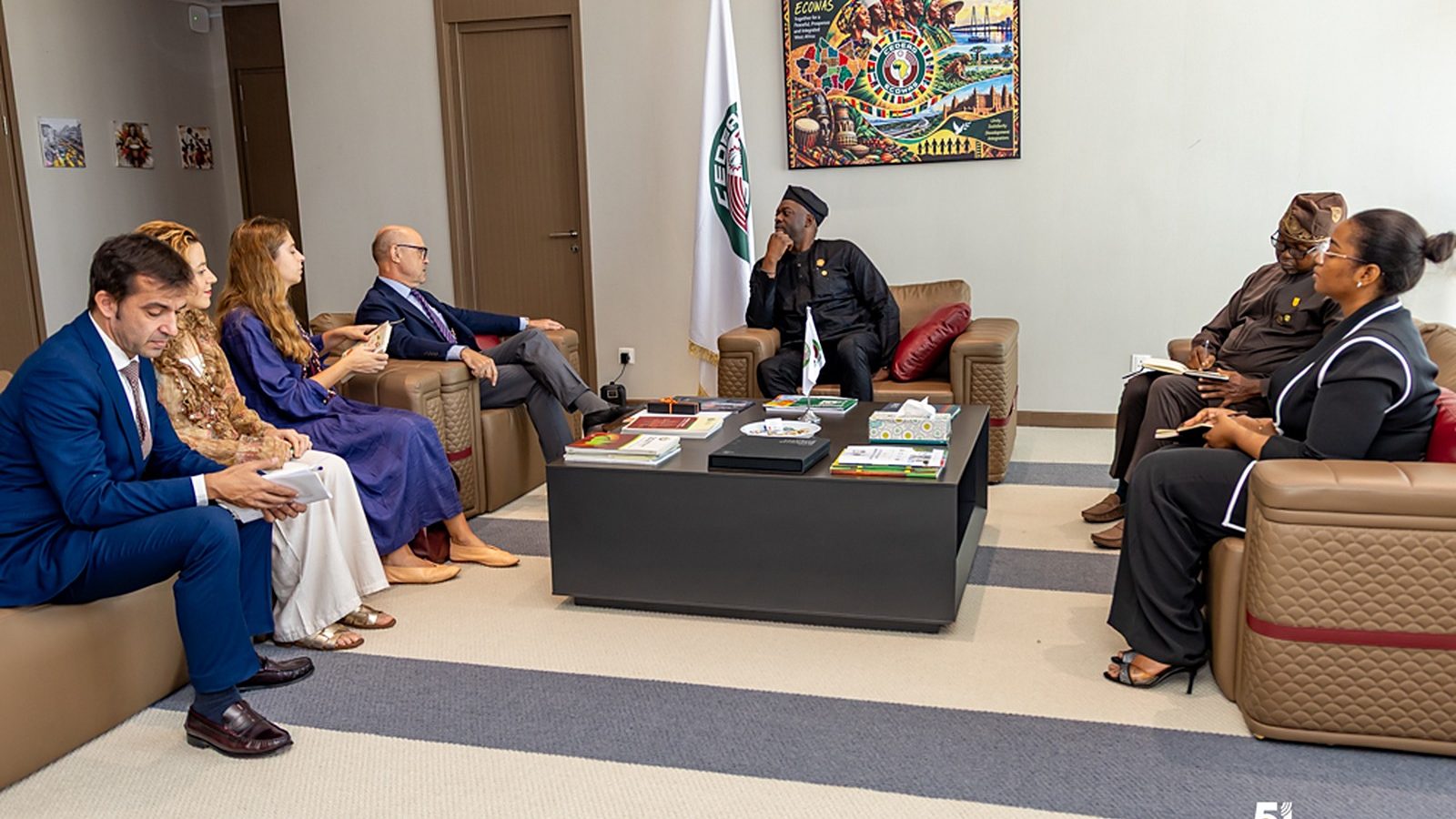
Spanish Ambassador to Nigeria Félix Costales Artieda met ECOWAS Commission Vice-President Anthony Oluwatosin Ogunjimi at the Commission’s headquarters in Abuja on Thursday, November 26.
Costales Artieda congratulated Ogunjimi and the Commission’s new management team, which took office at the end of August. He also expressed interest in the implementation of the Commission’s “3-6-9” strategy.
The ambassador was accompanied by Lara de la Peña Fernández, Deputy Head of Mission at the Spanish Embassy; Santiago Ormeno Garcia, Head of Spanish Cooperation; and Marta Avalos, from the Directorate-General for Foreign Policy at Spain’s Ministry of Foreign Affairs.
Three priorities underpin the ‘3-6-9’ strategy
Ogunjimi welcomed the delegation and said the Commission, under President General Birame Diop, was committed to strengthening ECOWAS’s regional influence and advancing its Vision 2050.
He explained that the new leadership had organised its programme around nine pillars, grouped under three overarching priorities:
– Restoring confidence in the regional bloc.
– Accelerating regional integration.
ALSO READ: ECOWAS, World Bank Advance West Africa Digital Identity Integration
– Strengthening the implementation of Community programmes.
The Vice-President also announced plans for a strategic retreat to strengthen ECOWAS institutions. The meeting is expected to produce a practical action plan to improve institutional efficiency and performance.
Both sides welcomed the discussions and expressed their commitment to closer cooperation in support of peace, stability and sustainable development across West Africa.
New leadership takes charge amid regional tensions
Diop, a retired Senegalese general, assumed office as President of the ECOWAS Commission on August 31, 2026, succeeding Gambian diplomat Omar Alieu Touray, whose four-year term had come to an end. Ogunjimi, from Nigeria, replaced Togo’s Damtien Tchintchibidja as Vice-President during the same leadership transition.
Diop served as Senegal’s Minister of the Armed Forces from April 2024 to June 2026. He previously served as chief of staff of Senegal’s armed forces and as the United Nations Military Adviser, according to The Standard.
The new leadership inherits a regional organisation facing one of the most difficult periods in its history.
Mali, Burkina Faso and Niger formally withdrew from ECOWAS in January 2025 after their military-led governments broke with the bloc. The three countries subsequently pursued closer integration through the Alliance of Sahel States, creating new challenges for regional cooperation, security coordination and the movement of people and goods.
ECOWAS must also contend with longstanding integration ambitions, including the proposed single currency, the Eco, and efforts to improve regional infrastructure and connectivity.
Against this backdrop, restoring confidence is more than an institutional priority. The Commission must rebuild trust among member states while demonstrating that regional cooperation can deliver practical benefits for citizens and businesses.
ALSO READ: ECOWAS 50 Years: A Deeper Battle Against Money Laundering Demands Continental Urgency
Spain builds on two decades of cooperation
Spain’s renewed engagement comes against the backdrop of a partnership with ECOWAS that dates back more than two decades.
The relationship is anchored in a memorandum of understanding signed in 2005 and the 2009 Abuja Declaration, according to the Spanish Agency for International Development Cooperation (AECID).
In February 2026, ECOWAS and AECID signed two memoranda of understanding worth €16 million under the ECOWAS-AECID Cooperation Programme for 2025 to 2028.
The programme covers agriculture and food security, access to energy, infrastructure, institutional strengthening and gender equality, according to ECOWAS.
Spain has also supported the ECOWAS Migration and Development Fund, extending cooperation into an area that has become increasingly important as West African countries grapple with migration pressures and the need to create economic opportunities.
The partnership forms part of Spain’s Africa Strategy for 2025 to 2028, presented by Prime Minister Pedro Sánchez in December 2024. The strategy identifies West Africa, North Africa and the Sahel as priority regions for Spanish engagement.
The participation of Spain’s head of cooperation in the Abuja delegation points to the continued importance of development assistance in the relationship.
For the new ECOWAS leadership, the challenge will be to turn diplomatic commitments and funding agreements into measurable progress. Its “3-6-9” strategy will ultimately be judged by whether it can strengthen the bloc’s institutions, rebuild confidence among member states and improve the lives of people across the region.